. 2023 Jan;39(1):221-228.
doi: 10.1007/s00381-022-05678-2. Epub 2022 Sep 22.

Aesthetic results in children with single suture craniosynostosis: proposal for a modified Whitaker classification

Affiliations

Aesthetic results in children with single suture craniosynostosis: proposal for a modified Whitaker classification

Mahmoud Messerer et al. Childs Nerv Syst. 2023 Jan.

Abstract

Objective: Aesthetic assessment after surgery for non-syndromic single suture craniosynostosis (SSC) is crucial. Surgeons' evaluation is generally based on Whitaker classification, while parental impression is generally neglected. The aim of this paper is to compare aesthetic perceptions of parents and surgeons after surgery for SSC, expressed by a 10-item questionnaire that complement Whitaker's classification.

Methods: The authors submitted a 10-item questionnaire integrating Whitaker's classification in order to evaluate the degree of satisfaction, the detailed aesthetics results and the need for surgical revision, to surgeons and parents of a consecutive series of patients operated for SSC between January 2007 and December 2018. The results were collected blindly.

Results: A total of 70 patients were included in the study. Scaphocephaly and trigonocephaly were the two most frequent craniosynostosis. Parents and surgeons general aesthetics evaluation and average rating for Whitaker's classification were 1.86 vs 1.67 (p = 0.69) and 1.19 vs 1.1 (p = 0.45) respectively. Parents' evaluation for scar perception and alopecia (p < 0.00001), the presence of bony crest (0.002), bony bump (p < 0.00001), or other bone irregularities (p = 0.02) are significantly worse when compared to surgeons' perception.

Conclusions: Parents seem to be more sensitive to the detection of some aesthetic anomalies and their opinion should not be neglected. The authors propose a modified Whitaker classification based on their results to better stratify the aesthetic outcome after surgery for SSC.

Keywords: Aesthetic result; Craniosynostosis; Surgery; Whitaker classification.


Conflict of interest statement

The authors declare no competing interests.

Figures
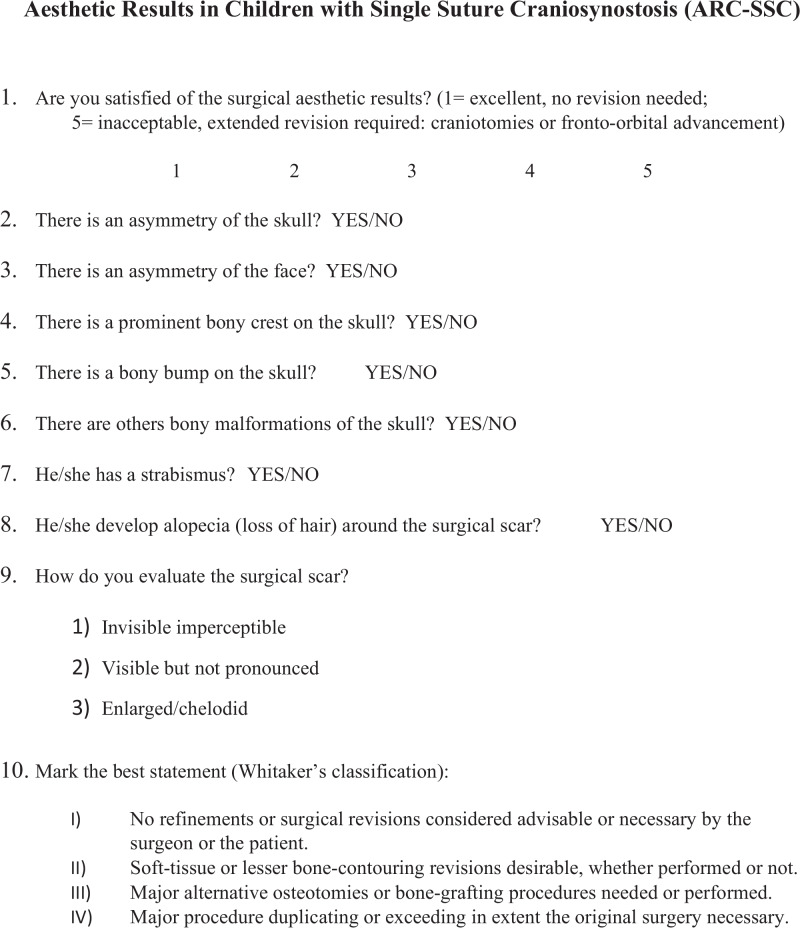
Fig. 1
Fig. 1
A 10-item questionnaire that we submitted to surgeons and parents of patients operated for a single-suture craniosynostosis
Fig. 2
Fig. 2
Pictures of a patient presenting a non-syndromic scaphocephaly before surgery (A, B) and 3 months after surgery (C, D)
Fig. 3
Fig. 3
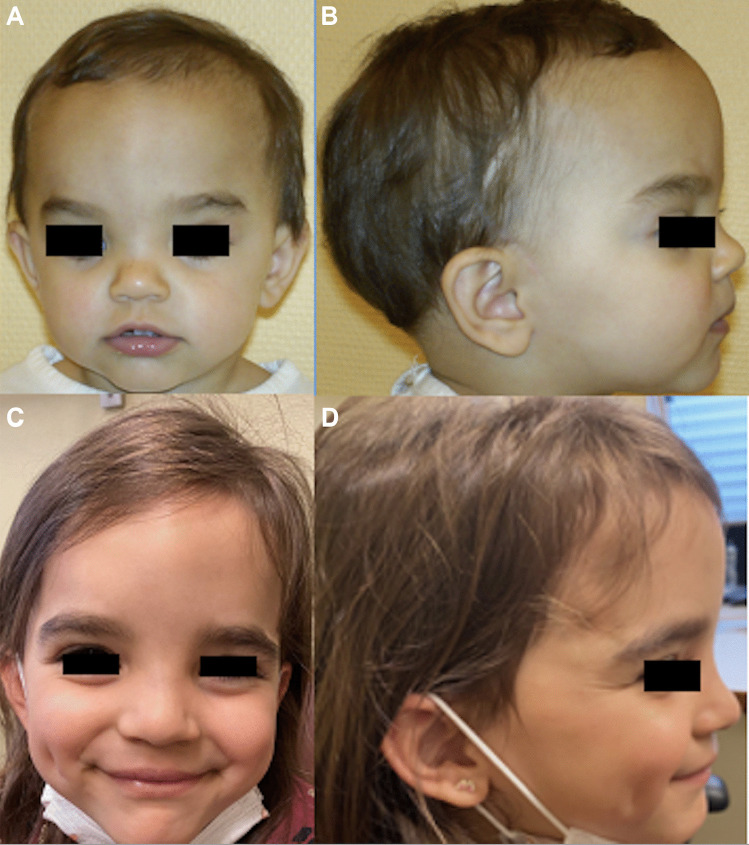
Pictures of a patient presenting a non-syndromic metopic synostosis at 3 months (A, B) and 5 years after surgery (C, D)
Fig. 4
Fig. 4
Pictures of a patient presenting a non-syndromic anterior plagiocephaly before surgery (A, B) and 6 months after surgery (C, D)
Fig. 5
Fig. 5
A A 3D reconstruction of a CT scan performed to evaluate the bony asymmetry after a surgical remodelling of an anterior plagiocephaly. A flattening of the right side of the frontal bone was confirmed. B, C 3D reconstructions of the postoperative results after plagiocephaly remodelling confirming a residual asymmetry of the frontal bone. D An axial T2-weighted MRI confirming the presence of an encephalocele, secondary to a dural tear accidentally performed during the first surgery. A second surgery performed 2 years after the first one allowed to address the frontal flattening and the treatment of the encephalocele
Fig. 6
Fig. 6
Our proposal of modified Whitaker classification. Class 0 is introduced to define patients with an excellent result. Class I is used to indicate the presence of minor defects, where no surgical revision was required. Classes I and II were separated into two categories: A indicated a soft tissue defect (including scar problem or alopecia), while B indicated a bone defect, namely bony crest and bumps

References

    1. Greenwood J, Flodman P, Osann K, Boyadjiev SA, Kimonis V. Familial incidence and associated symptoms in a population of individuals with nonsyndromic craniosynostosis. Genet Med. 2014;16:302–310. doi: 10.1038/gim.2013.134. - DOI - PMC - PubMed
    1. Kabbani H, Raghuveer TS. Craniosynostosis. Am Fam Physician. 2004;69:2863–2870. - PubMed
    1. Thompson DN, Malcolm GP, Jones BM, Harkness WJ, Hayward RD. Intracranial pressure in single-suture craniosynostosis. Pediatr Neurosurg. 1995;22:235–240. doi: 10.1159/000120907. - DOI - PubMed
    1. Tamburrini G, Caldarelli M, Massimi L, Santini P, Di Rocco C. Intracranial pressure monitoring in children with single suture and complex craniosynostosis: a review. Childs Nerv Syst. 2005;21:913–921. doi: 10.1007/s00381-004-1117-x. - DOI - PubMed
    1. Kunz M, Lehner M, Heger A, Armbruster L, Weigand H, Mast G, Peraud A. Neurodevelopmental and esthetic results in children after surgical correction of metopic suture synostosis: a single institutional experience. Childs Nerv Syst. 2014;30:1075–1082. doi: 10.1007/s00381-013-2340-0. - DOI - PubMed

LinkOut - more resources