Review
. 2022 Sep 17;11(18):2907.
doi: 10.3390/cells11182907.

Transient Receptor Potential (TRP) Channels in Airway Toxicity and Disease: An Update

Affiliations
Review

Transient Receptor Potential (TRP) Channels in Airway Toxicity and Disease: An Update

Isabel Müller et al. Cells. .

Abstract

Our respiratory system is exposed to toxicants and pathogens from both sides: the airways and the vasculature. While tracheal, bronchial and alveolar epithelial cells form a natural barrier in the airways, endothelial cells protect the lung from perfused toxic compounds, particulate matter and invading microorganism in the vascular system. Damages induce inflammation by our immune response and wound healing by (myo)fibroblast proliferation. Members of the transient receptor potential (TRP) superfamily of ion channel are expressed in many cells of the respiratory tract and serve multiple functions in physiology and pathophysiology. TRP expression patterns in non-neuronal cells with a focus on TRPA1, TRPC6, TRPM2, TRPM5, TRPM7, TRPV2, TRPV4 and TRPV6 channels are presented, and their roles in barrier function, immune regulation and phagocytosis are summarized. Moreover, TRP channels as future pharmacological targets in chronic obstructive pulmonary disease (COPD), asthma, cystic and pulmonary fibrosis as well as lung edema are discussed.

Keywords: TRPA1; TRPC6; TRPM2; TRPM5; TRPV2; TRPV4; alveoli; bronchi; lung; pulmonary vasculature.


Conflict of interest statement

The authors declare no conflict of interest.

Figures
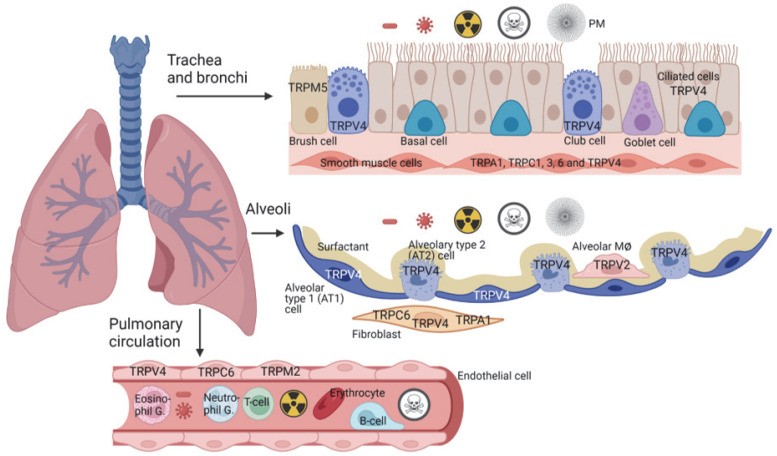
Figure 1
Figure 1
Cells of the human and murine respiratory tract and TRP channel function. The upper part of the lower airways with basal, goblet, club and ciliated cells as well as the alveolus and the pulmonary vasculature are shown. Functional active TRP channels based on reported data are indicated. In the very specialized brush cells TRPM5 channels are exclusively active. In the alveoli, alveolar type 1 (AT1) cells are important for barrier function, while AT2 cells secrete a surfactant that can renew damaged AT1 cells. Alveolar and interstitial macrophages (MØ) are able to phagocytize microorganisms and particulate matter (PM). Fibroblasts involved in wound healing own TRPC6 and TRPA1 proteins. The latter channel, however, exists only in human and not in mouse fibroblasts. Endothelial cells as natural barrier to exclude toxicants perfused in the blood need active TRPC6, TRPM2 and TRPV4 channels. PM, particulate matter. See also Table 1 for single-cell mRNA expression data and the text for more details.

References

    1. Aggarwal N.R., King L.S., D’Alessio F.R. Diverse macrophage populations mediate acute lung inflammation and resolution. Am. J. Physiol. Cell. Mol. Physiol. 2014;306:L709–L725. doi: 10.1152/ajplung.00341.2013. - DOI - PMC - PubMed
    1. King T.E., Jr., Pardo A., Selman M. Idiopathic pulmonary fibrosis. Lancet. 2011;378:1949–1961. doi: 10.1016/S0140-6736(11)60052-4. - DOI - PubMed
    1. Nilius B., Szallasi A. Transient Receptor Potential Channels as Drug Targets: From the Science of Basic Research to the Art of Medicine. Pharmacol. Rev. 2014;66:676–814. doi: 10.1124/pr.113.008268. - DOI - PubMed
    1. Zergane M., Kuebler W., Michalick L. Heteromeric TRP Channels in Lung Inflammation. Cells. 2021;10:1654. doi: 10.3390/cells10071654. - DOI - PMC - PubMed
    1. Dietrich A., Steinritz D., Gudermann T. Transient receptor potential (TRP) channels as molecular targets in lung toxicology and associated diseases. Cell Calcium. 2017;67:123–137. doi: 10.1016/j.ceca.2017.04.005. - DOI - PubMed

Publication types

MeSH terms
