


Antioxidant and Antimicrobial Activity of Hydroethanolic Leaf Extracts from Six Mediterranean Olive Cultivars
- PMID: 36139730
- PMCID: PMC9495989
- DOI: 10.3390/antiox11091656
Antioxidant and Antimicrobial Activity of Hydroethanolic Leaf Extracts from Six Mediterranean Olive Cultivars
Abstract
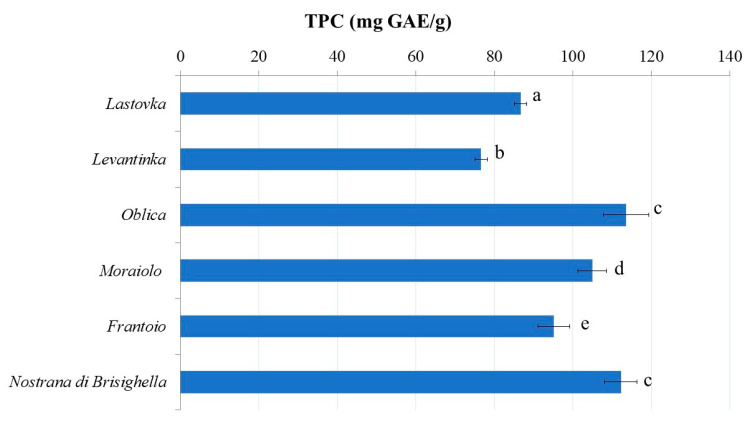
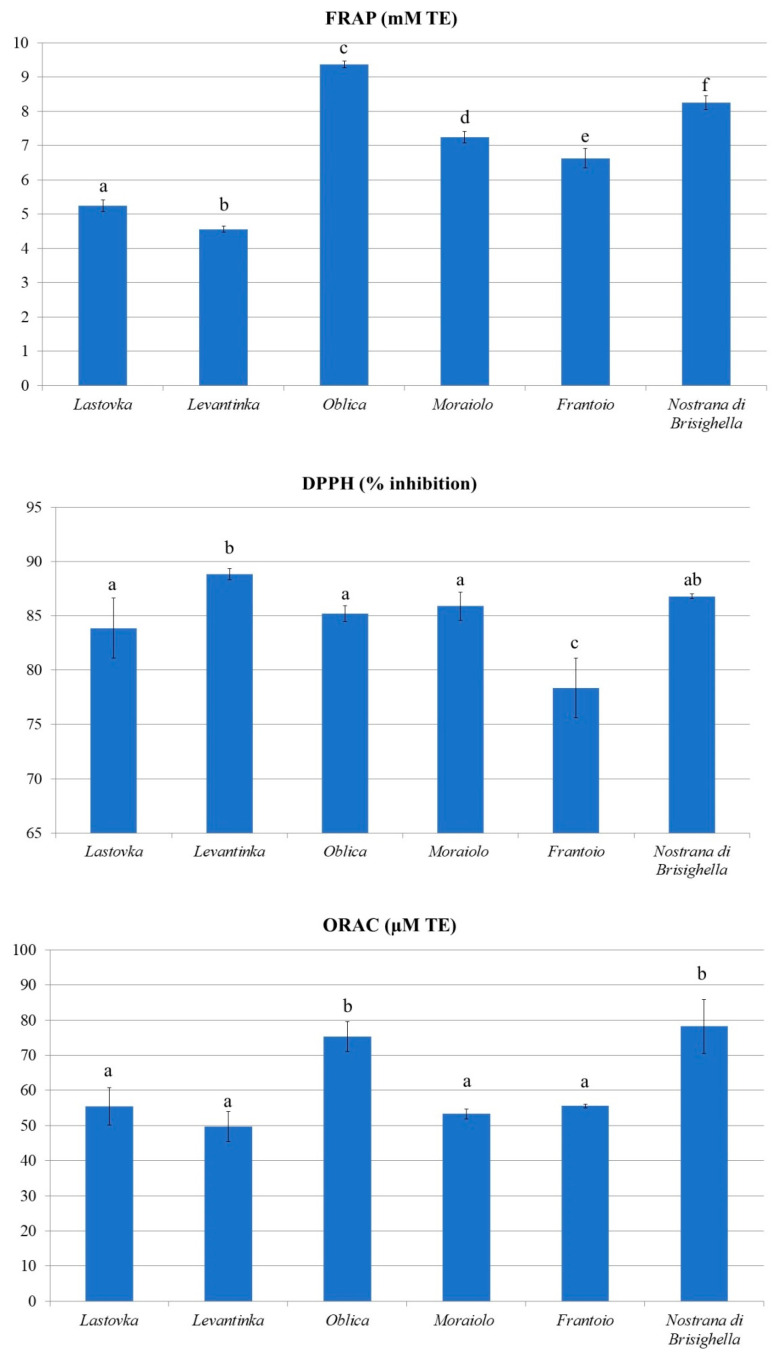
Phenolic profiles, antioxidant, and antimicrobial activities of hydroethanolic olive leaf extracts from six Mediterranean olive cultivars (Croatian: Lastovka, Levantinka, Oblica; Italian: Moraiolo, Frantoio, Nostrana di Brisighella) were investigated. As expected, various distributions of phenolic levels were observed for each cultivar and the total phenolic content showed high variability (ranging from 4 to 22 mg GAE/g of dry extract), with the highest amount of phenolics found in the Oblica sample, which also provided the highest antiradical (ORAC) and reducing activity (FRAP). The screening of individual compounds was performed by HPLC-PDA-ESI-QTOF-MS and the main detected compounds were oleuropein, hydroxytyrosol, oleoside/secologanoside, verbascoside, rutin, luteolin glucoside, hydroxyoleuropein, and ligstroside. While the antioxidant activity of the samples was relatively high, they showed no bactericidal and bacteriostatic activity against E. coli and S. Typhimurium; weak activity against Staphylococcus aureus, Bacillus cereus, and Listeria innocua; and inhibitory effects against Campylobacter jejuni at 0.5 mg dry extract/mL. The obtained results support the fact that olive leaf extracts, and especially those from the Oblica cultivar, could potentially be applied in various industries as natural preservatives and effective and inexpensive sources of valuable antioxidants.
Keywords: antimicrobial activity; antioxidant activity; olive leaves; phenolic compounds.
Conflict of interest statement
The authors declare no conflict of interest. The funders had no role in the design of the study; in the collection, analyses, or interpretation of data; in the writing of the manuscript, or in the decision to publish the results.
Figures
References
-
- Generalić Mekinić I., Gotovac M., Skroza D., Ljubenkov I., Burčul F., Katalinić V. Effect of the Extraction Solvent on the Oleuropein Content and Antioxidant Properties of Olive Leaf (Cv. Oblica, Lastovka and Levantinka) Extracts. Croat. J. Food Sci. Technol. 2014;6:7–14.
-
- Del Contreras M.M., Lama-Muñoz A., Gutiérrez-Pérez J.M., Espínola F., Moya M., Romero I., Castro E. Integrated Process for Sequential Extraction of Bioactive Phenolic Compounds and Proteins from Mill and Field Olive Leaves and Effects on the Lignocellulosic Profile. Foods. 2019;8:531. doi: 10.3390/foods8110531. - DOI - PMC - PubMed
-
- Medfai W., del Contreras M.M., Lama-Muñoz A., Mhamdi R., Oueslati I., Castro E. How Cultivar and Extraction Conditions Affect Antioxidants Type and Extractability for Olive Leaves Valorization. ACS Sustain. Chem. Eng. 2020;8:5107–5118. doi: 10.1021/acssuschemeng.9b07175. - DOI
-
- Liu Y., McKeever L.C., Suo Y., Jin T.Z., Malik N.S.A. Natural and Bio-Based Antimicrobials for Food Applications. American Chemical Society; Washington, DC, USA: 2018. Antimicrobial Activities of Olive Leaf Extract and Its Potential Use in Food Industry; pp. 119–132. - DOI
LinkOut - more resources
Full Text Sources
Molecular Biology Databases
Research Materials
Miscellaneous
