


First Belgian Report of Ertapenem Resistance in an ST11 Klebsiella Pneumoniae Strain Isolated from a Dog Carrying blaSCO-1 and blaDHA-1 Combined with Permeability Defects
- PMID: 36140031
- PMCID: PMC9495147
- DOI: 10.3390/antibiotics11091253
First Belgian Report of Ertapenem Resistance in an ST11 Klebsiella Pneumoniae Strain Isolated from a Dog Carrying blaSCO-1 and blaDHA-1 Combined with Permeability Defects
Abstract
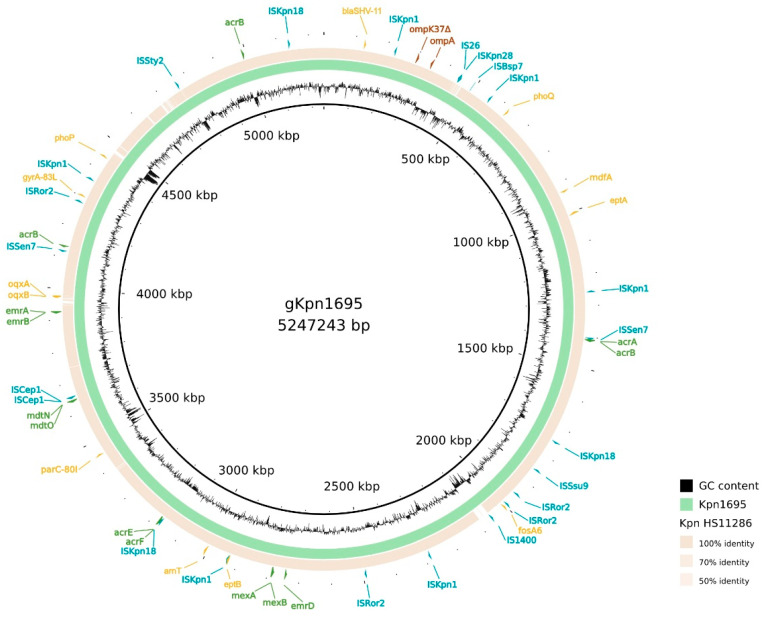
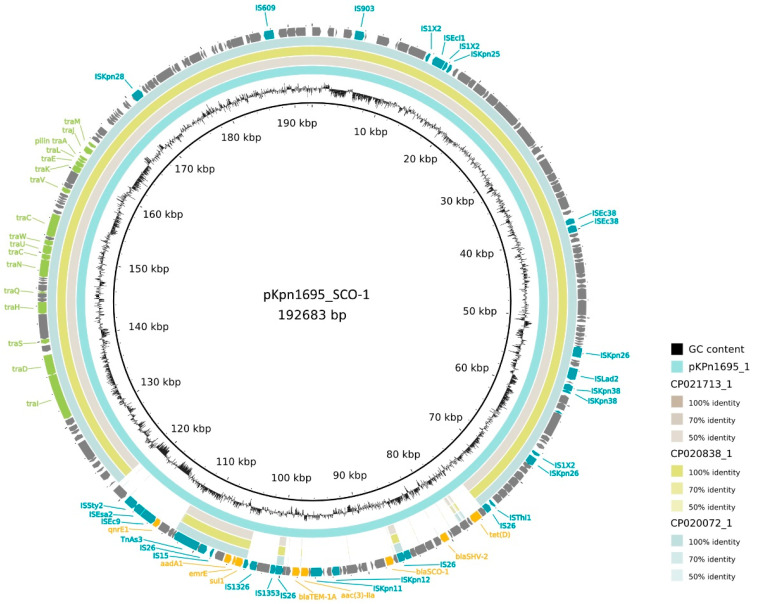
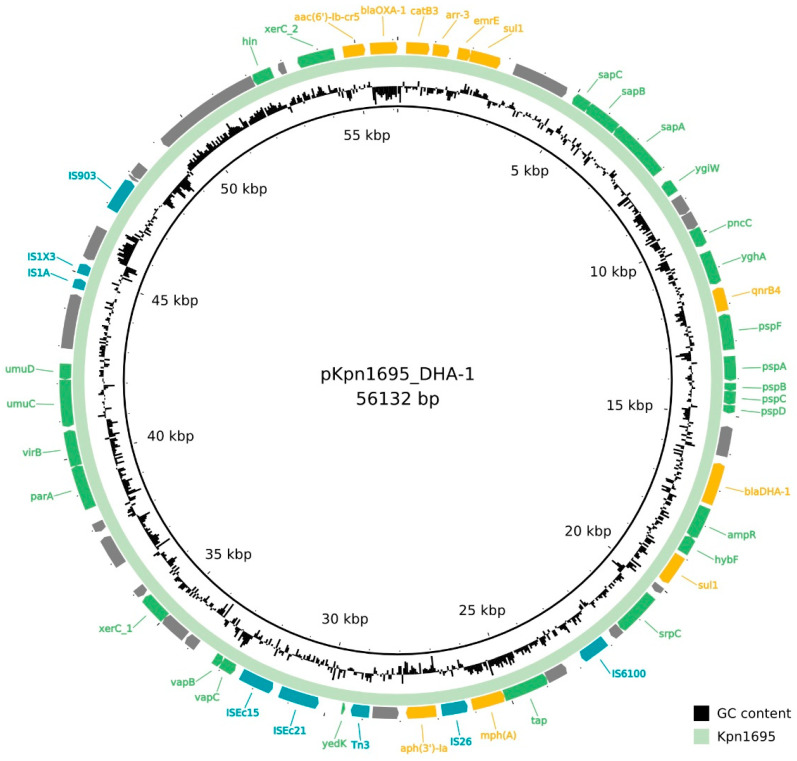
Klebsiella pneumoniae of sequence type (ST) 11 is a hyper-epidemic nosocomial clone, which is spreading worldwide among humans and emerging in pets. This is the first report, to the best of our knowledge, of multidrug-resistant (MDR) K. pneumoniae ST11 carrying blaSCO-1 and blaDHA-1, isolated from a four-month-old dog in Belgium. Antimicrobial susceptibility testing (AST) of the isolate, performed via broth microdilution following the European Committee on Antimicrobial Susceptibility Testing (EUCAST) guidelines, revealed resistance to eight different classes of antimicrobials, including carbapenems, in particular ertapenem, third-generation cephalosporins and fluoroquinolones. A hybrid approach, combining long- and short-read sequencing, was employed for in silico plasmid characterization, multi-locus sequence typing (MLST) and the identification and localization of antimicrobial resistance (AMR) and virulence-associated genes. Three plasmids were reconstructed from the whole-genome sequence (WGS) data: the conjugative IncFIB(K), the non-mobilizable IncR and the mobilizable but unconjugative ColRNAI. The IncFIB(K) plasmid carried the blaSCO-1 gene, whereas IncR carried blaDHA-1, both alongside several other antimicrobial resistance genes (ARGs). No virulence genes could be detected. Here, we suggest that the resistance to ertapenem associated with susceptibility to imipenem and meropenem in K. pneumoniae could be related to the presence of blaSCO-1 and blaDHA-1, combined with permeability defects caused by point mutations in an outer membrane porin (OmpK37). The presence of the blaSCO-1 gene on a conjugative IncFIB(K) plasmid is worrisome as it can increase the risk of transmission to humans, to animals and to the environment.
Keywords: Klebsiella pneumoniae; OmpK37; antimicrobial resistance (AMR); carbapenem; companion animal; emerging risk; hybrid sequencing; sepsis; sequence type 11.
Conflict of interest statement
The authors declare no conflict of interest.
Figures
References
-
- Tacconelli E., Carrara E., Savoldi A., Harbarth S., Mendelson M., Monnet D.L., Pulcini C., Kahlmeter G., Kluytmans J., Carmeli Y., et al. Discovery, Research, and Development of New Antibiotics: The WHO Priority List of Antibiotic-Resistant Bacteria and Tuberculosis. Lancet Infect. Dis. 2018;18:318–327. doi: 10.1016/S1473-3099(17)30753-3. - DOI - PubMed
LinkOut - more resources
Full Text Sources
Molecular Biology Databases
