


The Role of Glymphatic System in Alzheimer's and Parkinson's Disease Pathogenesis
- PMID: 36140362
- PMCID: PMC9496080
- DOI: 10.3390/biomedicines10092261
The Role of Glymphatic System in Alzheimer's and Parkinson's Disease Pathogenesis
Abstract
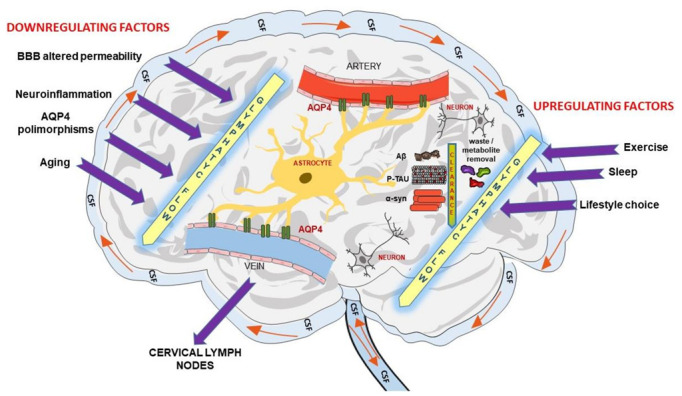
Alzheimer's disease (AD) is the most common cause of neurodegenerative dementia, whilst Parkinson's disease (PD) is a neurodegenerative movement disorder. These two neurodegenerative disorders share the accumulation of toxic proteins as a pathological hallmark. The lack of definitive disease-modifying treatments for these neurogenerative diseases has led to the hypothesis of new pathogenic mechanisms to target and design new potential therapeutic approaches. The recent observation that the glymphatic system is supposed to be responsible for the movement of cerebrospinal fluid into the brain and clearance of metabolic waste has led to study its involvement in the pathogenesis of these classic proteinopathies. Aquaporin-4 (AQP4), a water channel located in the endfeet of astrocyte membrane, is considered a primary driver of the glymphatic clearance system, and defective AQP4-mediated glymphatic drainage has been linked to proteinopathies. The objective of the present review is to present the recent body of knowledge that links the glymphatic system to the pathogenesis of AD and PD disease and other lifestyle factors such as sleep deprivation and exercise that may influence glymphatic system function. We will also focus on the potential neuroimaging approaches that could identify a neuroimaging marker to detect glymphatic system changes.
Keywords: Alzheimer’s disease; Aquaporin 4; Parkinson’s disease; glymphatic system; neuroimaging.
Conflict of interest statement
The authors declare no conflict of interest.
Figures
References
-
- Iliff J.J., Wang M., Liao Y., Plogg B.A., Peng W., Gundersen G.A., Benveniste H., Vates G.E., Deane R., Goldman S.A., et al. A Paravascular Pathway Facilitates CSF Flow Through the Brain Parenchyma and the Clearance of Interstitial Solutes, Including Amyloid β. Sci. Transl. Med. 2012;4:147ra111. doi: 10.1126/scitranslmed.3003748. - DOI - PMC - PubMed
Publication types
Grants and funding
LinkOut - more resources
Full Text Sources
Other Literature Sources
