


Ultrathin Struts Drug-Eluting Stents: A State-of-the-Art Review
- PMID: 36143162
- PMCID: PMC9503315
- DOI: 10.3390/jpm12091378
Ultrathin Struts Drug-Eluting Stents: A State-of-the-Art Review
Abstract
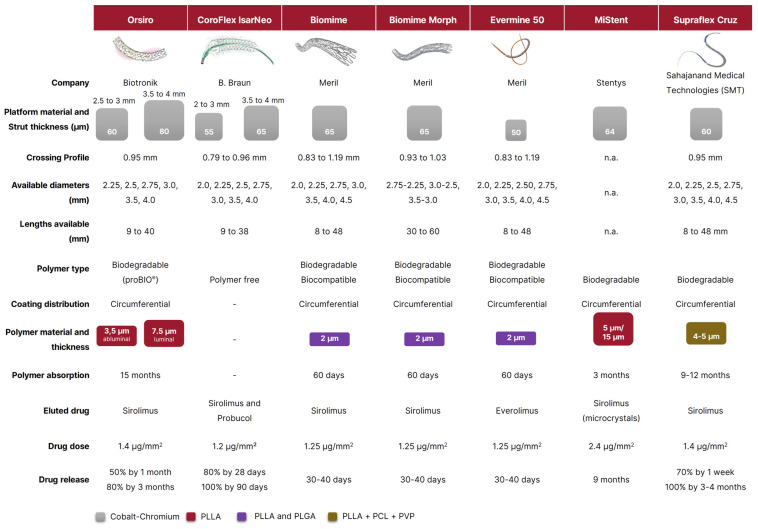
New-generation drug-eluting stents (DESs) represent the standard of care for patients undergoing percutaneous coronary intervention (PCI). Recent iterations in DES technology have led to the development of newer stent platforms with a further reduction in strut thickness. This new DES class, known as ultrathin struts DESs, has struts thinner than 70 µm. The evidence base for these devices consists of observational data, large-scale meta-analyses, and randomized trials with long-term follow-up, which have been conducted to investigate the difference between ultrathin struts DESs and conventional new-generation DESs in a variety of clinical settings and lesion subsets. Ultrathin struts DESs may further improve the efficacy and safety profile of PCI by reducing the risk of target-lesion and target-vessel failures in comparison to new-generation DESs. In this article, we reviewed device characteristics and clinical data of the Orsiro (Biotronik, Bülach, Switzerland), Coroflex ISAR (B. Braun Melsungen, Germany), BioMime (Meril Life Sciences Pvt. Ltd., Gujarat, India), MiStent (MiCell Technologies, USA), and Supraflex (Sahajanand Medical Technologies, Surat, India) sirolimus-eluting stents.
Keywords: coronary artery disease; drug-eluting stents; percutaneous coronary intervention; ultrathin struts.
Conflict of interest statement
Giovanni Esposito reports personal fees from Abbott Vascular, Amgen, Boehringer Ingelheim, Edwards Lifesciences, Terumo, and Sanofi, outside the submitted work and research grants to the institution from Alvimedica, Boston Scientific, and Medtronic. Raffaele Piccolo reports personal fees from Abbott Vascular, Biotronik, Terumo, Amgen, Boehringer Ingelheim, and Daiichi-Sankyo, outside the submitted work. The other authors have no conflicts of interest to declare.
Figures
References
-
- Piccolo R., Pilgrim T., Heg D., Franzone A., Rat-Wirtzler J., Räber L., Silber S., Serruys P.W., Jüni P., Windecker S. Comparative Effectiveness and Safety of New-Generation Versus Early-Generation Drug-Eluting Stents According to Complexity of Coronary Artery Disease. JACC Cardiovasc. Interv. 2015;8:1657–1666. doi: 10.1016/j.jcin.2015.08.013. - DOI - PubMed
-
- Tada T., Byrne R.A., Simunovic I., King L.A., Cassese S., Joner M., Fusaro M., Schneider S., Schulz S., Ibrahim T., et al. Risk of Stent Thrombosis Among Bare-Metal Stents, First-Generation Drug-Eluting Stents, and Second-Generation Drug-Eluting Stents. JACC Cardiovasc. Interv. 2013;6:1267–1274. doi: 10.1016/j.jcin.2013.06.015. - DOI - PubMed
Publication types
LinkOut - more resources
Full Text Sources
Miscellaneous
