


The Influence of the Matrix on the Apatite-Forming Ability of Calcium Containing Polydimethylsiloxane-Based Cements for Endodontics
- PMID: 36144487
- PMCID: PMC9504520
- DOI: 10.3390/molecules27185750
The Influence of the Matrix on the Apatite-Forming Ability of Calcium Containing Polydimethylsiloxane-Based Cements for Endodontics
Abstract
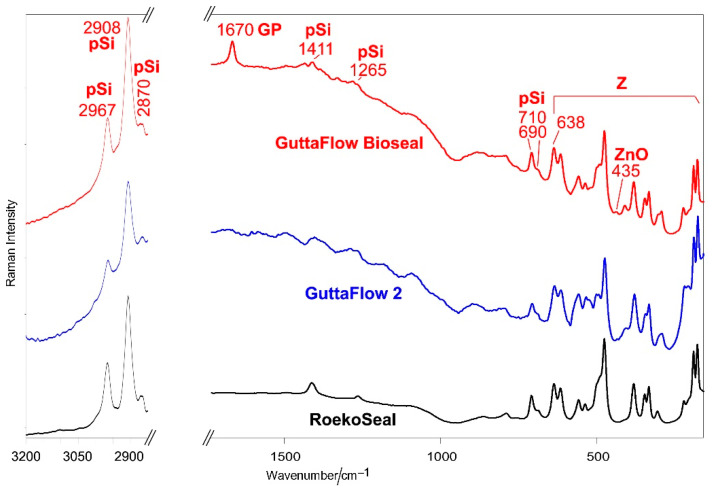
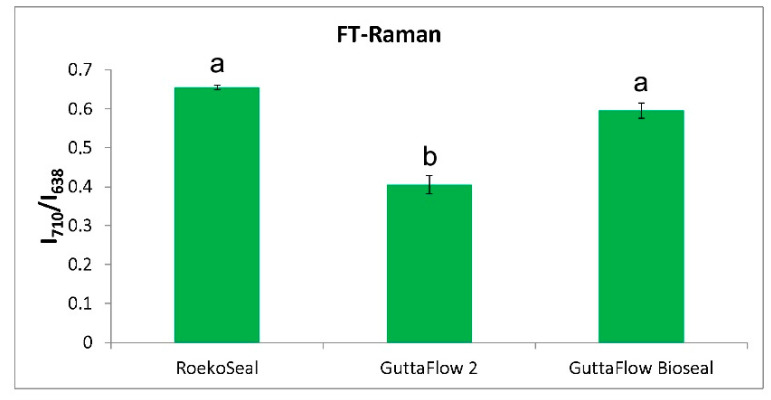
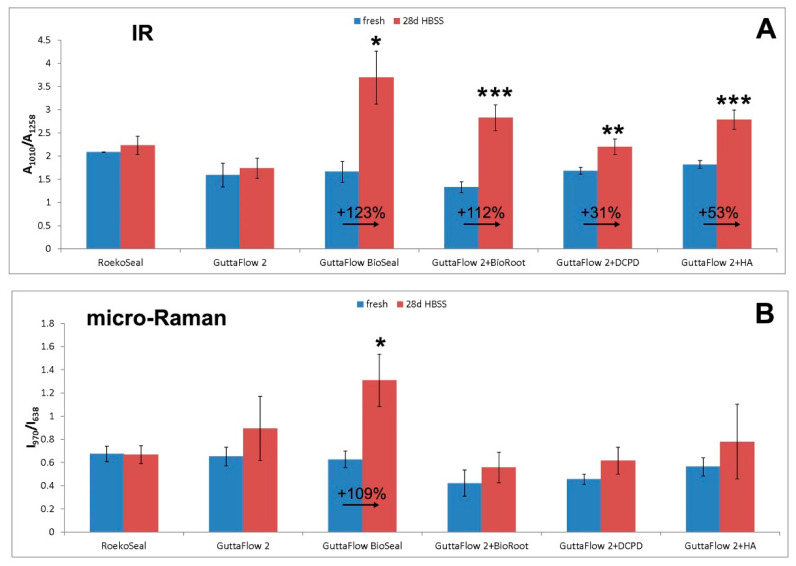
This study aimed to characterize the chemical properties and bioactivity of an endodontic sealer (GuttaFlow Bioseal) based on polydimethylsiloxane (PDMS) and containing a calcium bioglass as a doping agent. Commercial PDMS-based cement free from calcium bioglass (GuttaFlow 2 and RoekoSeal) were characterized for comparison as well as GuttaFlow 2 doped with dicalcium phosphate dihydrate, hydroxyapatite, or a tricalcium silicate-based cement. IR and Raman analyses were performed on fresh materials as well as after aging tests in Hank’s Balanced Salt Solution (28 d, 37 °C). Under these conditions, the strengthening of the 970 cm−1 Raman band and the appearance of the IR components at 1455−1414, 1015, 868, and 600−559 cm−1 revealed the deposition of B-type carbonated apatite. The Raman I970/I638 and IR A1010/A1258 ratios (markers of apatite-forming ability) showed that bioactivity decreased along with the series: GuttaFlow Bioseal > GuttaFlow 2 > RoekoSeal. The PDMS matrix played a relevant role in bioactivity; in GuttaFlow 2, the crosslinking degree was favorable for Ca2+ adsorption/complexation and the formation of a thin calcium phosphate layer. In the less crosslinked RoekoSeal, such processes did not occur. The doped cements showed bioactivity higher than GuttaFlow 2, suggesting that the particles of the mineralizing agents are spontaneously exposed on the cement surface, although the hydrophobicity of the PDMS matrix slowed down apatite deposition. Relevant properties in the endodontic practice (i.e., setting time, radiopacity, apatite-forming ability) were related to material composition and the crosslinking degree.
Keywords: GuttaFlow 2; GuttaFlow Bioseal; RoekoSeal; apatite; bioactivity; bioglass; calcium phosphate dihydrate (DCPD); calcium silicates (CaSi); crosslinking; endodontic sealer; hydroxiapatite (HA); polydimethylsiloxane; root filling materials; vibrational IR and Raman spectroscopy.
Conflict of interest statement
The authors declare no conflict of interest. The funders had no role in the design of the study; in the collection, analyses, or interpretation of data; in the writing of the manuscript; or in the decision to publish the results.
Figures





References
-
- Johnson W., Kulild J.C., Tay F. Obturation of the Cleaned and Shaped Root Canal System. In: Hargreaves K.M., Berman L.H., editors. Cohen’s Pathways of the Pulp. Elsevier; St. Louis, MO, USA: 2016. pp. 280–322.
-
- Grossman L. Endodontics. 11th ed. Lea & Febiger; Philadelphia, PA, USA: 1988.
-
- Ørstavik D. Materials used for root canal obturation: Technical, biological and clinical testing. Endod. Top. 2005;12:25–38. doi: 10.1111/j.1601-1546.2005.00197.x. - DOI
MeSH terms
Substances
Grants and funding
LinkOut - more resources
Full Text Sources
Miscellaneous
