


Intranasal Immunization with Liposome-Displayed Receptor-Binding Domain Induces Mucosal Immunity and Protection against SARS-CoV-2
- PMID: 36145467
- PMCID: PMC9505078
- DOI: 10.3390/pathogens11091035
Intranasal Immunization with Liposome-Displayed Receptor-Binding Domain Induces Mucosal Immunity and Protection against SARS-CoV-2
Abstract
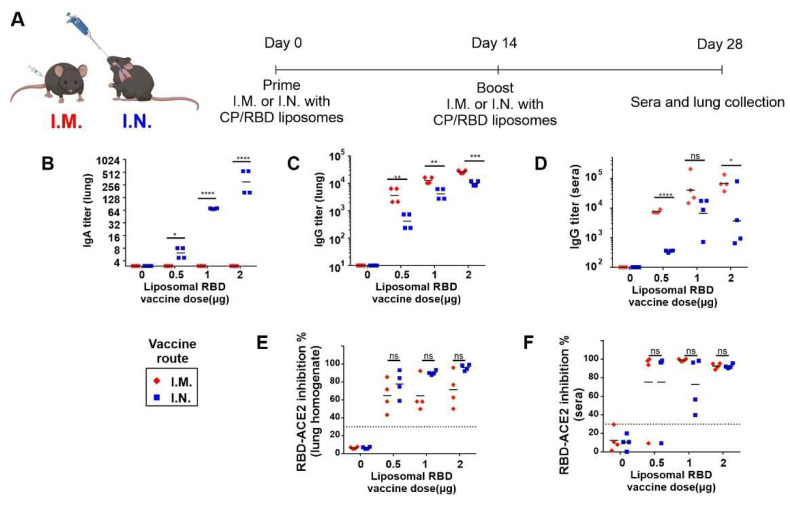
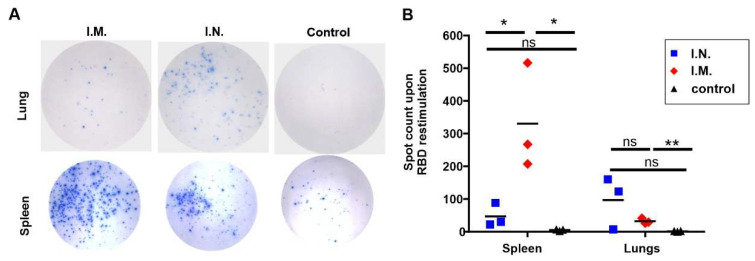
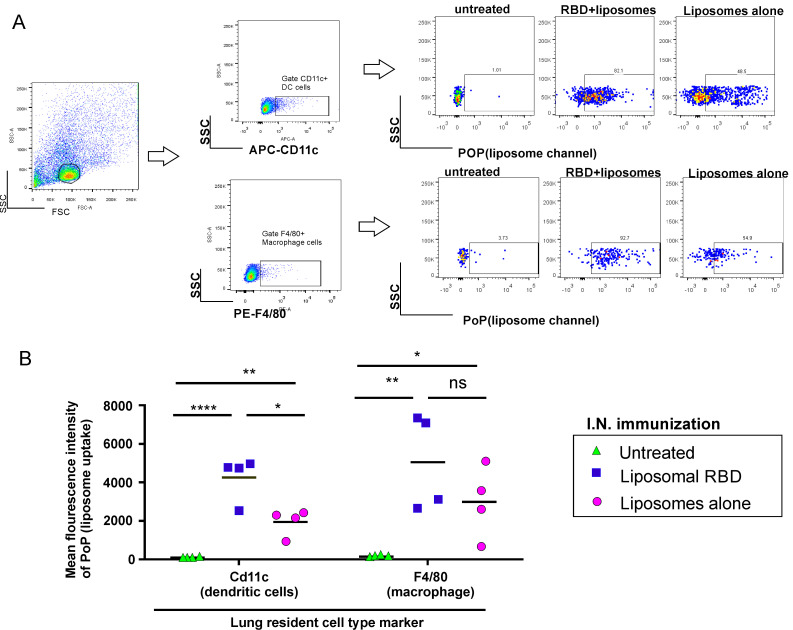
The global pandemic, caused by severe acute respiratory syndrome coronavirus 2 (SARS-CoV-2), has led to efforts in developing effective vaccine approaches. Currently, approved coronavirus disease 2019 (COVID-19) vaccines are administered through an intramuscular (I.M.) route. Here, we show that the SARS-CoV-2 spike (S) glycoprotein receptor-binding domain (RBD), when displayed on immunogenic liposomes, can be intranasally (I.N.) administered, resulting in the production of antigen-specific IgA and antigen-specific cellular responses in the lungs. Following I.N. immunization, antigen-presenting cells of the lungs took up liposomes displaying the RBD. K18 human ACE2-transgenic mice that were immunized I.M or I.N with sub-microgram doses of RBD liposomes and that were then challenged with SARS-CoV-2 had a reduced viral load in the early course of infection, with I.M. achieving complete viral clearance. Nevertheless, both vaccine administration routes led to full protection against lethal viral infection, demonstrating the potential for the further exploration and optimization of I.N immunization with liposome-displayed antigen vaccines.
Keywords: RBD; SARS-CoV-2; intranasal; liposomes; vaccines.
Conflict of interest statement
J.F.L. and W.-C.H. hold interest in POP Biotechnologies. W.-C.H. is an employee of POP Biotechnologies. Other authors declare no competing interests.
Figures

Similar articles
-
Intranasal VLP-RBD vaccine adjuvanted with BECC470 confers immunity against Delta SARS-CoV-2 challenge in K18-hACE2-mice.Vaccine. 2023 Jul 31;41(34):5003-5017. doi: 10.1016/j.vaccine.2023.06.080. Epub 2023 Jun 28. Vaccine. 2023. PMID: 37407405 Free PMC article.
-
Intranasal immunization with a Middle East respiratory syndrome-coronavirus antigen conjugated to the M-cell targeting ligand Co4B enhances antigen-specific mucosal and systemic immunity and protects against infection.Vaccine. 2022 Jan 31;40(5):714-725. doi: 10.1016/j.vaccine.2021.12.057. Epub 2021 Dec 30. Vaccine. 2022. PMID: 34991928 Free PMC article.
-
Intranasal immunization with the recombinant measles virus encoding the spike protein of SARS-CoV-2 confers protective immunity against COVID-19 in hamsters.Vaccine. 2024 Jan 12;42(2):69-74. doi: 10.1016/j.vaccine.2023.12.011. Epub 2023 Dec 14. Vaccine. 2024. PMID: 38097457
-
Intranasal administration of adenoviral vaccines expressing SARS-CoV-2 spike protein improves vaccine immunity in mouse models.Vaccine. 2023 May 11;41(20):3233-3246. doi: 10.1016/j.vaccine.2023.04.020. Epub 2023 Apr 14. Vaccine. 2023. PMID: 37085458 Free PMC article.
-
An Intranasal OMV-Based Vaccine Induces High Mucosal and Systemic Protecting Immunity Against a SARS-CoV-2 Infection.Front Immunol. 2021 Dec 17;12:781280. doi: 10.3389/fimmu.2021.781280. eCollection 2021. Front Immunol. 2021. PMID: 34987509 Free PMC article.
Cited by
-
Circularized Nanodiscs for Multivalent Mosaic Display of SARS-CoV-2 Spike Protein Antigens.Vaccines (Basel). 2023 Oct 28;11(11):1655. doi: 10.3390/vaccines11111655. Vaccines (Basel). 2023. PMID: 38005987 Free PMC article.
-
Liposome-Enabled Nanomaterials for Muscle Regeneration.Small Methods. 2025 Feb 18:e2402154. doi: 10.1002/smtd.202402154. Online ahead of print. Small Methods. 2025. PMID: 39967365 Review.
-
Editorial for the Topical Collection "SARS-CoV-2 Infection and COVID-19 Disease".Pathogens. 2024 Feb 21;13(3):191. doi: 10.3390/pathogens13030191. Pathogens. 2024. PMID: 38535534 Free PMC article.
-
Antiviral effect of SARS-CoV-2 N-specific CD8+ T cells induced in lungs by engineered extracellular vesicles.NPJ Vaccines. 2023 Jun 2;8(1):83. doi: 10.1038/s41541-023-00686-y. NPJ Vaccines. 2023. PMID: 37268624 Free PMC article.
-
Enhanced mucosal immune responses and reduced viral load in the respiratory tract of ferrets to intranasal lipid nanoparticle-based SARS-CoV-2 proteins and mRNA vaccines.J Nanobiotechnology. 2023 Feb 22;21(1):60. doi: 10.1186/s12951-023-01816-3. J Nanobiotechnology. 2023. PMID: 36814238 Free PMC article.
References
-
- Chan J.F., Yuan S., Kok K.H., To K.K., Chu H., Yang J., Xing F., Liu J., Yip C.C., Poon R.W., et al. A familial cluster of pneumonia associated with the 2019 novel coronavirus indicating person-to-person transmission: A study of a family cluster. Lancet. 2020;395:514–523. doi: 10.1016/S0140-6736(20)30154-9. - DOI - PMC - PubMed
-
- Allergy N.I.O., Diseases I., ModernaTX I. Safety and Immunogenicity Study of 2019-nCoV Vaccine (mRNA-1273) for Prophylaxis of SARS-CoV-2 Infection (COVID-19) [(accessed on 2 January 2020)];2020 Available online: https://ClinicalTrials.gov/show/NCT04283461.
Grants and funding
LinkOut - more resources
Full Text Sources
Molecular Biology Databases
Miscellaneous
