


Human Cytomegalovirus Induces Vitamin-D Resistance In Vitro by Dysregulating the Transcriptional Repressor Snail
- PMID: 36146811
- PMCID: PMC9505537
- DOI: 10.3390/v14092004
Human Cytomegalovirus Induces Vitamin-D Resistance In Vitro by Dysregulating the Transcriptional Repressor Snail
Abstract
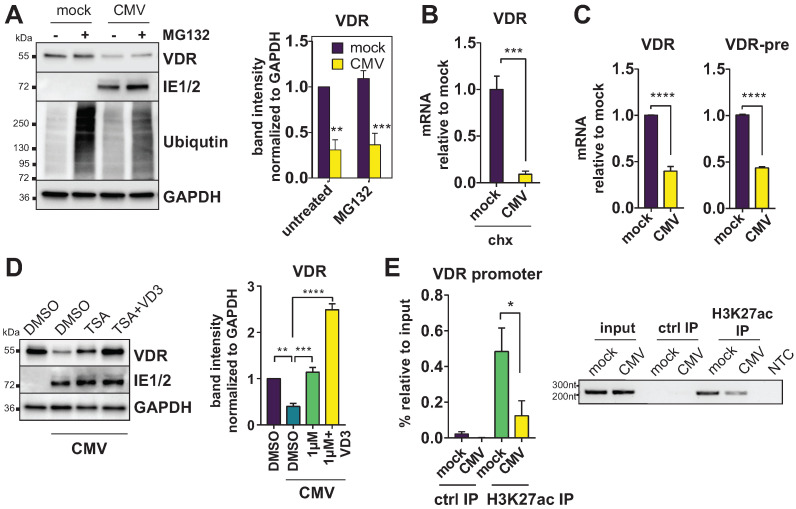
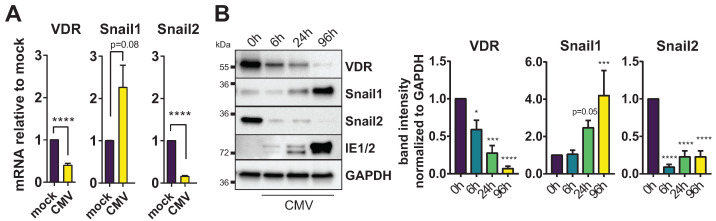
Vitamin-D supplementation is considered to play a beneficial role against multiple viruses due to its immune-regulating and direct antimicrobial effects. In contrast, the human cytomegalovirus (HCMV) has shown to be resistant to treatment with vitamin D in vitro by downregulation of the vitamin-D receptor. In this study, we aimed to elucidate the mechanism and possible biological consequences of vitamin-D resistance during HCMV infection. Mechanistically, HCMV induced vitamin-D resistance by downregulating the vitamin-D receptor (VDR) within hours of lytic infection. We found that the VDR was inhibited at the promoter level, and treatment with histone deacetylase inhibitors could restore VDR expression. VDR downregulation highly correlated with the upregulation of the transcriptional repressor Snail1, a mechanism likely contributing to the epigenetic inactivation of the VDR promoter, since siRNA-mediated knockdown of Snail partly restored levels of VDR expression. Finally, we found that direct addition of the vitamin-D-inducible antimicrobial peptide LL-37 strongly and significantly reduced viral titers in infected fibroblasts, highlighting VDR biological relevance and the potential of vitamin-D-inducible peptides for the antiviral treatment of vitamin-D deficient patients.
Keywords: HCMV; LL-37; Snail; VDR; calcitriol; cathelicidin; cytomegalovirus; vitamin D.
Conflict of interest statement
The authors declare no conflict of interest.
Figures
References
-
- Bhalla A.K., Amento E.P., Serog B., Glimcher L.H. 1,25-Dihydroxyvitamin D3 inhibits antigen-induced T cell activation. J. Immunol. 1984;133:1748–1754. - PubMed
-
- Wang T.-T., Nestel F.P., Bourdeau V., Nagai Y., Wang Q., Liao J., Tavera-Mendoza L., Lin R., Hanrahan J.W., Mader S., et al. Cutting Edge: 1,25-Dihydroxyvitamin D 3 Is a Direct Inducer of Antimicrobial Peptide Gene Expression. J. Immunol. 2004;173:2909–2912. doi: 10.4049/jimmunol.173.5.2909. - DOI - PubMed
-
- Gordon Y.J., Huang L.C., Romanowski E.G., Yates K.A., Proske R.J., McDermott A.M. Human cathelicidin (LL-37), a multifunctional peptide, is expressed by ocular surface epithelia and has potent antibacterial and antiviral activity. Curr. Eye Res. 2005;30:385–394. doi: 10.1080/02713680590934111. - DOI - PMC - PubMed
Publication types
MeSH terms
Substances
Grants and funding
LinkOut - more resources
Full Text Sources
Research Materials
