


Co-Deletion of A238L and EP402R Genes from a Genotype IX African Swine Fever Virus Results in Partial Attenuation and Protection in Swine
- PMID: 36146830
- PMCID: PMC9501025
- DOI: 10.3390/v14092024
Co-Deletion of A238L and EP402R Genes from a Genotype IX African Swine Fever Virus Results in Partial Attenuation and Protection in Swine
Abstract
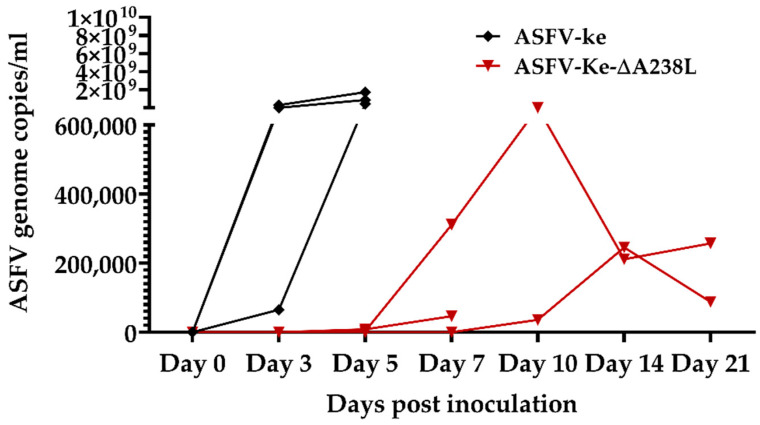
African swine fever virus (ASFV) is the causative agent of African swine fever (ASF), resulting in up to 100% mortality in pigs. Although endemic in most sub-Saharan African countries, where all known ASFV genotypes have been reported, the disease has caused pandemics of significant economic impact in Eurasia, and no vaccines or therapeutics are available to date. In endeavors to develop live-attenuated vaccines against ASF, deletions of several of the ~170 ASFV genes have shown contrasting results depending on the genotype of the investigated ASFV. Here, we report the in vivo outcome of a single deletion of the A238L (5EL) gene and double deletions of A238L (5EL) and EP402R (CD2v) genes from the genome of a highly virulent genotype IX ASFV isolate. Domestic pigs were intramuscularly inoculated with (i) ASFV-Ke-ΔA238L to assess the safety of A238L deletion and (ii) ASFV-Ke-ΔEP402RΔA238L to investigate protection against challenge with the virulent wildtype ASFV-Ke virus. While A238L (5EL) gene deletion did not yield complete attenuation, co-deletion of A238L (5EL) and EP402R (CD2v) improved the safety profile of the single deletions, eliciting both humoral and cellular immune responses and conferred partial protection against challenge with the virulent wildtype ASFV-Ke virus.
Keywords: ASFV; attenuation; gene deletion; protection; vaccine; virulence.
Conflict of interest statement
The authors declare no conflict of interest. The funders had no role in the design of the study; in the collection, analyses, or interpretation of data; in the writing of the manuscript, or in the decision to publish the results.
Figures



References
-
- Sun E., Huang L., Zhang X., Zhang J., Shen D., Zhang Z., Wang Z., Huo H., Wang W., Huangfu H., et al. Genotype I African Swine Fever Viruses Emerged in Domestic Pigs in China and Caused Chronic Infection. Emerg. Microbes Infect. 2021;10:2183–2193. doi: 10.1080/22221751.2021.1999779. - DOI - PMC - PubMed
-
- O’Donnell V., Risatti G.R., Holinka L.G., Krug P.W., Carlson J., Velazquez-Salinas L., Azzinaro P.A., Gladue D.P., Borca M.V. Simultaneous Deletion of the 9GL and UK Genes from the African Swine Fever Virus Georgia 2007 Isolate Offers Increased Safety and Protection against Homologous Challenge. J. Virol. 2016;91 doi: 10.1128/JVI.01760-16. - DOI - PMC - PubMed
-
- O’Donnell V., Holinka L.G., Krug P.W., Gladue D.P., Carlson J., Sanford B., Alfano M., Kramer E., Lu Z., Arzt J., et al. African Swine Fever Virus Georgia 2007 with a Deletion of Virulence-Associated Gene 9GL (B119L), When Administered at Low Doses, Leads to Virus Attenuation in Swine and Induces an Effective Protection against Homologous Challenge. J. Virol. 2015;89:8556–8566. doi: 10.1128/JVI.00969-15. - DOI - PMC - PubMed
Publication types
MeSH terms
Substances
LinkOut - more resources
Full Text Sources
