Review
. 2022 Sep 6:13:965258.
doi: 10.3389/fendo.2022.965258. eCollection 2022.

Immunoporosis: Role of immune system in the pathophysiology of different types of osteoporosis

Affiliations
Review

Immunoporosis: Role of immune system in the pathophysiology of different types of osteoporosis

Weidong Zhang et al. Front Endocrinol (Lausanne). .

Abstract

Osteoporosis is a skeletal system disease characterized by low bone mass and altered bone microarchitecture, with an increased risk of fractures. Classical theories hold that osteoporosis is essentially a bone remodeling disorder caused by estrogen deficiency/aging (primary osteoporosis) or secondary to diseases/drugs (secondary osteoporosis). However, with the in-depth understanding of the intricate nexus between both bone and the immune system in recent decades, the novel field of "Immunoporosis" was proposed by Srivastava et al. (2018, 2022), which delineated and characterized the growing importance of immune cells in osteoporosis. This review aimed to summarize the response of the immune system (immune cells and inflammatory factors) in different types of osteoporosis. In postmenopausal osteoporosis, estrogen deficiency-mediated alteration of immune cells stimulates the activation of osteoclasts in varying degrees. In senile osteoporosis, aging contributes to continuous activation of the immune system at a low level which breaks immune balance, ultimately resulting in bone loss. Further in diabetic osteoporosis, insulin deficiency or resistance-induced hyperglycemia could lead to abnormal regulation of the immune cells, with excessive production of proinflammatory factors, resulting in osteoporosis. Thus, we reviewed the pathophysiology of osteoporosis from a novel insight-immunoporosis, which is expected to provide a specific therapeutic target for different types of osteoporosis.

Keywords: diabetic osteoporosis; immune cells; inflammatory factors; postmenopausal osteoporosis; senile osteoporosis.


Conflict of interest statement

The authors declare that the research was conducted in the absence of any commercial or financial relationships that could be construed as a potential conflict of interest.

Figures
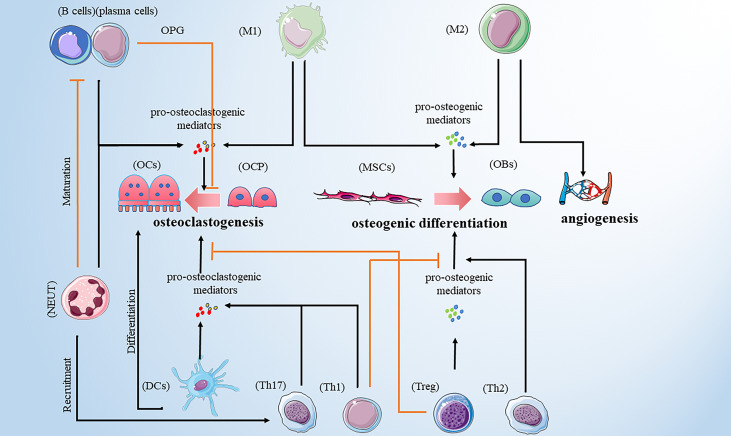
Figure 1
Figure 1
Immune cells promote osteoclastogenesis by secreting pro-osteoclastogenic mediators. Those immune cells include M1 macrophages, DCs, neutrophils, Th1, Th17 and B cells. M1 macrophages are also involved in osteogenic difference. M1 macrophages and Treg cells promote osteogenic differences by releasing pro-osteogenic mediators. Th2 cells play a bone-protective role. In addition to promoting osteoclastogenesis, neutrophils can recruit Th17cells and inhibit the maturation of B cells. B cells play a dual role in osteoclastogenesis. Note: Various types of immune cell image materials are from https://smart.servier.com.
Figure 2
Figure 2
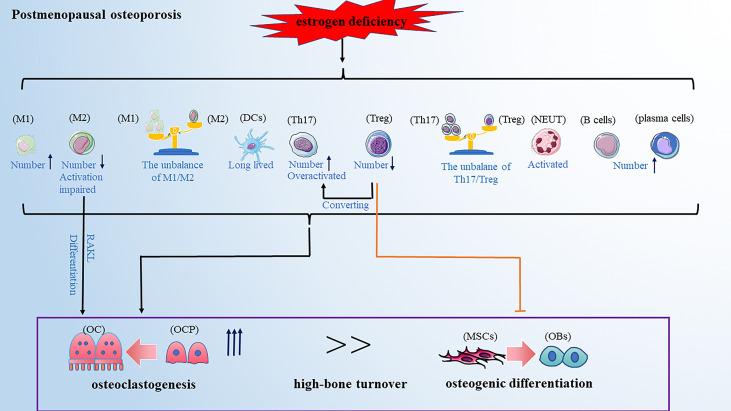
PMOP is a high-bone turnover disease. Estrogen deficiency leads to changes in the number and function of immune cells, which ultimately affecting bone remodeling and leads to osteoporosis. These changes included: the balance of M1/M2 and Th17/Treg favors pro-inflammatory M1 and Th17 cells; the activation of M2 macrophages and Treg cells are impaired; Th17 cells are overactivated and Treg cells can convert into Th17 cells; DCs become long-lived; neutrophils are activated; The number of B cells and plasma cells is increased. Note: Various types of immune cell image materials are from https://smart.servier.com.
Figure 3
Figure 3
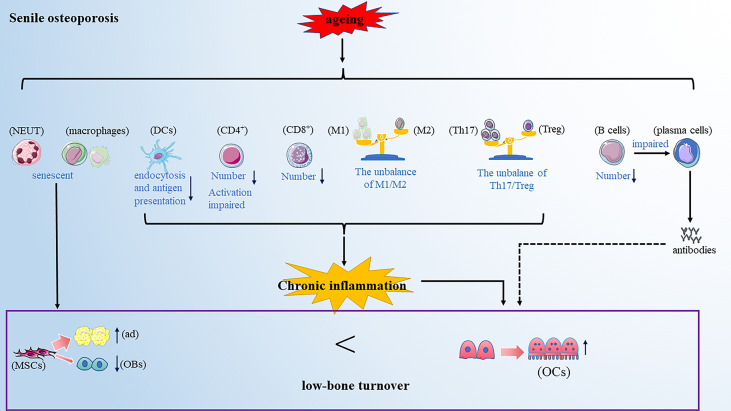
Senile osteoporosis is a low-bone turnover disease. Aging makes the immune cells senescent. On the one hand, the senescent immune cells promote the differentiation of mesenchymal cells into adipocytes and inhibit the differentiation of mesenchymal cells into osteoblasts; further, the altered immune cells promote osteoclastogenesis. Note: Various types of immune cell image materials are from https://smart.servier.com.
Figure 4
Figure 4
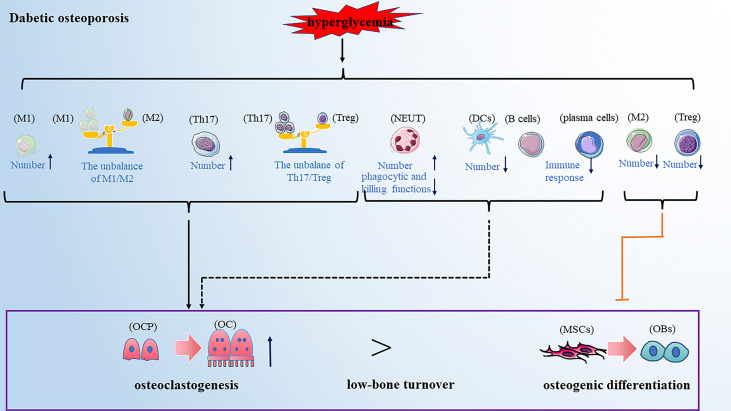
Dibetic osteoporosis is also a low-bone turnover disease. Hyperglycemia leads to the alteration of immune cells in numbers and function, promoting osteoclastogenesis and inhibiting osteogenic differentiation, partially resulting to the development of diabetic osteoporosis. Note: Various types of immune cell image material are from https://smart.servier.com.
Figure 5
Figure 5
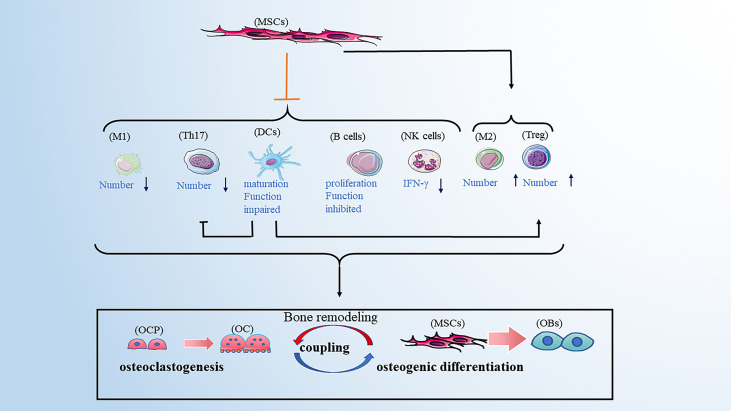
BMSCs have immunoregulatory function by affecting the immune cells. BMSCs can favor the balance of M1/M2 toward M2 macrophages, the balance of Th17/Treg toward Treg cells. BMSCs can also inhibit the maturation and function of DCs, further suppressing the activation and proliferation of T cells. BMSCs have an inhibitory role in the secretion of IFN-γ from NK cells. Moreover, BMSCs inhibit the proliferation and function of B cells. Note: Various types of immune cell image material are from https://smart.servier.com.

References

    1. Lane JM, Russell L, Khan SN. Osteoporosis. Clin Orthop Relat Res (2000) 372):139–50. doi: 10.1097/00003086-200003000-00016 - DOI - PubMed
    1. Siddiqui JA, Partridge NC. Physiological bone remodeling: Systemic regulation and growth factor involvement. Physiol (Bethesda). (2016) 31(3):233–45. doi: 10.1152/physiol.00061.2014 - DOI - PMC - PubMed
    1. Rosen CJ. Endocrine disorders and osteoporosis. Curr Opin Rheumatol (1997) 9(4):355–61. doi: 10.1097/00002281-199707000-00014 - DOI - PubMed
    1. Okamoto K, Takayanagi H. Osteoimmunology. Cold Spring Harb Perspect Med (2019) 9(1):a031245. doi: 10.1101/cshperspect.a031245 - DOI - PMC - PubMed
    1. Brunetti G, D’Amelio P, Mori G, Faienza MF. Editorial: Updates on osteoimmunology: What’s new on the crosstalk between bone and immune cells. Front Endocrinol (Lausanne). (2020) 11:74. doi: 10.3389/fendo.2020.00074 - DOI - PMC - PubMed

Publication types