


Surgical outcomes of periprosthetic distal femur fractures after total knee arthroplasty classified by Su et al. system
- PMID: 36148178
- PMCID: PMC9486061
- DOI: 10.1016/j.jor.2022.09.005
Surgical outcomes of periprosthetic distal femur fractures after total knee arthroplasty classified by Su et al. system
Abstract
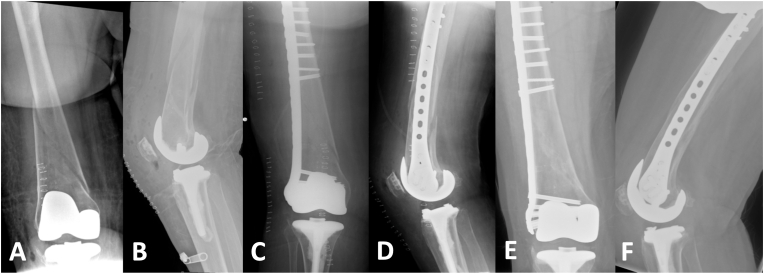
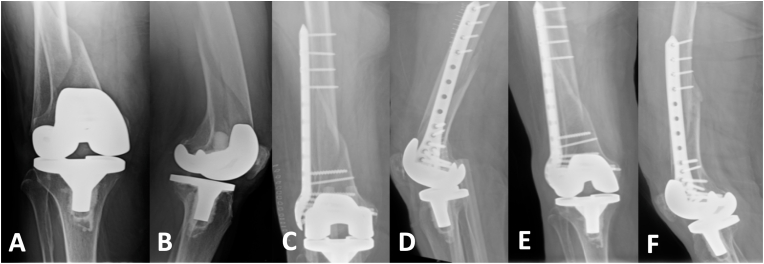
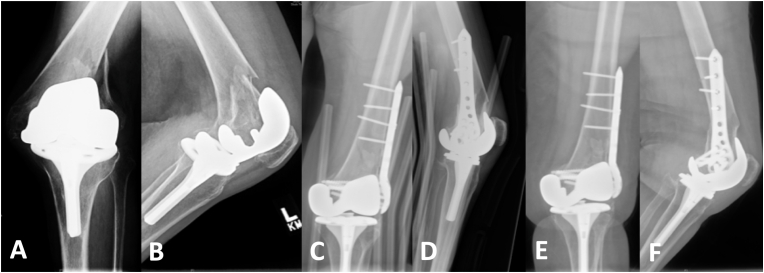
Background: Periprosthetic fractures of the distal femur remain a challenge to treat due to variations in both patient- and fracture-specific factors. This study was designed to analyze the outcomes of different subtypes of periprosthetic distal femur fractures based on the Su et al. classification system.
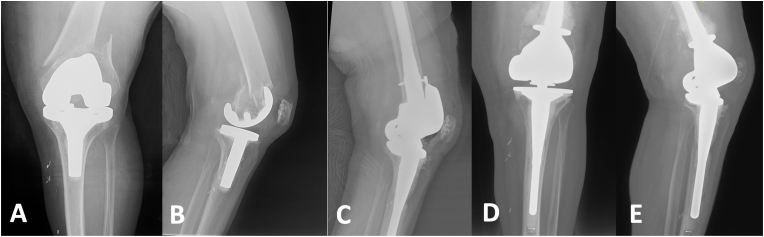
Methods: Thirty-six patients were classified with Su et al. system. All Type I and II fractures were managed with a locking plate. Most Type III fractures were managed with locking plate, while two were managed with long-stem revision arthroplasty due to evidence of implant loosening. Outcomes were measured and analyzed based on healing time, revision rate, and complication rate.
Results: Of the 36 patients, 30 (83.3%) achieved acceptable fracture union, while the remaining 6 (16.7%) experienced either delayed union or non-union. Type I fractures showed a significantly lower healing time than Type II and III fractures managed by locking plate. Delayed union was present in the Type II group, while non-union was recorded for two Type III fractures. Need for revision was more prevalent in fracture Types II and III.
Conclusion: The Su et al. system of classification for periprosthetic fractures of the distal femur matches the clinical outcomes of this study and would seem to be useful in the approach to the treatment of these fractures. The majority of these fractures can be managed with locking plate with reasonable results. However, if the implant is loosened in Type III fractures, revision arthroplasty is suggested.
Keywords: Classification system; Distal femur; Outcomes; Periprosthetic fractures; Subtypes; Total knee arthroplasty.
© 2022 Professor P K Surendran Memorial Education Foundation. Published by Elsevier B.V. All rights reserved.
Conflict of interest statement
All authors have nothing to disclose.
Figures
References
-
- Lavernia C.J., Guzman J.F., Gachupin-Garcia A. Cost effectiveness and quality of life in knee arthroplasty. Clin Orthop Relat Res. 1997 Dec;345:134–139. - PubMed
-
- Jain N.B., Higgins L.D., Ozumba D., et al. Trends in epidemiology of knee arthroplasty in the United States, 1990-2000. Arthritis Rheum. 2005 Dec;52(12):3928–3933. - PubMed
-
- Della Rocca G.J., Leung K.S., Pape H.C. Periprosthetic fractures: epidemiology and future projections. J Orthop Trauma. 2011 Jun;25(Suppl 2):S66–S70. - PubMed
-
- Frenzel S., Vécsei V., Negrin L. Periprosthetic femoral fractures--incidence, classification problems and the proposal of a modified classification scheme. Int Orthop. 2015 Oct;39(10):1909–1920. - PubMed
-
- Ruder J.A., Hart G.P., Kneisl J.S., Springer B.D., Karunakar M.A. Predictors of functional recovery following periprosthetic distal femur fractures. J Arthroplasty. 2017;32(5):1571–1575. - PubMed
LinkOut - more resources
Full Text Sources
