


[Rare-disease data standards]
- PMID: 36149471
- PMCID: PMC9636095
- DOI: 10.1007/s00103-022-03591-2
[Rare-disease data standards]
Abstract
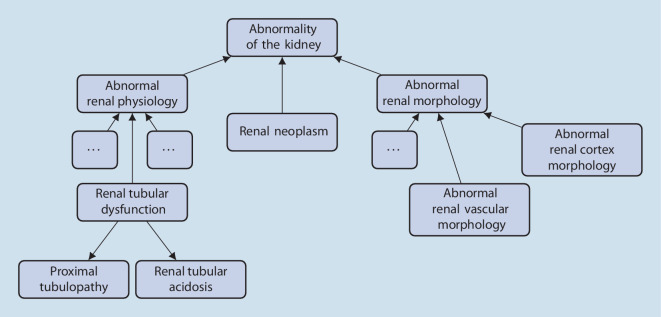
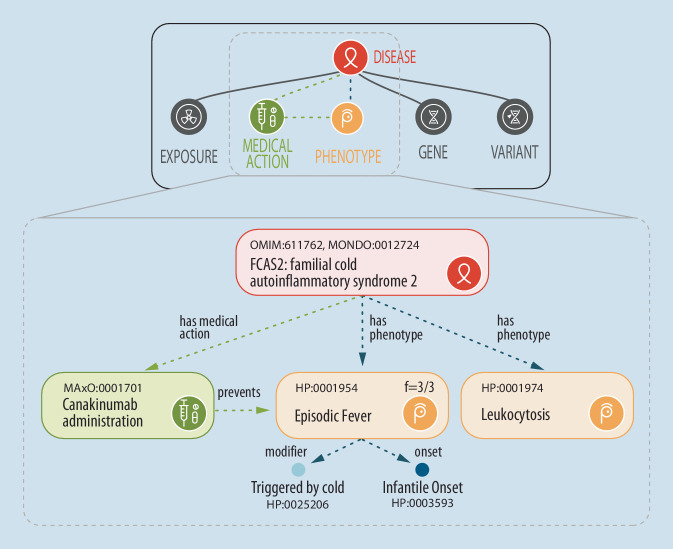
The use of standardized data formats (data standards) in healthcare supports four main goals: (1) exchange of data, (2) integration of computer systems and tools, (3) data storage and archiving, and (4) support of federated databases. Standards are especially important for rare-disease research and clinical care.In this review, we introduce healthcare standards and present a selection of standards that are commonly used in the field of rare diseases. The Human Phenotype Ontology (HPO) is the most commonly used standard for annotating phenotypic abnormalities and supporting phenotype-driven analysis of diagnostic exome and genome sequencing. Numerous standards for diseases are available that support a range of needs. Online Mendelian Inheritance in Man (OMIM) and the Orphanet Rare Disease Ontology (ORDO) are the most important standards developed specifically for rare diseases. The Mondo Disease Ontology (Mondo) is a new disease ontology that aims to integrate data from a comprehensive range of current nosologies. New standards and schemas such as the Medical Action Ontology (MAxO) and the Global Alliance for Genomics and Health (GA4GH) phenopacket are being introduced to extend the scope of standards that support rare disease research.In order to provide optimal care for patients with SE in different healthcare settings, it will be necessary to better integrate standards for rare disease with electronic healthcare resources such as the Fast Healthcare Interoperability Resources (FHIR) standard for healthcare data exchange.
Die Verwendung von einheitlichen Datenformaten (Datenstandards) im Gesundheitswesen dient vier Hauptzwecken: 1) dem Datenaustausch, 2) der Integration von Computersystemen und -instrumenten, 3) der Datenspeicherung und -archivierung und 4) der Unterstützung föderierter Datenbanken. Sie sind besonders wichtig für die Erforschung und die klinische Versorgung Seltener Erkrankungen (SE).In dieser Übersicht stellen wir Standards im Gesundheitswesen vor und präsentieren eine Auswahl von Standards, die im Bereich der seltenen Krankheiten häufig verwendet werden. Die „Human Phenotype Ontology“ (HPO) ist der am häufigsten verwendete Standard zur Annotation phänotypischer Anomalien und zur Unterstützung der phänotypgesteuerten Analyse der diagnostischen Exom- und Genomsequenzierung. Es gibt zahlreiche Standards für Krankheiten, die unterschiedlichen Anforderungen entsprechen. Das „Online Mendelian Inheritance in Man“ (OMIM) und die „Orphanet Rare Disease Ontology“ (ORDO) sind die wichtigsten Standards, die speziell für seltene Krankheiten entwickelt wurden. Die „Mondo Disease Ontology“ (Mondo) ist eine neue Krankheitsontologie, die darauf abzielt, auf umfassende Weise Daten aus aktuellen Nosologien zu integrieren. Neue Standards und Schemata wie die „Medical Action Ontology“ (MAxO) und das „Phenopacket“ der Global Alliance for Genomics and Health (GA4GH) werden gegenwärtig eingeführt, um die Palette der verfügbaren Standards zur Unterstützung der Forschung an seltenen Krankheiten zu erweitern.Um eine optimale Versorgung von Patienten mit SE in verschiedenen Bereichen des Gesundheitswesens zu ermöglichen, müssen die Standards für seltene Krankheiten besser in die elektronischen Ressourcen des Gesundheitswesens integriert werden, z. B. über den Standard „FHIR“ (Fast Healthcare Interoperability Resources).
Keywords: Nosology; Ontology; Rare diseases; Standards for healthcare data; Terminology.
© 2022. The Author(s).
References
Publication types
MeSH terms
Grants and funding
LinkOut - more resources
Full Text Sources
Medical
