. 2022 Oct 6;13(39):9028-9034.
doi: 10.1021/acs.jpclett.2c02613. Epub 2022 Sep 23.

Excited-State Barrier Controls EZ Photoisomerization in p-Hydroxycinnamate Biochromophores

Affiliations

Excited-State Barrier Controls EZ Photoisomerization in p-Hydroxycinnamate Biochromophores

Eleanor K Ashworth et al. J Phys Chem Lett. .

Abstract

Molecules based on the deprotonated p-hydroxycinnamate moiety are widespread in nature, including serving as UV filters in the leaves of plants and as the biochromophore in photoactive yellow protein. The photophysical behavior of these chromophores is centered around a rapid EZ photoisomerization by passage through a conical intersection seam. Here, we use photoisomerization and photodissociation action spectroscopies with deprotonated 4-hydroxybenzal acetone (pCK-) to characterize a wavelength-dependent bifurcation between electron autodetachment (spontaneous ejection of an electron from the S1 state because it is situated in the detachment continuum) and EZ photoisomerization. While autodetachment occurs across the entire S1(ππ*) band (370-480 nm), EZ photoisomerization occurs only over a blue portion of the band (370-430 nm). No EZ photoisomerization is observed when the ketone functional group in pCK- is replaced with an ester or carboxylic acid. The wavelength-dependent bifurcation is consistent with potential energy surface calculations showing that a barrier separates the Franck-Condon region from the EZ isomerizing conical intersection. The barrier height, which is substantially higher in the gas phase than in solution, depends on the functional group and governs whether EZ photoisomerization occurs more rapidly than autodetachment.


Conflict of interest statement

The authors declare no competing financial interest.

Figures

Figure 1
Figure 1
(a) p-Hydroxycinnamate anions considered in this study. (b) Action spectra for pCK (photodissociation, black) and pCEs (photodetachment, blue, from ref (32)) as proxies for the S1 ← S0 absorption bands. The absorption spectrum of pCK in water (at T = 300 K) is shown in red. Solid lines are moving averages over three data points for the gas phase and seven data points for the condensed phase data.
Figure 2
Figure 2
Action spectroscopy of pCK: (a) light-off (black) and photoaction (blue) ATD at 420 nm in pure N2 buffer gas; (b) light-off (black) and photoaction (blue, 420 nm and red, 435 nm) ATD in N2 buffer gas seeded with ≈1% propan-2-ol and ≈1% SF6; (c) electron photodetachment (red) and EZ photoisomerization (blue) action spectra. The photoaction spectra show the changes between light-on and light-off ATDs, reflecting any photoinduced processes. The photoisomerization quantum yield is estimated at a 1–2% at 400 nm. See the Supporting Information for CO2 buffer gas data. The excited-state barrier to isomerization is estimated at ≈0.18 eV from the difference in spectral maxima in (c); use of thresholds is not reliable because of hot bands and the direct photodetachment contribution to electron detachment because the S1 state is situated in the detachment threshold.
Figure 3
Figure 3
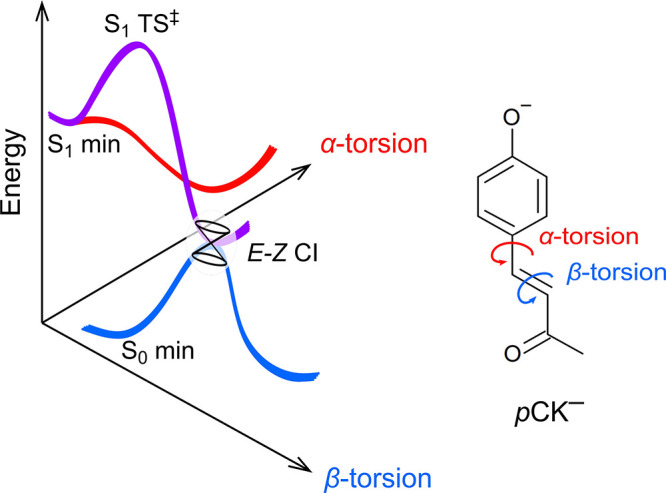
Schematic illustration of potential energy surfaces for the E isomer of pCK showing the α and β coordinates and identifying S0 and S1 minimum-energy geometries, the β-coordinate transition state (S1 TS), and the E–Z minimum-energy conical intersection (CI). Calculated energies for these critical points are given in Table 2. The α coordinate has been considered in ref (35).
Figure 4
Figure 4
Fluorescence spectroscopy of pCK in solution at T = 300 K: (a) excitation (red, monitoring at 480 nm) and emission (blue, exciting at 400 nm) fluorescence spectra in water; (b) time-resolved fluorescence upconversion decay curves and model fits in a series of alcohols (fitted values are given in the Supporting Information). Experimental data points are shown for ButOH; (c) viscosity (η) effect of formula image in a series of alcohols (red) and water–ethylene glycol mixtures (blue).

References

    1. Pei K.; Ou J.; Huang J.; Ou S. p-Coumaric Acid and its Conjugates: Dietary Sources, Pharmacokinetic Properties and Biological Activities. J. Sci. Food Agricul. 2016, 96, 2952–2962. 10.1002/jsfa.7578. - DOI - PubMed
    1. Baker L. A.; Horbury M. D.; Greenough S. E.; Allais F.; Walsh P. S.; Habershon S.; Stavros V. G. Ultrafast Photoprotecting Sunscreens in Natural Plants. J. Phys. Chem. Lett. 2016, 7, 56–61. 10.1021/acs.jpclett.5b02474. - DOI - PubMed
    1. Baker L. A.; Marchetti B.; Karsili T. N. V.; Stavros V. G.; Ashfold M. N. R. Photoprotection: Extending Lessons Learned From Studying Natural Sunscreens to the Design of Artificial Sunscreen Constituents. Chem. Soc. Rev. 2017, 46, 3770–3791. 10.1039/C7CS00102A. - DOI - PubMed
    1. Holt E. L.; Stavros V. G. Applications of Ultrafast Spectroscopy to Sunscreen Development, From First Principles to Complex Mixtures. Int. Rev. Phys. Chem. 2019, 38, 243–285. 10.1080/0144235X.2019.1663062. - DOI
    1. Kinoshita S.; Harabuchi Y.; Inokuchi Y.; Maeda S.; Ehara M.; Yamazaki K.; Ebata T. Substitution Effect on the Nonradiative Decay and trans → cis Photoisomerization Route: A Guideline to Develop Efficient Cinnamate-Based Sunscreens. Phys. Chem. Chem. Phys. 2021, 23, 834–845. 10.1039/D0CP04402D. - DOI - PubMed