


Oral Health and Mortality Among Older Adults: A Doubly Robust Survival Analysis
- PMID: 36150950
- PMCID: PMC11018359
- DOI: 10.1016/j.amepre.2022.08.006
Oral Health and Mortality Among Older Adults: A Doubly Robust Survival Analysis
Abstract
Introduction: Evidence on the association between oral health and mortality is inconclusive, and few studies have accounted for the nonrandom selection bias in estimating their relationship. This study aims to investigate the link between oral health and mortality in community-dwelling older adults by adjusting for confounding factors with a doubly robust survival estimation.
Methods: Data came from the third National Health and Nutrition Examination Survey (1988-1994) and were linked to the National Death Index mortality data through December 2015. The analytic sample consisted of 4,880 adults aged ≥60 years. Oral health measures included objective clinical indicators (edentulism, periodontitis, and untreated dental caries) and self-rated oral health. Cox proportional hazards regression models and inverse probability weighting with regression adjustment for observational survival-time estimation were utilized to assess the relationship between oral health and mortality. Analyses were conducted in 2021.
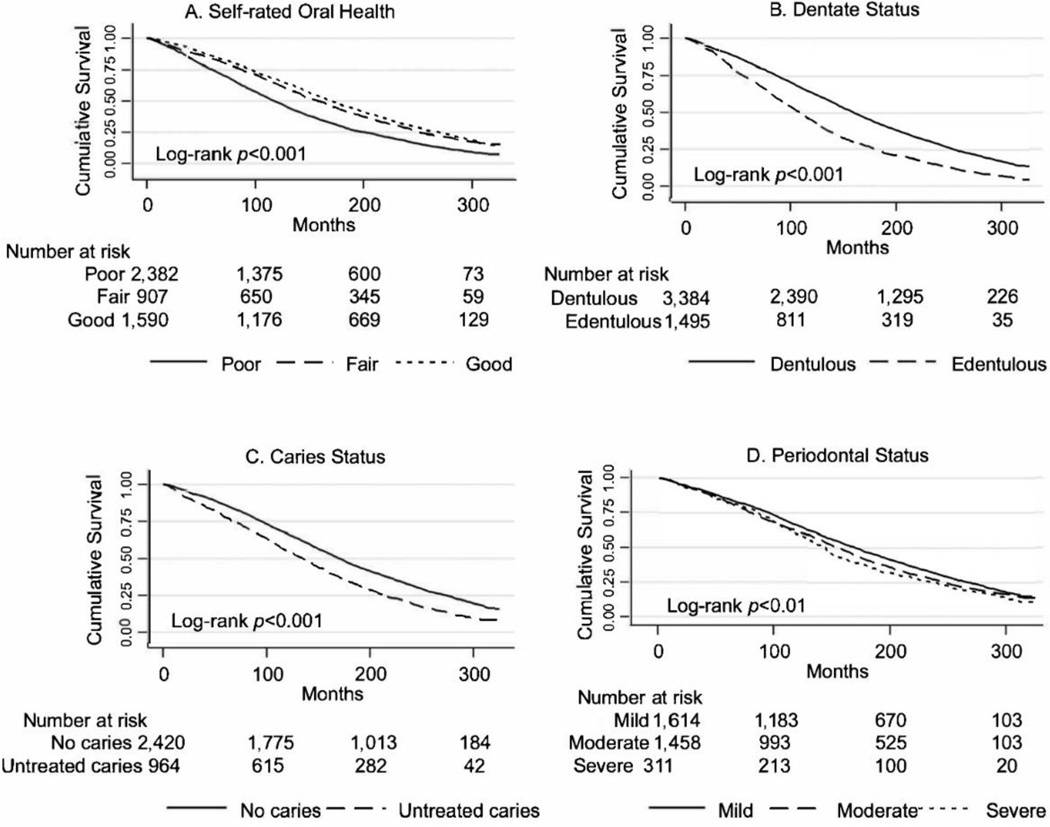
Results: Edentulism (average treatment effect= -26.13, 95% CI= -48.69, -3.57) was associated with a reduction in survival time. Periodontal conditions and dental caries were related to all-cause mortality in Cox models but became nonsignificant when inverse probability weighting with regression adjustment survival estimation was applied. Good self-rated oral health was significantly related to an increase in survival time (average treatment effect=21.50; 95% CI= 4.92, 38.07).
Conclusions: Both objective and subjective oral health are risk factors for mortality among older adults. Improving access to dental screening and treatment among community-dwelling older adults has the potential to reduce oral health‒related risks of mortality.
Copyright © 2022 American Journal of Preventive Medicine. Published by Elsevier Inc. All rights reserved.
Conflict of interest statement
The preparation of this article was supported in part by the National Institute on Aging of the National Institutes of Health (T32AG000221)(W.Q.). The content is solely the responsibility of the author and does not necessarily represent the official views of the National Institutes of Health.
Figures
References
-
- National Institute of Dental and Craniofacial Research. Dental Caries (Tooth Decay) in Seniors (Age 65 and Over).; 2018. https://www.nidcr.nih.gov/research/data-statistics/dental-caries/seniors
-
- Centers for Disease Control and Prevention. Edentulism and Tooth Retention.; 2021. www.cdc.gov/oralhealth/publications/OHSR-2019-edentulism-tooth-retention...
-
- National Institute of Dental and Craniofacial Research. Oral Health in America: Advances and Challenges: Executive Summary.; 2021. www.ncbi.nlm.nih.gov/books/NBK576536/ - PubMed
Publication types
MeSH terms
Grants and funding
LinkOut - more resources
Full Text Sources
Medical
