Randomized Controlled Trial
. 2022 Sep 23;12(1):15233.
doi: 10.1038/s41598-022-19395-y.

Hyperbaric oxygen therapy in children with post-concussion syndrome improves cognitive and behavioral function: a randomized controlled trial

Affiliations
Randomized Controlled Trial

Hyperbaric oxygen therapy in children with post-concussion syndrome improves cognitive and behavioral function: a randomized controlled trial

Amir Hadanny et al. Sci Rep. .

Abstract

Persistent post-concussion syndrome (PPCS) is a common and significant morbidity among children following traumatic brain injury (TBI) and the evidence for effective PPCS treatments remains limited. Recent studies have shown the beneficial effects of hyperbaric oxygen therapy (HBOT) in PPCS adult patients. This randomized, sham-control, double blind trial evaluated the effect of hyperbaric oxygen therapy (HBOT) on children (age 8-15) suffering from PPCS from mild-moderate TBI events six months to 10 years prior. Twenty-five children were randomized to receive 60 daily sessions of HBOT (n = 15) or sham (n = 10) treatments. Following HBOT, there was a significant increase in cognitive function including the general cognitive score (d = 0.598, p = 0.01), memory (d = 0.480, p = 0.02), executive function (d = 0.739, p = 0.003), PPCS symptoms including emotional score (p = 0.04, d = - 0.676), behavioral symptoms including hyperactivity (d = 0.244, p = 0.03), global executive composite score (d = 0.528, p = 0.001), planning/organizing score (d = 1.09, p = 0.007). Clinical outcomes correlated with significant improvements in brain MRI microstructural changes in the insula, supramarginal, lingual, inferior frontal and fusiform gyri. The study suggests that HBOT improves both cognitive and behavioral function, PPCS symptoms, and quality of life in pediatric PPCS patients at the chronic stage, even years after injury. Additional data is needed to optimize the protocol and to characterize the children who can benefit the most.


Conflict of interest statement

AH, ES, SG, BY, ZY work for AVIV Scientific LTD. ES is a shareholder at AVIV Scientific LTD. Other authors don't have any conflict of interest.

Figures
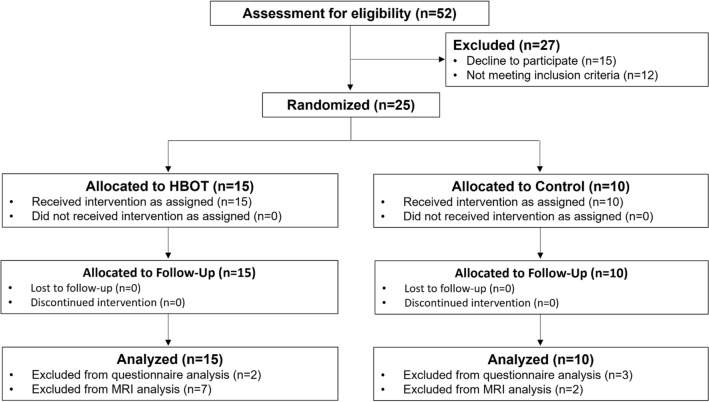
Figure 1
Figure 1
Patient flowchart.
Figure 2
Figure 2
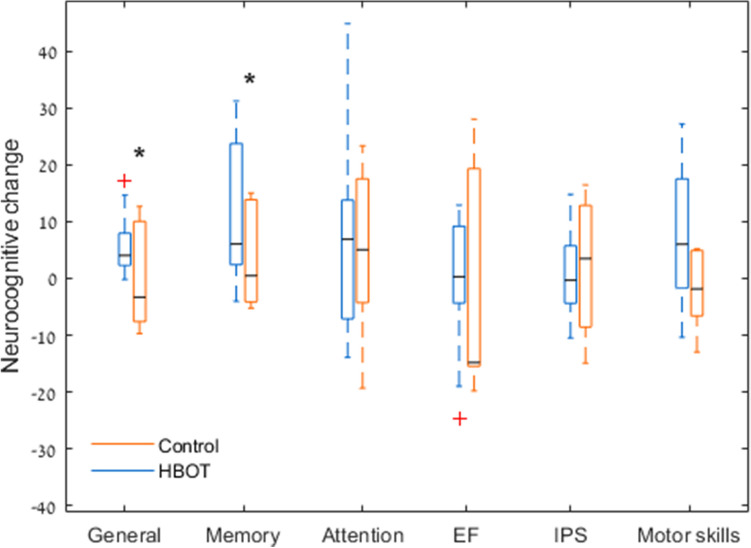
Primary endpoint changes boxplot. Both memory and the general cognitive scores were significantly increased after HBOT, with no changes in the sham group. Data shown as absolute mean change per cognitive domain. The central mark indicates the median, and the bottom and top edges of the box indicate the 25th and 75th percentiles, respectively. Red + symbols indicate outliers. *P < 0.05.
Figure 3
Figure 3
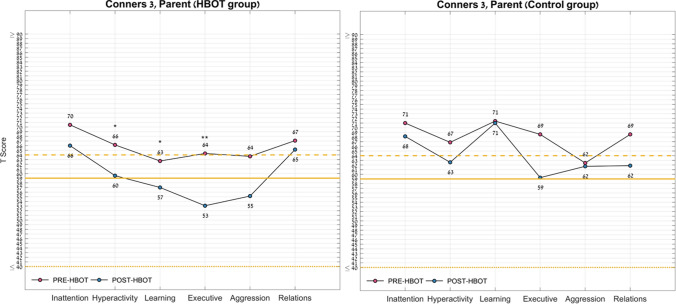
Conners scale for assessing ADHD questionnaire domains change. Following HBOT, the Conners 3 questionnaire showed significant improvements in the hyperactivity score, executive score, learning problem score and negative impression. Normal range [40–59]. *P < 0.05; **P < 0.01; See Table 4 for full statistical information.
Figure 4
Figure 4
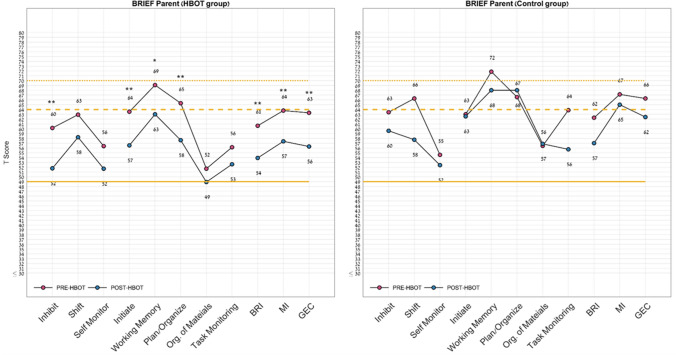
Behavior rating inventory of executive function questionnaire domains change. Following HBOT, the BRIEF questionnaire showed significant improvements in the inhibit, initiate, working memory, planning, behavioral regulation index, metacognition and global executive composite scores. Normal range, [49–64]; BRIEF behavior rating inventory of executive function. *P < 0.05; **P < 0.01; See Table 4 for full statistical information.
Figure 5
Figure 5
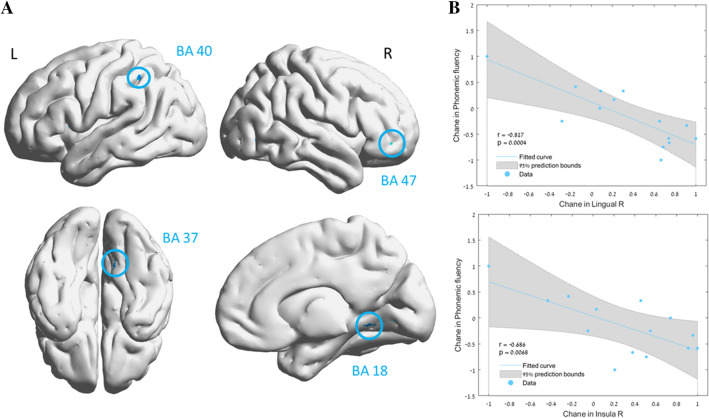
Brain regions with significant post HBOT changes in mean diffusivity (MD). Group-by-time interaction ANOVA model in: (A) DTI—mean diffusivity (MD) in gray matter, p < 0.005, uncorrected (B). Significant correlation between change in phonemic fluency and the right lingual MD (BA 18), and right insula MD (BA 13). r is Pearson's correlation coefficient. The 95% prediction interval is presented in the shaded area. R right, L left, BA Brodmann area. Brain images were created using BrainNet Viewer Software (http://www.nitrc.org/projects/bnv/).

References

    1. Barlow KM, Crawford S, Stevenson A, Sandhu SS, Belanger F, Dewey D. Epidemiology of postconcussion syndrome in pediatric mild traumatic brain injury. Pediatrics. 2010;126(2):e374–e381. doi: 10.1542/peds.2009-0925. - DOI - PubMed
    1. Langlois JA, Rutland-Brown W, Thomas KE. The incidence of traumatic brain injury among children in the United States: Differences by race. J. Head Trauma Rehabil. 2005;20(3):229–238. doi: 10.1097/00001199-200505000-00006. - DOI - PubMed
    1. McKinlay A, Grace RC, Horwood LJ, Fergusson DM, Ridder EM, MacFarlane MR. Prevalence of traumatic brain injury among children, adolescents and young adults: Prospective evidence from a birth cohort. Brain Inj. 2008;22(2):175–181. doi: 10.1080/02699050801888824. - DOI - PubMed
    1. Zemek RL, Yeates KO. Rates of persistent postconcussive symptoms. JAMA. 2017;317(13):1375–1376. doi: 10.1001/jama.2017.1327. - DOI - PubMed
    1. Ganesalingam K, Yeates KO, Ginn MS, Taylor HG, Dietrich A, Nuss K, et al. Family burden and parental distress following mild traumatic brain injury in children and its relationship to post-concussive symptoms. J. Pediatr. Psychol. 2008;33(6):621–629. doi: 10.1093/jpepsy/jsm133. - DOI - PMC - PubMed

Publication types