Review
. 2022 Sep 24;17(1):62.
doi: 10.1186/s13024-022-00566-4.

APOE in the bullseye of neurodegenerative diseases: impact of the APOE genotype in Alzheimer's disease pathology and brain diseases

Affiliations
Review

APOE in the bullseye of neurodegenerative diseases: impact of the APOE genotype in Alzheimer's disease pathology and brain diseases

Rosalía Fernández-Calle et al. Mol Neurodegener. .

Abstract

ApoE is the major lipid and cholesterol carrier in the CNS. There are three major human polymorphisms, apoE2, apoE3, and apoE4, and the genetic expression of APOE4 is one of the most influential risk factors for the development of late-onset Alzheimer's disease (AD). Neuroinflammation has become the third hallmark of AD, together with Amyloid-β plaques and neurofibrillary tangles of hyperphosphorylated aggregated tau protein. This review aims to broadly and extensively describe the differential aspects concerning apoE. Starting from the evolution of apoE to how APOE's single-nucleotide polymorphisms affect its structure, function, and involvement during health and disease. This review reflects on how APOE's polymorphisms impact critical aspects of AD pathology, such as the neuroinflammatory response, particularly the effect of APOE on astrocytic and microglial function and microglial dynamics, synaptic function, amyloid-β load, tau pathology, autophagy, and cell-cell communication. We discuss influential factors affecting AD pathology combined with the APOE genotype, such as sex, age, diet, physical exercise, current therapies and clinical trials in the AD field. The impact of the APOE genotype in other neurodegenerative diseases characterized by overt inflammation, e.g., alpha- synucleinopathies and Parkinson's disease, traumatic brain injury, stroke, amyotrophic lateral sclerosis, and multiple sclerosis, is also addressed. Therefore, this review gathers the most relevant findings related to the APOE genotype up to date and its implications on AD and CNS pathologies to provide a deeper understanding of the knowledge in the APOE field.

Keywords: Alzheimer’s disease; Apolipoprotein E; Neurodegeneration; Neuroinflammation.


Conflict of interest statement

The authors declare that there are no competing interests.

Figures
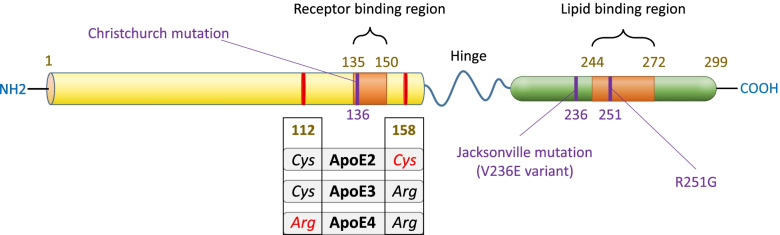
Fig. 1
Fig. 1
ApoE protein structure and mutations. The human apoE protein is characterized by three main domains, an N-terminal containing the receptor-binding region and a C-terminal domain where the lipid-binding region is located. A flexible hinge region joins N-terminal and C-terminal domains. Mutations at positions 112 and 158 will give rise to the most prevalent apoE isoforms, apoE2, apoE3, and apoE4. Other apoE variants characterized are the Christchurch mutation, which presents a Ser-136 variant [R136S]. ApoE Jacksonville mutation, also called V236E, variant is located at position 236 proximal to the lipid-binding region and reduces apoE self-aggregation. Lastly, the apoE R251G variant induces a single amino acid switch at position 251 and has been initially linked with decreased risk of suffering AD
Fig. 2
Fig. 2
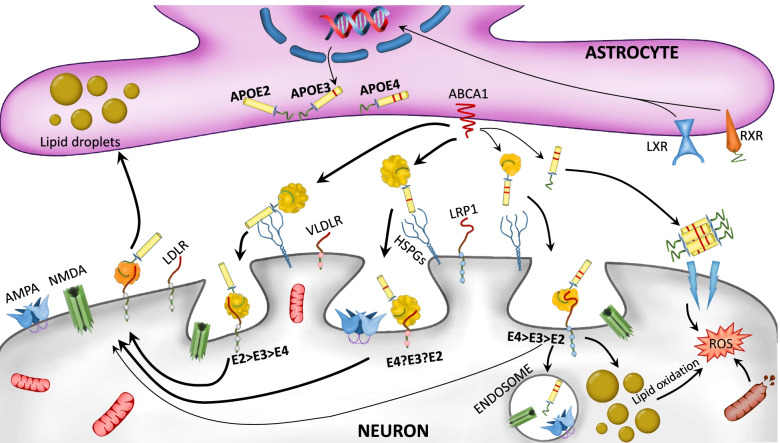
Roles of distinct APOE isoforms in astrocyte-neuron communication. The liver X receptor (LXR) and retinoid X receptor (RXR) activation regulate APOE isoforms expression in astrocytes. ATP-binding cassette transporter (ABCA1) is responsible for apoE lipidation and secretion to the extracellular space, so as to lipidate apoE already present in the extracellular space. ApoE can be later on recognized by several neuronal lipid receptors including VLDL-receptor (VLDLR), LDLR, Low-density lipoprotein receptor-related protein 1 (LRP1), and heparan sulfate proteoglycans (HSPGs). The distinct apoE isoform lipidation status promotes distinct receptor affinities. The apoE4 isoform presents alterations in its physiological pathways compared to other isoforms, such as low lipidation status, the formation of non-lipidated apoE4 aggregates, and a poor lipid turnover towards astrocytes, which leads to neuronal lipid-droplet accumulation. This promotes mitochondrial damage and reactive oxygen species (ROS) production. Moreover, apoE4 promotes endosome formation and degradation of synaptic receptors like AMPA or NMDA, leading to impaired synaptic function
Fig. 3
Fig. 3
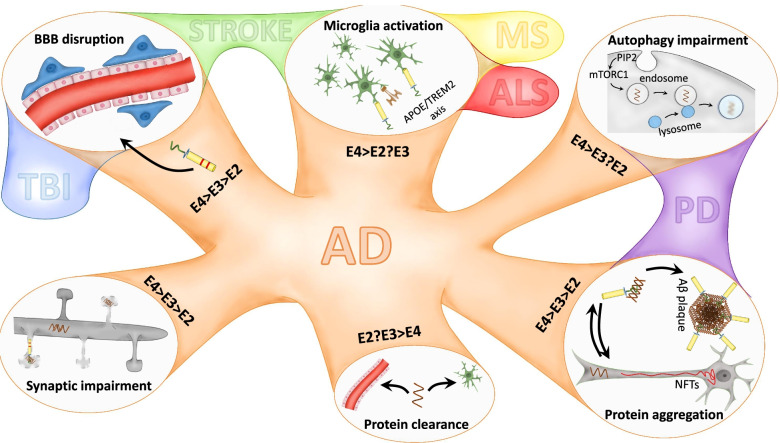
Mechanisms involved in apoE-related neurodegeneration. The influence of the APOE genotype has been associated with CNS diseases such as Alzheimer’s Disease (AD), Parkinson’s Disease (PD), Traumatic Brain Injury (TBI), Stroke, Amyotrophic Lateral Sclerosis (ALS), and Multiple Sclerosis (MS). In particular, APOE4 promotes synaptic impairment, amyloid-β (Aβ) protein seeding, aggregation, Aβ-plaque formation and defective protein clearance in AD. APOE4 will contribute to additional pathological features characteristic of AD, but also present in other CNS pathologies such as, for instance, impairment of the autophagy/endosomal system, altered microglial reactivity and neuroinflammation, and blood–brain barrier disruption

References

    1. Gauthier S, Rosa-Neto P, Morais JA, Webster C. World Alzheimer Report 2021: Journey through the diagnosis of dementia. London: Alzheimer’s Disease International; 2021.
    1. Wong W. Economic burden of Alzheimer disease and managed care considerations. Am J Manag Care. 2020;26(8 Suppl):S177–S183. - PubMed
    1. Hardy JA, Higgins GA. Alzheimer's disease: the amyloid cascade hypothesis. Science. 1992;256(5054):184–185. doi: 10.1126/science.1566067. - DOI - PubMed
    1. Haass C, et al. Trafficking and proteolytic processing of APP. Cold Spring Harb Perspect Med. 2012;2(5):a006270. doi: 10.1101/cshperspect.a006270. - DOI - PMC - PubMed
    1. Harris ME, et al. Direct evidence of oxidative injury produced by the Alzheimer's beta-amyloid peptide (1–40) in cultured hippocampal neurons. Exp Neurol. 1995;131(2):193–202. doi: 10.1016/0014-4886(95)90041-1. - DOI - PubMed

Publication types