Review
. 2022 Sep 24;13(1):482.
doi: 10.1186/s13287-022-03163-w.

Recent findings on chimeric antigen receptor (CAR)-engineered immune cell therapy in solid tumors and hematological malignancies

Affiliations
Review

Recent findings on chimeric antigen receptor (CAR)-engineered immune cell therapy in solid tumors and hematological malignancies

Ali Keshavarz et al. Stem Cell Res Ther. .

Abstract

Advancements in adoptive cell therapy over the last four decades have revealed various new therapeutic strategies, such as chimeric antigen receptors (CARs), which are dedicated immune cells that are engineered and administered to eliminate cancer cells. In this context, CAR T-cells have shown significant promise in the treatment of hematological malignancies. However, many obstacles limit the efficacy of CAR T-cell therapy in both solid tumors and hematological malignancies. Consequently, CAR-NK and CAR-M cell therapies have recently emerged as novel therapeutic options for addressing the challenges associated with CAR T-cell therapies. Currently, many CAR immune cell trials are underway in various human malignancies around the world to improve antitumor activity and reduce the toxicity of CAR immune cell therapy. This review will describe the comprehensive literature of recent findings on CAR immune cell therapy in a wide range of human malignancies, as well as the challenges that have emerged in recent years.

Keywords: CAR T-cell; CAR-M solid tumors; CAR-NK cell; Chimeric antigen receptors; Hematological malignancies; Immunotherapy.


Conflict of interest statement

There is no conflict of interests.

Figures
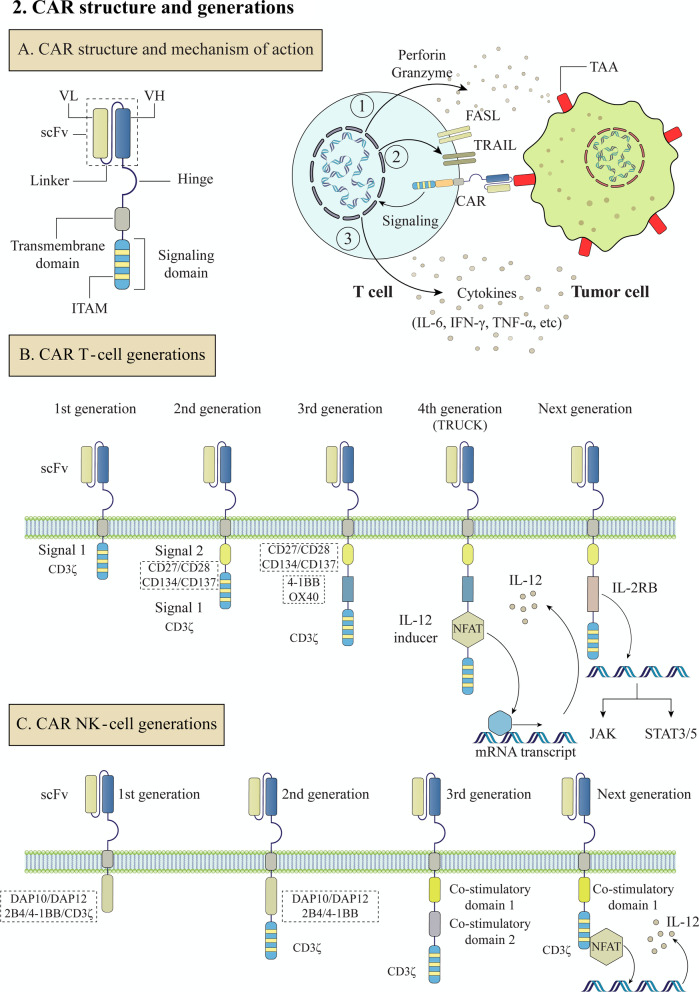
Fig. 1
Fig. 1
Chimeric antigen receptors' structure and generations. A CAR structure and mechanism of action. B CAR T-cell generations. C CAR NK-cell generations. Abbreviations: CAR (Chimeric antigen receptor), TAAs (tumor-associated antigens), NFAT (Nuclear factor of activated T-cells)
Fig. 2
Fig. 2
Tumor immunosuppressive microenvironment. The TME plays an important role in immune tolerance. The aspects of the complex TME that can sustain tumor growth, promote immune escape, and enhance immunosuppressive features are hypoxia, hypoglucosis, lactosis, acidity, and nutrient deprivation. Furthermore, changes in signal transduction molecules, the loss of tumor-specific antigens, stimulation of the inhibiting receptor CTLA-4 on T-cells, and some soluble molecules (IL-10, IL-35, type I IFNs, IDO, adenosine, VEGF-A, and TGF-) secreted by tumor cells or non-tumor cells in the TME all contribute to immune cell dysfunction. Moreover, the TME contains immunosuppressive cells (Tregs, MDSCs, TAMs, and CAFs) which contribute to immune cell dysfunction. Abbreviations: TME (tumor microenvironment), TSAs (tumor-specific antigens), CTLA-4 (cytotoxic T-lymphocyteassociated antigen 4), IFNs (interferons), IDO (Indoleamine 2,3-Dioxygenase), VEGF-A (vascular endothelial growth factor A), TGF-β, transforming growth factor-beta, Tregs (Regulatory T-cells), MDSCs (myeloid-derived suppressor cells), TAMs (tumor-associated macrophages), CAFs (cancer-associated fibroblasts)
Fig. 3
Fig. 3
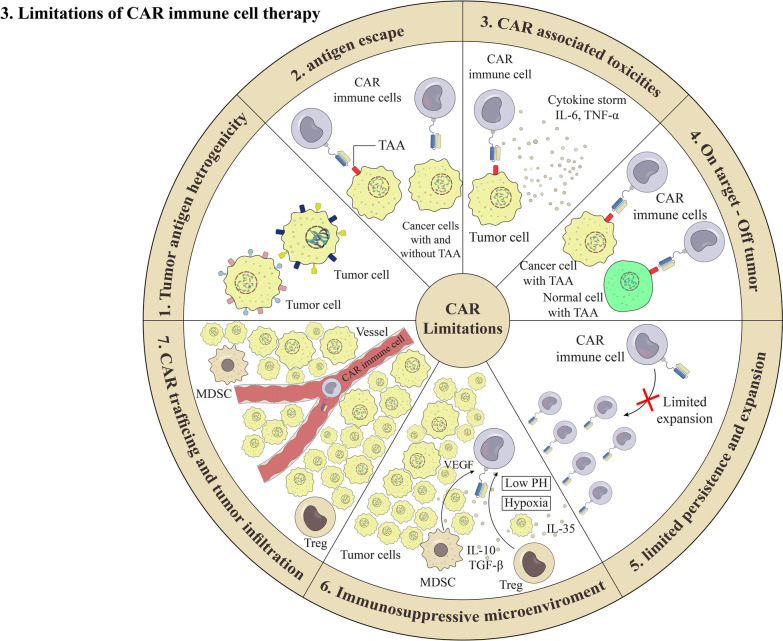
Limitations of chimeric antigen receptor (CAR) T cells. There are several limitations in using CAR-immune cells in tumor therapy, including antigen hetrogenicity, limit proliferation and short retention in tumor site, low trafficking and infiltration of CAR T cells to the tumor site, on target off tumor condition, cytokine release syndrome (CRS), and immunesuppressive TME. Abbreviations: PD-1 (programmed cell death protein 1), TAM (tumor associated macrophage), MDSC (Myeloidderived suppressor cell),T-reg (T regulatory), TAA (tumor associated antigen)

References

    1. Grupp SA, et al. Chimeric antigen receptor–modified T cells for acute lymphoid leukemia. N Engl J Med. 2013;368(16):1509–1518. doi: 10.1056/NEJMoa1215134. - DOI - PMC - PubMed
    1. Maude SL, et al. CD19-targeted chimeric antigen receptor T-cell therapy for acute lymphoblastic leukemia Blood. J Am Soc Hematol. 2015;125(26):4017–4023. - PMC - PubMed
    1. Hartmann J, et al. Clinical development of CAR T cells—challenges and opportunities in translating innovative treatment concepts. EMBO Mol Med. 2017;9(9):1183–1197. doi: 10.15252/emmm.201607485. - DOI - PMC - PubMed
    1. Rafiq S, Hackett CS, Brentjens RJ. Engineering strategies to overcome the current roadblocks in CAR T cell therapy. Nat Rev Clin Oncol. 2020;17(3):147–167. doi: 10.1038/s41571-019-0297-y. - DOI - PMC - PubMed
    1. Feins S, et al. An introduction to chimeric antigen receptor (CAR) T-cell immunotherapy for human cancer. Am J Hematol. 2019;94(S1):S3–S9. doi: 10.1002/ajh.25418. - DOI - PubMed

MeSH terms

Substances