


Hospital characteristics associated with COVID-19 mortality: data from the multicenter cohort Brazilian Registry
- PMID: 36153772
- PMCID: PMC9510333
- DOI: 10.1007/s11739-022-03092-9
Hospital characteristics associated with COVID-19 mortality: data from the multicenter cohort Brazilian Registry
Abstract
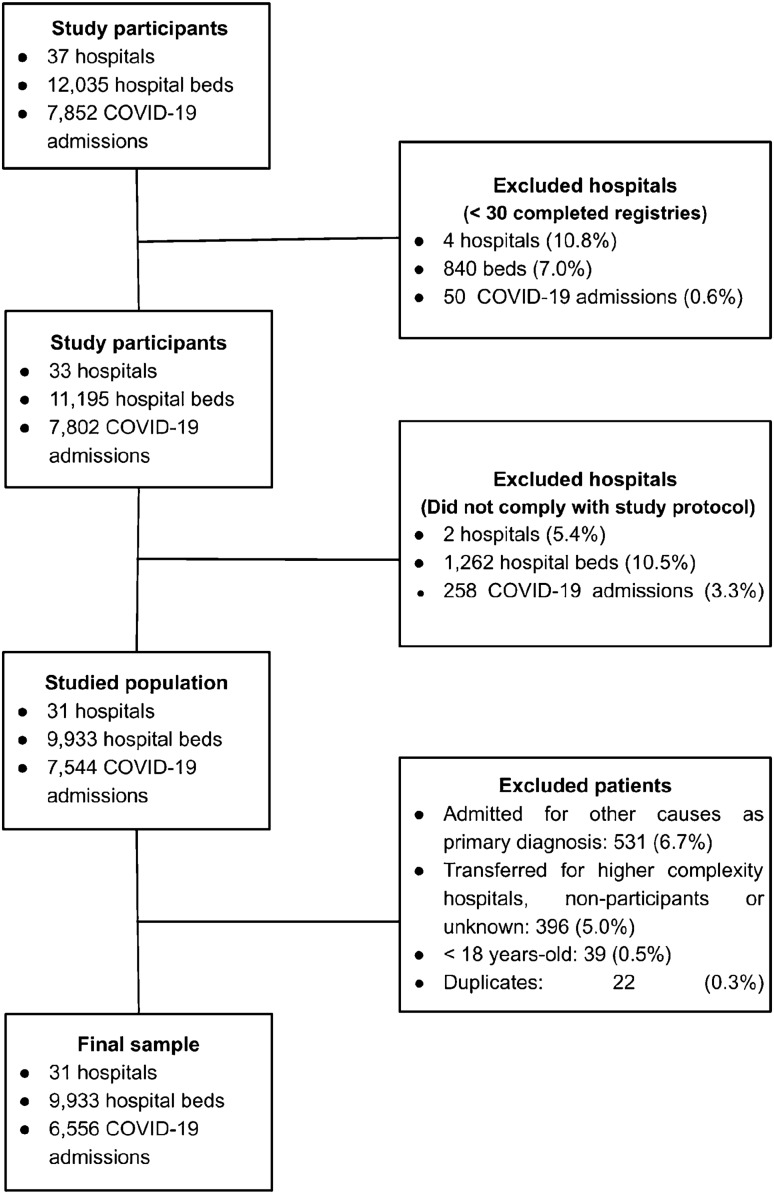
The COVID-19 pandemic caused unprecedented pressure over health care systems worldwide. Hospital-level data that may influence the prognosis in COVID-19 patients still needs to be better investigated. Therefore, this study analyzed regional socioeconomic, hospital, and intensive care units (ICU) characteristics associated with in-hospital mortality in COVID-19 patients admitted to Brazilian institutions. This multicenter retrospective cohort study is part of the Brazilian COVID-19 Registry. We enrolled patients ≥ 18 years old with laboratory-confirmed COVID-19 admitted to the participating hospitals from March to September 2020. Patients' data were obtained through hospital records. Hospitals' data were collected through forms filled in loco and through open national databases. Generalized linear mixed models with logit link function were used for pooling mortality and to assess the association between hospital characteristics and mortality estimates. We built two models, one tested general hospital characteristics while the other tested ICU characteristics. All analyses were adjusted for the proportion of high-risk patients at admission. Thirty-one hospitals were included. The mean number of beds was 320.4 ± 186.6. These hospitals had eligible 6556 COVID-19 admissions during the study period. Estimated in-hospital mortality ranged from 9.0 to 48.0%. The first model included all 31 hospitals and showed that a private source of funding (β = - 0.37; 95% CI - 0.71 to - 0.04; p = 0.029) and location in areas with a high gross domestic product (GDP) per capita (β = - 0.40; 95% CI - 0.72 to - 0.08; p = 0.014) were independently associated with a lower mortality. The second model included 23 hospitals and showed that hospitals with an ICU work shift composed of more than 50% of intensivists (β = - 0.59; 95% CI - 0.98 to - 0.20; p = 0.003) had lower mortality while hospitals with a higher proportion of less experienced medical professionals had higher mortality (β = 0.40; 95% CI 0.11-0.68; p = 0.006). The impact of those association increased according to the proportion of high-risk patients at admission. In-hospital mortality varied significantly among Brazilian hospitals. Private-funded hospitals and those located in municipalities with a high GDP had a lower mortality. When analyzing ICU-specific characteristics, hospitals with more experienced ICU teams had a reduced mortality.
Keywords: COVID-19; Healthcare; Hospital; Intensive care; Mortality.
© 2022. The Author(s), under exclusive licence to Società Italiana di Medicina Interna (SIMI).
Conflict of interest statement
The author(s) declared no potential conflicts of interest with respect to the research, authorship, and/or publication of this article.
Figures

References
-
- Noronha KVMS, Guedes GR, Turra CM, Andrade MV, Botega L, Nogueira D, et al. The COVID-19 pandemic in Brazil: analysis of supply and demand of hospital and ICU beds and mechanical ventilators under different scenarios. Cad Saude Publica. 2020;36(6):e00115320. doi: 10.1590/0102-311X00115320. - DOI - PubMed
-
- World Health Organization (2021) WHO Coronavirus (COVID-19) Dashboard. Avaliable from: https://covid19.who.int. Accessed: 27 Dec 2021
Publication types
MeSH terms
Grants and funding
LinkOut - more resources
Full Text Sources
Medical
