


Factors for the change in frailty status during the COVID-19 pandemic: A prospective cohort study over six- and 12-month periods in Japan
- PMID: 36155309
- PMCID: PMC9436893
- DOI: 10.1016/j.gerinurse.2022.08.014
Factors for the change in frailty status during the COVID-19 pandemic: A prospective cohort study over six- and 12-month periods in Japan
Abstract
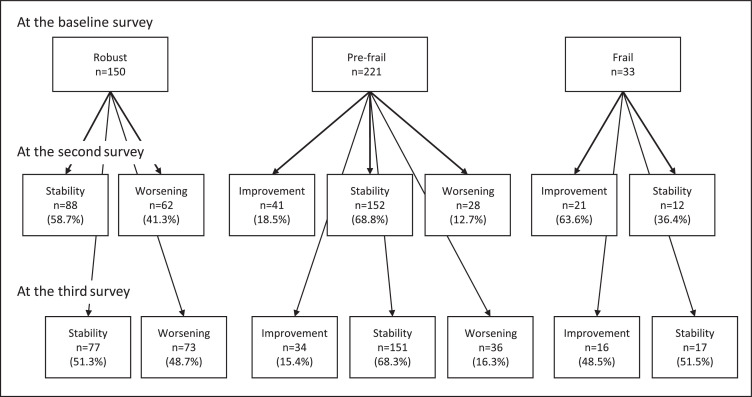
We aimed to verify the frailty status and the factors associated with the change in frailty status during the COVID-19 pandemic. A three-wave cohort study was conducted every six months, from May to July 2020, November 2020 to January 2021, and again from May to July 2021. The frailty status was assessed using the frailty screening index. Multivariate generalized linear mixed-effects models were used to determine whether changes in frailty status were associated with health conditions and lifestyle. The 404 survey forms were analyzed. Decline in chewing function (beta = 0.552) and leg muscle strength weakness (beta = 0.515) were significantly associated with the change in frailty status over six months, and leg muscle strength weakness (beta = 0.512) was significantly associated over 12 months. Risk factors associated with worsening health should be assessed for appropriate support. It is especially important to assess subjective leg muscle weakness in older adults.
Keywords: COVID-19; Community-dwelling; Frailty; Frailty transition.
Copyright © 2022 Elsevier Inc. All rights reserved.
Conflict of interest statement
Declaration of competing interest The authors have no declarations of interest.
Figures

References
-
- Salman D, Beaney T, E Robb C, et al. Impact of social restrictions during the COVID-19 pandemic on the physical activity levels of adults aged 50-92 years: a baseline survey of the CHARIOT COVID-19 Rapid Response prospective cohort study. BMJ Open. 2021;11 doi: 10.1136/bmjopen-2021-050680. - DOI - PMC - PubMed
MeSH terms
LinkOut - more resources
Full Text Sources
Medical
