


Long COVID symptoms in exposed and infected children, adolescents and their parents one year after SARS-CoV-2 infection: A prospective observational cohort study
- PMID: 36155957
- PMCID: PMC9495281
- DOI: 10.1016/j.ebiom.2022.104245
Long COVID symptoms in exposed and infected children, adolescents and their parents one year after SARS-CoV-2 infection: A prospective observational cohort study
Abstract
Background: Long COVID in children and adolescents remains poorly understood due to a lack of well-controlled studies with long-term follow-up. In particular, the impact of the family context on persistent symptoms following SARS-CoV-2 infection remains unknown. We examined long COVID symptoms in a cohort of infected children, adolescents, and adults and their exposed but non-infected household members approximately 1 year after infection and investigated clustering of persistent symptoms within households.
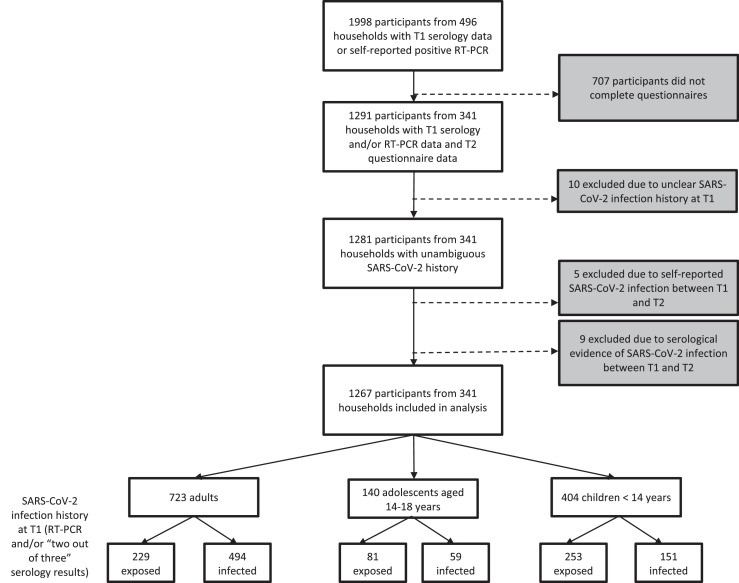
Methods: 1267 members of 341 households (404 children aged <14 years, 140 adolescents aged 14-18 years and 723 adults) were categorized as having had either a SARS-CoV-2 infection or household exposure to SARS-CoV-2 without infection, based on three serological assays and history of laboratory-confirmed infection. Participants completed questionnaires assessing the presence of long COVID symptoms 11-12 months after infection in the household using online questionnaires.
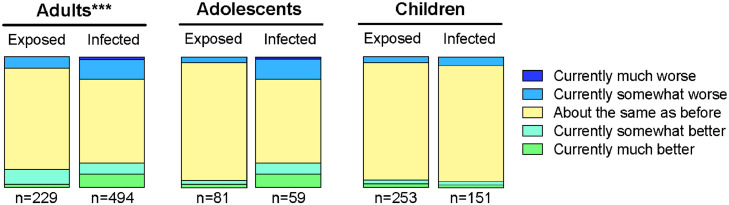
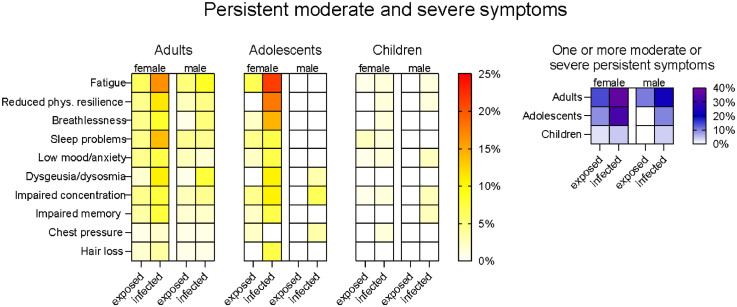
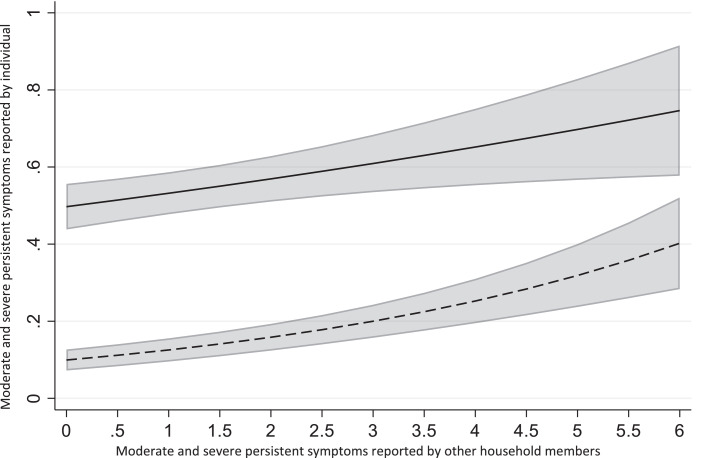
Findings: The prevalence of moderate or severe persistent symptoms was statistically significantly higher in infected than in exposed women (36.4% [95% CI: 30.7-42.4%] vs 14.2% [95% CI: 8.7-21.5%]), infected men (22.9% [95% CI: 17.9-28.5%] vs 10.3% [95% CI: 5.8-16.9%]) and infected adolescent girls (32.1% 95% CI: 17.2-50.5%] vs 8.9% [95%CI: 3.1-19.8%]). However, moderate or severe persistent symptoms were not statistically more common in infected adolescent boys aged 14-18 (9.7% [95% CI: 2.8-23.6%] or in infected children <14 years (girls: 4.3% [95% CI: 1.2-11.0%]; boys: 3.7% [95% CI: 1.1-9.6%]) than in their exposed counterparts (adolescent boys: 0.0% [95% CI: 0.0-6.7%]; girls < 14 years: 2.3% [95% CI: 0·7-6·1%]; boys < 14 years: 0.0% [95% CI: 0.0-2.0%]). The number of persistent symptoms reported by individuals was associated with the number of persistent symptoms reported by their household members (IRR=1·11, p=·005, 95% CI [1.03-1.20]).
Interpretation: In this controlled, multi-centre study, infected men, women and adolescent girls were at increased risk of negative outcomes 11-12 months after SARS-CoV-2 infection. Amongst non-infected adults, prevalence of negative outcomes was also high. Prolonged symptoms tended to cluster within families, suggesting family-level interventions for long COVID could prove useful.
Funding: Ministry of Science, Research and the Arts, Baden-Württemberg, Germany.
Keywords: Adolescents; COVID-19; Children and young people; Families; Long COVID; Paediatric; Post-COVID syndrome; SARS-CoV-2.
Copyright © 2022. Published by Elsevier B.V.
Conflict of interest statement
Declaration of interests The authors declare that they have no relevant conflicts of interest.
Figures
References
Publication types
MeSH terms
LinkOut - more resources
Full Text Sources
Medical
Miscellaneous
