Review
. 2022 May 3;8(4):275-285.
doi: 10.1159/000524475. eCollection 2022 Jul.

Chronic Kidney Disease and Cognitive Impairment: The Kidney-Brain Axis

Affiliations
Review

Chronic Kidney Disease and Cognitive Impairment: The Kidney-Brain Axis

Zuoquan Xie et al. Kidney Dis (Basel). .

Abstract

Background: Cognitive impairment, increasingly recognized as a major social burden, is commonly found in chronic kidney disease (CKD) patients.

Summary: Vascular damage, uremic toxicity, oxidative stress, and peripheral/central inflammation induced by CKD might be involved in brain lesions and ultimately result in cognitive decline. Uncovering the pathophysiology of CKD-associated cognitive impairment is important for early diagnosis and prevention, which undoubtedly prompts innovative pharmacological treatments.

Key messages: Here, we sequentially review the current understanding and advances in the epidemiology, risk factors, and pathological mechanisms of cognitive impairment in CKD. Furthermore, we summarize the currently available therapeutic strategies for cognitive impairment in CKD.

Keywords: Cognitive impairment; Kidney-brain axis; Mechanism; Treatment.


Conflict of interest statement

The authors have no conflicts of interest to declare.

Figures
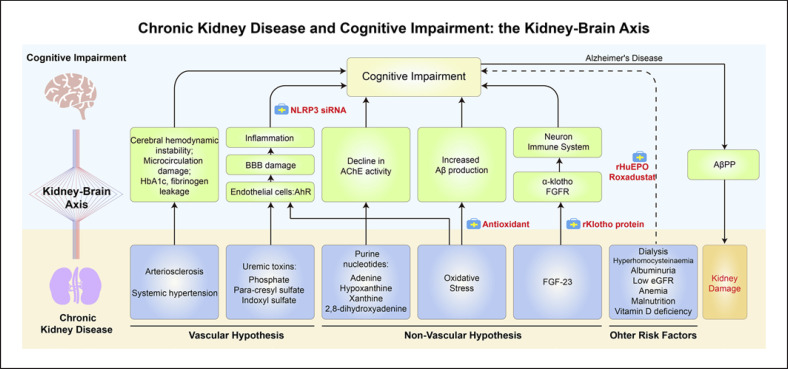
Fig. 1
Fig. 1
Schematic representation of the potential mechanism of cognitive impairment in patients with CKD and treatment strategies. In CKD-induced cognitive impairment, vascular hypothesis includes systemic hypertension, arteriosclerosis, and uremic toxin-related pathways. The nonvascular hypothesis contains purine nucleotides, oxidative stress, and FGF23-related pathways. These hypotheses together with other known factors such as albuminuria or anemia contribute to cognitive impairment. Specifically, CKD-related vascular damage can contribute to cognitive impairment by inducing impaired cerebral hemodynamics, altered brain microcirculation, or leakage of hemoglobin (HbA1c) and fibrinogen from vessels. Accumulation of uremic toxins, including phosphate, IS, and PCS, is agonists of the transcription factor AhR in endothelial cells. Activation of AhR leads to BBB disruption and subsequently increases the transportation of inflammatory immune cells and proteins into the brain. Purine nucleotides alter the activity of AChE which is associated with cognitive impairment. Oxidative stress leads to the cleavage of APP and Aβ production. Increased FGF23 directly impacts hippocampal neurons or interferes with the immune system. Therapies and interventions include inflammasome-targeted RNA interference approaches such as NLRP3 siRNA. The antioxidant drug 4-hydroxy-2,2,6,6-tetramethylpiperidine-N-oxyl shows potential to improve cognitive dysfunction in the CKD model. Recombinant klotho proteins are used to treat and/or prevent CKD by reducing inflammation and injury. For risk factors such as anemia, rHuEPO is the standard therapy and also acts as a neuroprotective agent. Roxadustat (FG-4592) is a PHD inhibitor that can stimulate endogenous EPO production. These anti-anemia drugs exhibit beneficial effects on CDK-induced cognitive impairment. In the context of AD, neuron-specific expressed Aβ can cause BACE-mediated kidney damage. PHD, prolyl-hydroxylase domain.

References

    1. http://ghdx.healthdata.org/gbd-results-tool .
    1. Drew DA, Weiner DE, Sarnak MJ. Cognitive impairment in CKD: pathophysiology, management, and prevention. Am J Kidney Dis. 2019 Dec;74((6)):782–90. - PMC - PubMed
    1. Kalantar-Zadeh K, Jafar TH, Nitsch D, Neuen BL, Perkovic V. Chronic kidney disease. Lancet. 2021 Aug 28;398((10302)):786–802. - PubMed
    1. Kurella Tamura M, Yaffe K. Dementia and cognitive impairment in ESRD: diagnostic and therapeutic strategies. Kidney Int. 2011 Jan;79((1)):14–22. - PMC - PubMed
    1. Kuo YT, Li CY, Sung JM, Chang CC, Wang JD, Sun CY, et al. Risk of dementia in patients with end-stage renal disease under maintenance dialysis-a nationwide population-based study with consideration of competing risk of mortality. Alzheimers Res Ther. 2019 Apr 9;11((1)):31. - PMC - PubMed