


Prevalence of smoking and smokeless tobacco use during breastfeeding: A cross-sectional secondary data analysis based on 0.32 million sample women in 78 low-income and middle-income countries
- PMID: 36159043
- PMCID: PMC9489519
- DOI: 10.1016/j.eclinm.2022.101660
Prevalence of smoking and smokeless tobacco use during breastfeeding: A cross-sectional secondary data analysis based on 0.32 million sample women in 78 low-income and middle-income countries
Abstract
Background: Smoking and smokeless tobacco use during the postpartum period is well studied in high-income countries, whereas low-income and middle-income countries (LMICs) lack evidence.
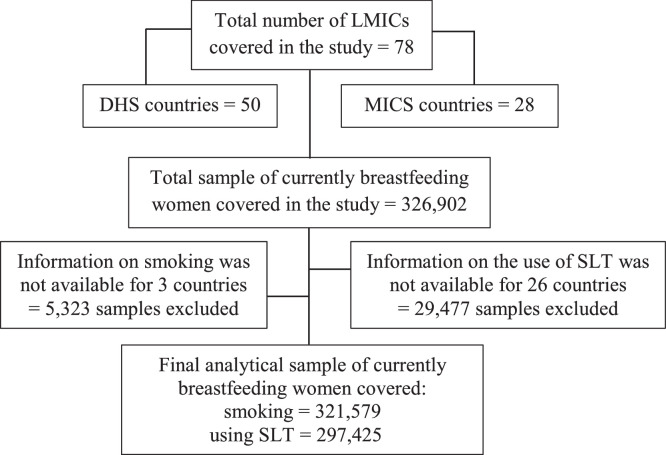
Methods: In this cross-sectional study we used data from the Demographic and Health Surveys (DHS) and Multiple Indicator Cluster Surveys (MICS) conducted in 78 LMICs between January 2010 and December 2019 to study tobacco use among 0.32 million sample lactating women. Age-standardized prevalence of smoking and smokeless tobacco use was estimated and presented with a 95% Confidence Interval (CI) for 78 LMICs. Pooled estimates overall and by WHO regions were obtained using random-effects meta-analyses. Country-level and community-level variance to understand contextual factors was also quantified using multilevel modelling.
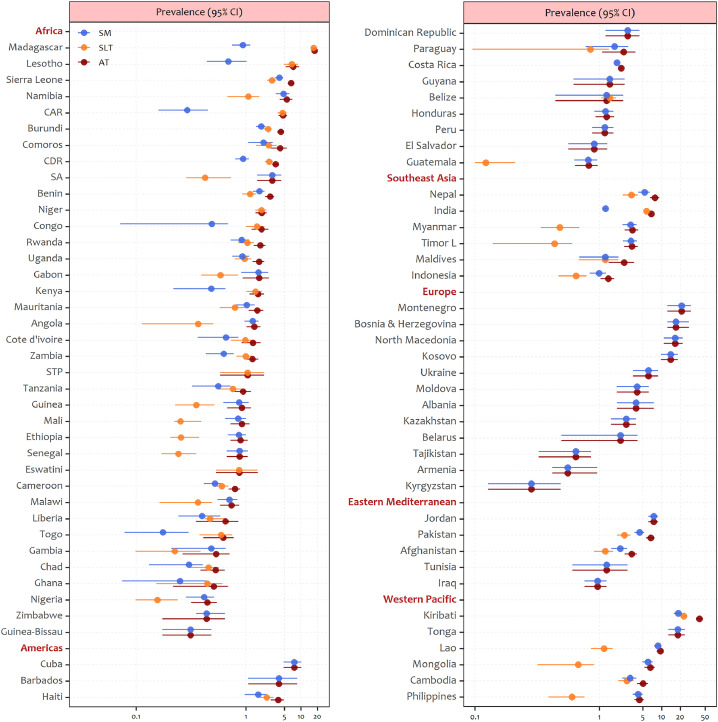
Findings: Pooled prevalence of any tobacco use among breastfeeding women in LMICs was 3.61% (95% CI 3.53-3.70); with the lowest prevalence in regions of the Americas (1.44%, 1.26-1.63) and the highest in the Southeast Asia region (6.13%, 6.0-6.27). The pooled prevalence of tobacco smoking was reported to be 1.16% (1.11-1.21), with the highest prevalence in the Eastern Mediterranean region (4.27%, 3.88-4.67) and the lowest in the African region (0.81%, 0.76-0.86). The pooled prevalence of smokeless tobacco use was reported to be 2.56% (2.49-2.63), with the highest prevalence in the Southeast Asia region (4.92%, 4.80-5.04). Illiterate and poor women in LMICs bore the enormous burden of tobacco use.
Interpretation: The prevalence of smoking and smokeless tobacco use among lactating women in LMICs varied considerably across different WHO regions. Considering the cross-sectional design of the study, caution is required while interpreting the results. To improve mothers' and children's health and nutrition outcomes and reduce health inequalities in LMICs, reducing tobacco use through evidence-based interventions is critical.
Funding: None.
Keywords: Breastfeeding; Lactating women; Low-income and middle-income countries; Smokeless tobacco; Smoking; WHO FCTC.
© 2022 The Author(s).
Conflict of interest statement
We declare no competing interests.
Figures
References
-
- WHO . World Health Organization; 2018. WHO Global Report on Trends in Prevalence of Tobacco Smoking 2000–2025.https://www.who.int/publications/i/item/who-global-report-on-trends-in-p...
-
- Macchi M, Bambini L, Franceschini S, Alexa ID, Agostoni C. The effect of tobacco smoking during pregnancy and breastfeeding on human milk composition—a systematic review. Eur J Clin Nutr. 2021;75(5):736–747. - PubMed
-
- Caleyachetty R, Tait CA, Kengne AP, Corvalan C, Uauy R, Echouff o-Tcheugui JB. Tobacco use in pregnant women: analysis of data from demographic and health surveys from 54 low-income and middle-income countries. Lancet Glob Heal. 2014;2(9):E513–E520. - PubMed
-
- Yang L, Wu H, Zhao M, Magnussen CG, Xi B. Prevalence and trends in tobacco use, secondhand smoke exposure at home and household solid fuel use among women in 57 low-and middle-income countries, 2000–2018. Environ Int. 2022;161 - PubMed
LinkOut - more resources
Full Text Sources
