


Socioeconomic inequalities in the 90-90-90 target, among people living with HIV in 12 sub-Saharan African countries - Implications for achieving the 95-95-95 target - Analysis of population-based surveys
- PMID: 36159044
- PMCID: PMC9489496
- DOI: 10.1016/j.eclinm.2022.101652
Socioeconomic inequalities in the 90-90-90 target, among people living with HIV in 12 sub-Saharan African countries - Implications for achieving the 95-95-95 target - Analysis of population-based surveys
Abstract
Background: Inequalities undermine efforts to end AIDS by 2030. We examined socioeconomic inequalities in the 90-90-90 target among people living with HIV (PLHIV) -men (MLHIV), women (WLHIV) and adolescents (ALHIV).
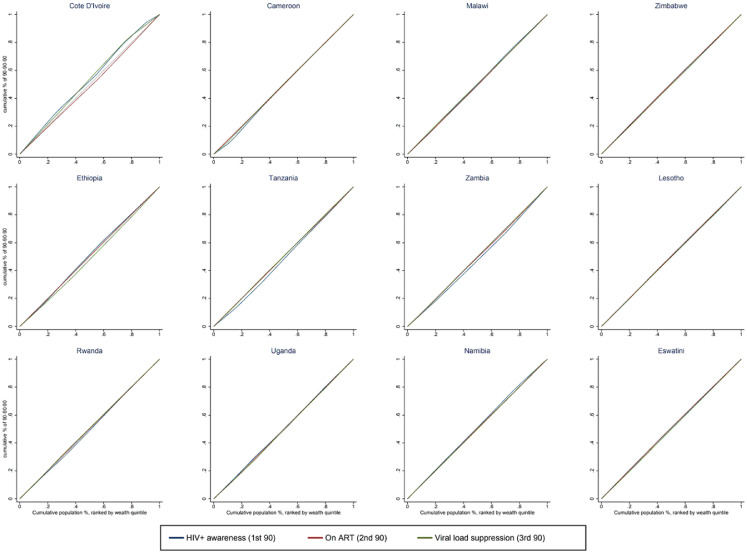
Methods: We analysed the available Population HIV Impact Assessment (PHIA) survey data for each of the 12 sub-Saharan African countries, collected between 2015 and 2018 to estimate the attainment of each step of the 90-90-90 target by wealth quintiles. We constructed concentration curves, computed concentration indices (CIX) -a negative (positive) CIX indicated pro-poor (pro-rich) inequalities- and identified factors associated with, and contributing to inequality.
Findings: Socioeconomic inequalities in achieving the 90-90-90 target components among PLHIV were noted in 11 of the 12 countries surveyed: not in Rwanda. Awareness of HIV positive status was pro-rich in 5/12 countries (Côte d'Ivoire, Tanzania, Uganda, Malawi, and Zambia) ranging from CIX=0·085 (p< 0·05) in Tanzania for PLHIV, to CIX = 0·378 (p<0·1) in Côte d'Ivoire for ALHIV. It was pro-poor in 5/12 countries (Côte d'Ivoire, Ethiopia, Malawi, Namibia and Eswatini), ranging from CIX = -0·076 (p<0·05) for PLHIV in Eswatini, and CIX = -0·192 (p<0·05) for WLHIV in Ethiopia. Inequalities in accessing ART were pro-rich in 5/12 countries (Cameroun, Tanzania, Uganda, Malawi and Zambia) ranging from CIX=0·101 (p<0·05) among PLHIV in Zambia to CIX=0·774 (p<0·1) among ALHIV in Cameroun and pro-poor in 4/12 countries (Tanzania, Zimbabwe, Lesotho and Eswatini), ranging from CIX = -0·072 (p<0·1) among PLHIV in Zimbabwe to CIX = -0·203 (p<0·05) among WLHIV in Tanzania. Inequalities in HIV viral load suppression were pro-rich in 3/12 countries (Ethiopia, Uganda, and Lesotho), ranging from CIX = 0·089 (p< 0·1) among PLHIV in Uganda to CIX = 0·275 (p<0·01) among WLHIV in Ethiopia. Three countries (Tanzania CIX = 0·069 (p< 0·5), Uganda CIX = 0·077 (p< 0·1), and Zambia CIX = 0·116 (p< 0·1)) reported pro-rich and three countries (Côte d'Ivoire CIX = -0·125 (p< 0·1), Namibia CIX = -0·076 (p< 0·05), and Eswatini CIX = -0·050 (p< 0·05) pro-poor inequalities for the cumulative CIX for HIV viral load suppression. The decomposition analysis showed that age, rural-urban residence, education, and wealth were associated with and contributed the most to inequalities observed in achieving the 90-90-90 target.
Interpretation: Some PLHIV in 11 of 12 countries were not receiving life-saving HIV testing, treatment, or achieving HIV viral load suppression due to socioeconomic inequalities. Socioeconomic factors were associated with and explained the inequalities observed in the 90-90-90 target among PLHIV. Governments should scale up equitable 95-95-95 target interventions, prioritizing the reduction of age, rural-urban, education and wealth-related inequalities. Research is needed to understand interventions to reduce socioeconomic inequities in achieving the 95-95-95 target.
Funding: This study was supported by the Swiss National Science Foundation (grant 202660).
Keywords: 90–90–90 target; 95–95–95 target; Concentration Index; Decomposition approach; Equity; HIV care cascade; Socioeconomic inequalities.
© 2022 The Author(s).
Conflict of interest statement
David Chipanta works for UNAIDS All authors declare no conflict of interest.
Figures

References
-
- UNAIDS, Joint United Nations Programme on HIV/AIDS . 2684th Ed. Joint United Nations Programme on HIV/AIDS; Geneva: 2014. 90-90-90 An ambitious treatment target to help end the AIDS epidemic. Report No.: UNAIDS / JC2684.
-
- UNAIDS, Joint United Nations Programme on HIV/AIDS . UNAIDS, Joint United Nations Programme on HIV/AIDS; Geneva: 2021. Global AIDS Update. Report No.: UNAIDS/JC3020E. - PubMed
-
- United Nations General Assembly . United Nations General Assembly; New York: 2021. Ending inequalities and Getting on Track to End AIDS by 2030. Report No.: 74th Plenary meeting.
LinkOut - more resources
Full Text Sources
