


Pressurized intraperitoneal aerosol chemotherapy (PIPAC) in multimodal therapy for patients with oligometastatic peritoneal gastric cancer: a randomized multicenter phase III trial PIPAC VEROne
- PMID: 36159218
- PMCID: PMC9467896
- DOI: 10.1515/pp-2022-0111
Pressurized intraperitoneal aerosol chemotherapy (PIPAC) in multimodal therapy for patients with oligometastatic peritoneal gastric cancer: a randomized multicenter phase III trial PIPAC VEROne
Abstract
Objectives: Peritoneal carcinomatosis is the most frequent site of metastases in patients with gastric cancer. Current standard treatment is palliative systemic chemotherapy with very poor prognosis. Cytoreductive surgery (CRS) combined with hyperthermic intraperitoneal chemotherapy (HIPEC) resulted in long-term benefits in selected patients. Among patients with peritoneal carcinomatosis, a distinctive subset is oligometastatic disease which is characterized by low metastatic burden. Pressurized intraperitoneal aerosol chemotherapy (PIPAC) is a recent technique of intraperitoneal chemotherapy used in combination with systemic chemotherapy with promising results.
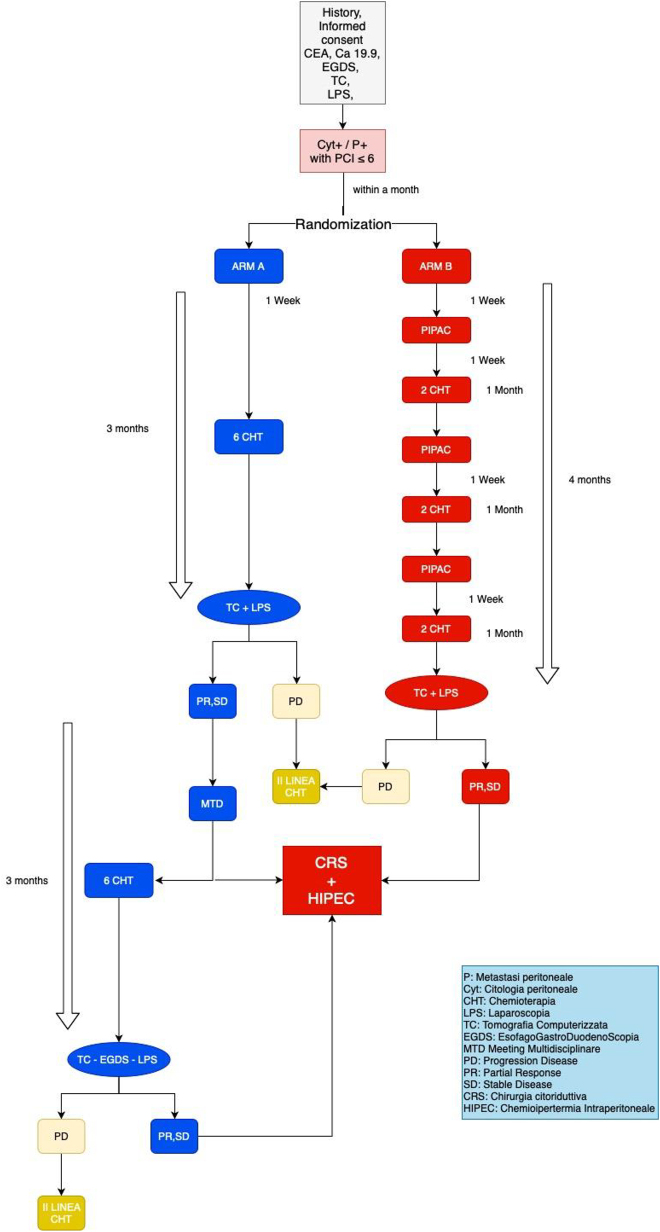
Methods: PIPAC VER-One is a prospective, randomized, multicenter phase III clinical trial that aims to evaluate the effectiveness of the use of PIPAC in combination with systemic chemotherapy in patients with gastric cancer and synchronous positive peritoneal cytology and/or limited peritoneal metastases (peritoneal cancer index [PCI] ≤6). Patients will be randomized into two arms: arm A (control) treated with standard systemic chemotherapy and arm B (experimental) treated with a bidirectional scheme including PIPAC and systemic chemotherapy.
Results: Primary endpoint is the secondary resectability rate. Secondary endpoints are: overall survival (OS), pregression-free survival (PFS), disease-free survival (DFS), histological response assessed both on primary tumor and peritoneal lesions, quality of life (QoL), complication rate (CTCAE v5), and incremental cost-effectiveness ratios (ICER).
Conclusions: The role of PIPAC in multimodal treatment for oligometastatic gastric cancer will be investigated in this trial.
Keywords: PIPAC; gastric cancer; intraperitoneal chemotherapy; peritoneal metastases; systemic chemotherapy.
© 2022 Francesco Casella et al., published by De Gruyter, Berlin/Boston.
Conflict of interest statement
Competing interests: Authors state no conflict of interest.
References
-
- Al-Batran SE, Goetze TO, Mueller DW, Vogel A, Winkler M, Lorenzen S, et al. The RENAISSANCE (AIO-FLOT5) trial: effect of chemotherapy alone vs. chemotherapy followed by surgical resection on survival and quality of life in patients with limited-metastatic adenocarcinoma of the stomach or esophagogastric junction—a phase III trial of the German AIO/CAO-V/CAOGI. BMC Cancer. 2017;17:893. doi: 10.1186/s12885-017-3918-9. - DOI - PMC - PubMed
-
- Al-Batran SE, Homann C, Pauligk C, Illerhaus G, Martens UM, Stoehlmacher J, et al. Effect of neoadjuvant chemotherapy followed by surgical resection on survival in patients with limited metastatic gastric or gastroesophageal junction cancer. The AIO-FLOT3 trial. JAMA Oncol. 2017;3:1237–44. doi: 10.1001/jamaoncol.2017.0515. - DOI - PMC - PubMed
LinkOut - more resources
Full Text Sources
Miscellaneous