. 2022 Sep 8:13:986946.
doi: 10.3389/fphar.2022.986946. eCollection 2022.

An acetonic extract and secondary metabolites from the endolichenic fungus Nemania sp. EL006872 exhibit immune checkpoint inhibitory activity in lung cancer cell

Affiliations

An acetonic extract and secondary metabolites from the endolichenic fungus Nemania sp. EL006872 exhibit immune checkpoint inhibitory activity in lung cancer cell

Mücahit Varlı et al. Front Pharmacol. .

Abstract

Background: Endolichenic fungi (ELF), which live the inside the lichen thallus, contain many secondary metabolites that show various biological activities. Recent studies show that lichen and ELF secondary metabolites have antioxidant, antibacterial, antifungal, cytotoxic, and anticancer activities. Purpose: Here, the effects of an ELF extract and its bioactive compounds were investigated on the H1975 cell line focusing on immune checkpoint marker inhibition. Methods: An ELF was isolated from the host lichen Bryoria fuscescens (Gyelnik) Brodo and D. Hawksw and identified the species as Nemania sp. EL006872. The fungus was cultured on agar medium and acetonic extracts were obtained. Secondary metabolites radianspenes C and D, and dahliane D, were isolated from the crude extract. The biological effects of both the crude extract and the isolated secondary metabolites were evaluated in cell viability, qRT-PCR assays, flow cytometry analysis and western blotting. Results: The cell viability assay revealed that extracts from Nemania sp. EL006872 and the isolated secondary compounds had low cytotoxicity. The crude extract, radianspenes C and D, and dahliane D, suppressed expression of mRNA encoding PD-L1 and aromatic hydrocarbon receptor (AhR), and surface expression of PD-L1 protein by cells exposed to benzo[a] pyrene. Radianspenes C and D, and dahliane D, reduced expression of AhR, PD-L1, ICOSL, and GITRL proteins by H1975 lung cancer cells, as well as exerting anti-proliferative effects. Conclusion: Radianspenes C and D, and dahliane D, bioactive compounds isolated from Nemania sp. EL006872 ELF, have the potential for use as immunotherapy and immunoncology treatments.

Keywords: Nemania sp.; benzo[a]pyrene; dahliane D; immune checkpoints; inducible T Cell costimulator ligand; programmed death-ligand 1; radianspenes C and D.


Conflict of interest statement

The authors declare that the research was conducted in the absence of any commercial or financial relationships that could be construed as a potential conflict of interest.

Figures
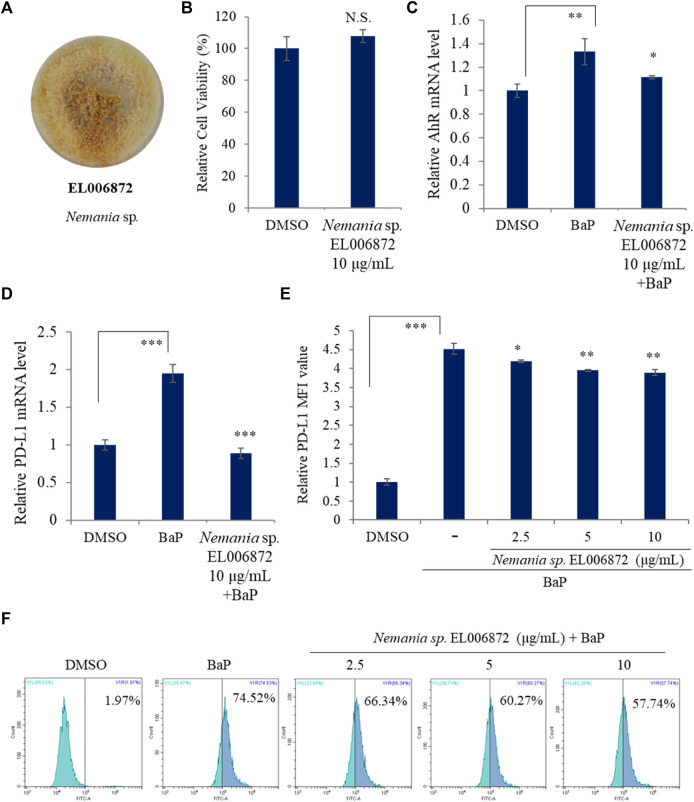
FIGURE 1
FIGURE 1
Nemania sp. EL006872 inhibits expression of PD-L1 and AhR. (A) Images of the isolated endolichenic fungus EL006872. (B) Effect of Nemania sp. EL006872 crude extract on the viability of H1975 cells. (C,D) Effect of Nemania sp. EL006872 crude extract on PD-L1 and aromatic hydrocarbon receptor (AhR) mRNA in benzo[a]pyrene (BaP) exposed H1975 cells. (E,F) Effects of Nemania sp. EL006872 crude extract on surface protein level of PD-L1 in BaP exposed H1975 cells. MFI: mean fluorescence intensity. Data are presented as the mean ± S.D. (standard deviation); n = 3. *p < 0.05; **p < 0.01; ***p < 0.001; NS, no significant difference compared with the BaP-treated group or between indicated group.
FIGURE 2
FIGURE 2
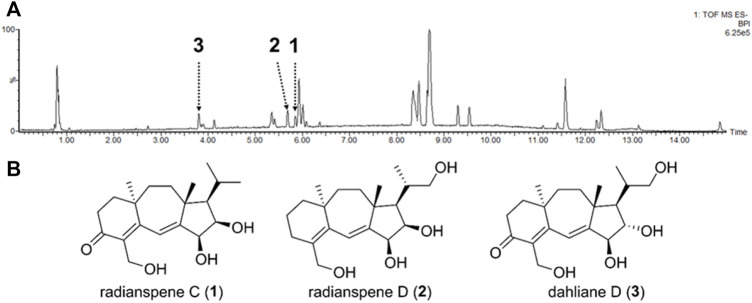
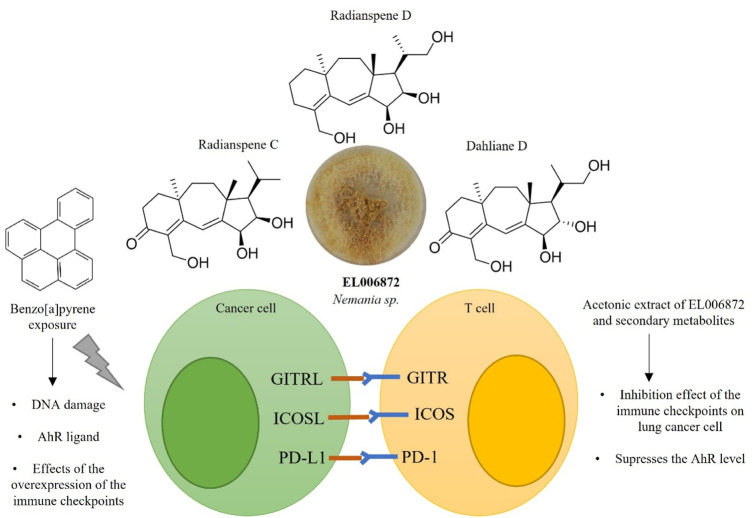
Chemical structures of radianspenes C and D, and dahliane D. (A) LC-MS base peak ion chromatogram (negative ion mode) of the Nemania sp. EL006872 crude extract. The isolated compounds were denoted. It should be noted that the intensities of chromatographic peaks do not represent absolute quantity of each compound, because the MS signal intensity is heavily affected by ionization efficiency of each molecule. (B) Chemical structures of radianspenes C and D, and dahliane D.
FIGURE 3
FIGURE 3
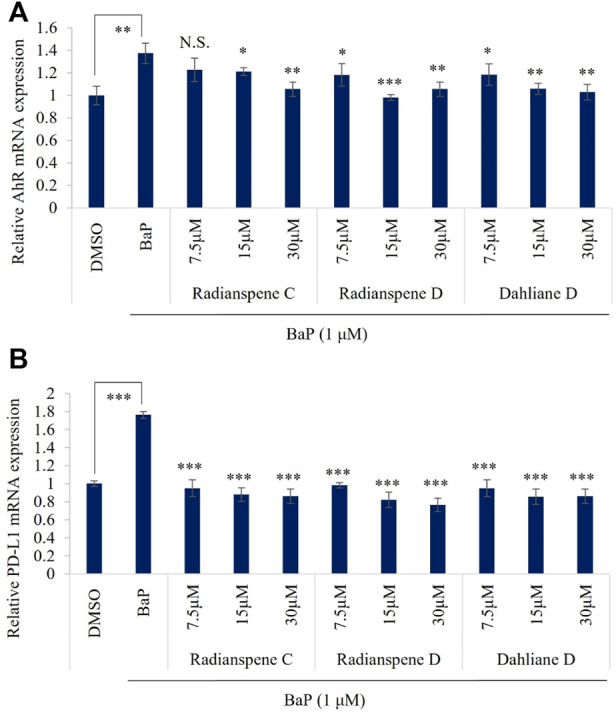
Radianspenes C and D, and dahliane D, suppress benzo[a]pyrene (BaP)-induced expression of AhR and PD-L1 mRNA. H1975 cells were treated with radianspene C and, D and dahliane D, at 7.5, 15, and 30 µM ( ~ 2.5, 5, 10 µg/mL) 4 h prior to exposure benzo[a]pyrene (1 µM) and then cells were incubated for 72 h, AhR (A) and PD-L1 (B) mRNA level was measured using qRT-PCR. *p < 0.05; **p < 0.01; ***p < 0.001; NS, no significant difference when compared with the BaP-treated group or between indicated group.
FIGURE 4
FIGURE 4
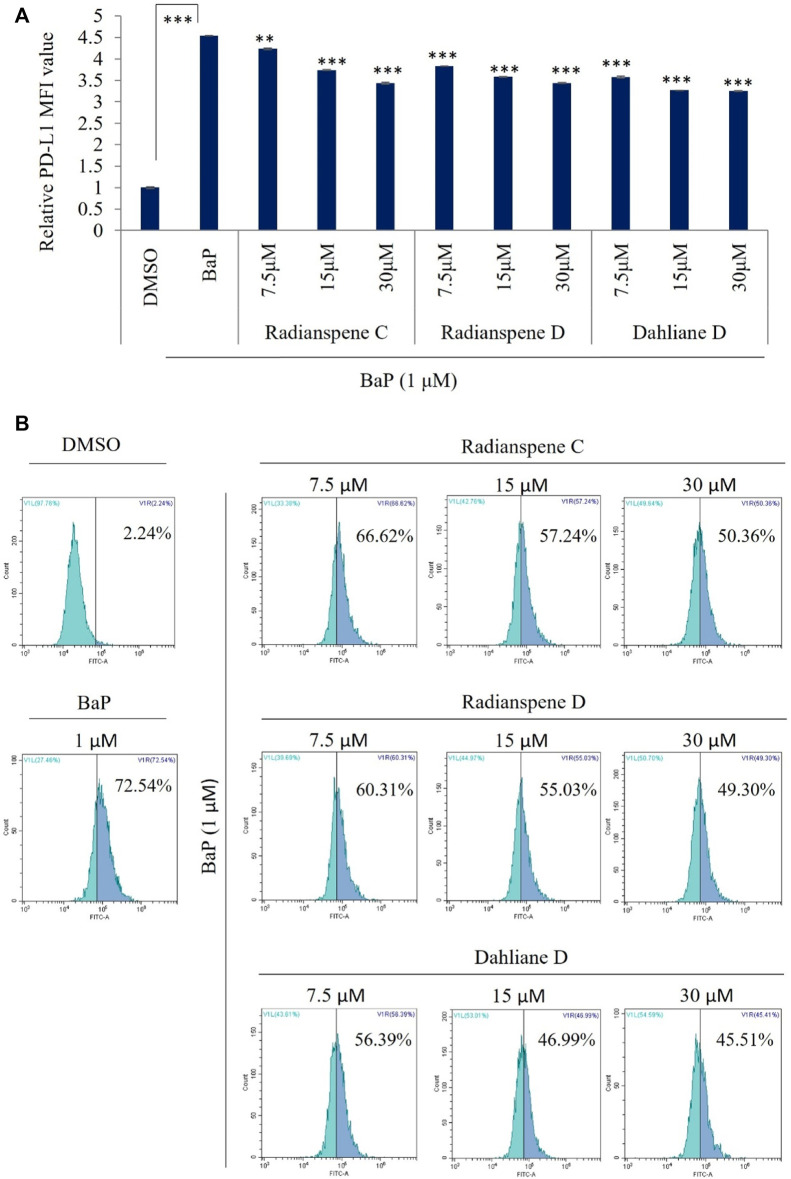
Evaluated the the PD-L1 surface protein activity on benzo[a]pyrene induction condition, treated with radianspenes C and D, and dahliane D. H1975 cells were treated with radianspenes C and, D and dahliane D, at 7.5, 15, and 30 µM ( ~2.5, 5, 10 µg/mL) 4 h prior to exposure benzo[a]pyrene (1 µM) and then cells were incubated for 72 h, and PD-L1 surface protein level was measured using flow cytometry. Relative PD-L1 MFI value was determined by flow cytometry (A,B). MFI: mean fluorescence intensity. *p < 0.05; **p < 0.01; ***p < 0.001; NS, no significant difference when compared with the BaP-treated group or between indicated group.
FIGURE 5
FIGURE 5
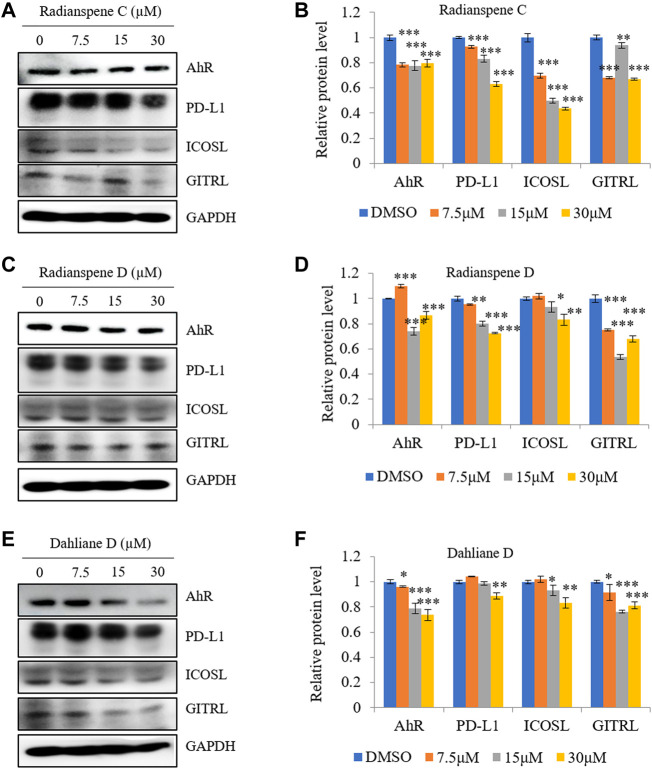
Effect of radianspenes C and D, and dahliane D, on expression of AhR, PD-L1, ICOSL, and GITRL. The level of AhR, PD-L1, ICOSL and GITRL protein by radianspenes C (A,B) and D (C,D), and dahliane D (E,F) treatment were shown. Data are presented as the mean ± SD, n = 3. *p < 0.05; **p < 0.01; ***p < 0.001 compared with the DMSO-treated group.
FIGURE 6
FIGURE 6
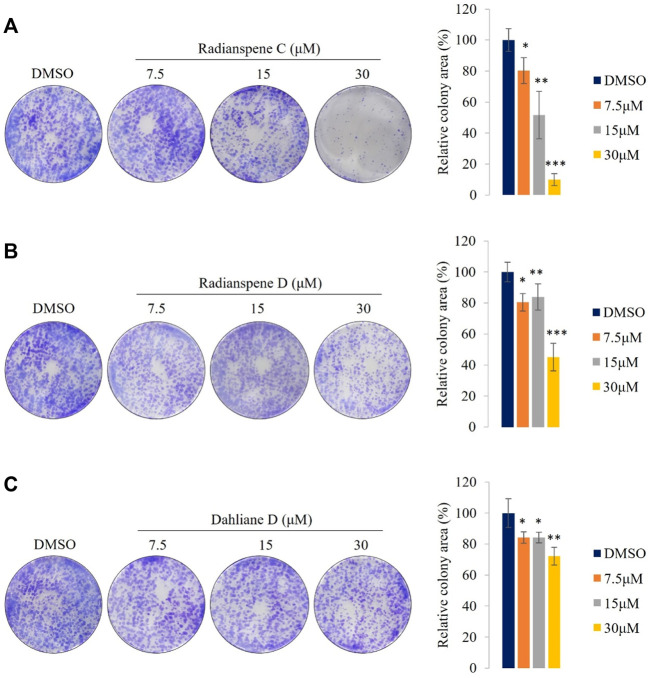
Radianspenes C and D, and dahliane D, show anti-proliferative effects against H1975 cells. (A) Radianspene C, (B) radianspene D, and (C) dahliane D show anti-proliferative activity in a clonogenic assay. Representative images are shown, alongside histograms showing the percentage of colony area in each condition. Data are presented as the mean ± SD, n = 3. *p < 0.05; **p < 0.01; ***p < 0.001 compared with the DMSO-treated group.
FIGURE 7
FIGURE 7
Schematic overview of the immune checkpoint inhibitory activity of diterpenoid compounds isolated from Nemania sp. EL006872.

References

    1. Agrawal S., Deshmukh S. K., Reddy M. S., Prasad R., Goel M. (2020). Endolichenic fungi: A hidden source of bioactive metabolites. South Afr. J. Bot. 134, 163–186. 10.1016/j.sajb.2019.12.008 - DOI
    1. Amatore F., Gorvel L., Olive D. (2020). Role of Inducible Co-Stimulator (ICOS) in cancer immunotherapy. Expert Opin. Biol. Ther. 20, 141–150. 10.1080/14712598.2020.1693540 - DOI - PubMed
    1. Aygün S. F., Kabadayi F. (2005). Determination of benzo[a]pyrene in charcoal grilled meat samples by HPLC with fluorescence detection. Int. J. Food Sci. Nutr. 56, 581–585. 10.1080/09637480500465436 - DOI - PubMed
    1. Borghaei H., Paz-Ares L., Horn L., Spigel D. R., Steins M., Ready N. E., et al. (2015). Nivolumab versus docetaxel in advanced nonsquamous non–small-cell lung cancer. N. Engl. J. Med. 373, 1627–1639. 10.1056/nejmoa1507643 - DOI - PMC - PubMed
    1. Buchbinder E. I., Desai A. (2016). CTLA-4 and PD-1 pathways similarities, differences, and implications of their inhibition. Am. J. Clin. Oncol. 39, 98–106. 10.1097/COC.0000000000000239 - DOI - PMC - PubMed