


Post‑COVID‑19 syndrome in children (Review)
- PMID: 36160884
- PMCID: PMC9468832
- DOI: 10.3892/etm.2022.11547
Post‑COVID‑19 syndrome in children (Review)
Abstract
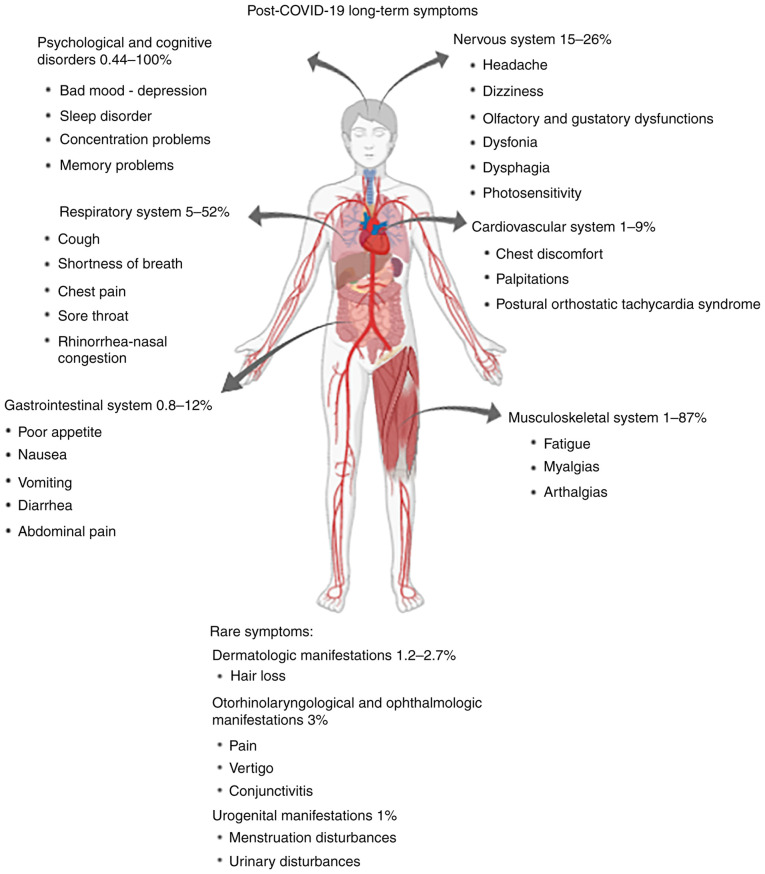
The persistence of symptoms for a long time after severe acute respiratory syndrome coronavirus 2 (SARS-CoV-2) infection is now familiar as post-COVID syndrome (PCS). To the best of our knowledge, the risk of long-term clinical outcomes in children after SARS-CoV-2 infection is still unclear. Unlike in adults, current evidence suggests a lower prevalence of persistent symptoms in children. However, since several studies are characterized by great heterogeneity, it is difficult to accurately estimate the exact incidence of PCS in children. The presence and course of recovery depend on risk factors that are more common in adults than children. Proposed pathophysiological mechanisms in PCS in children include age-dependent immune responses, angiotensin-converting enzyme 2 expression, blood-brain barrier development or social issues affecting children behavior, such as school closure and social isolation. However, further longitudinal studies are required for unanswered issues to be clarified. The aim of the present review is to describe the long-term symptoms per biological system in children, potential risk factors and the role of the immune system in the presence of PCS.
Keywords: children; clinical manifestations; coronavirus disease 2019; post-COVID syndrome; severe acute respiratory syndrome coronavirus 2.
Copyright: © Filippatos et al.
Conflict of interest statement
The authors declare that they have no competing interests.
Figures
References
-
- Center for Systems Science and Engineering: COVID-19 Map-Johns Hopkins coronavirus resource center. Johns Hopkins Coronavirus Resource Center, 2021.
-
- Collins FS. NIH launches new initiative to study ‘Long COVID’. National Institutes of Health (NIH), Bethesda, MD, 2021.
-
- Ahmed H, Patel K, Greenwood DC, Halpin S, Lewthwaite P, Salawu A, Eyre L, Breen A, O'Connor R, Jones A, Sivan M. Long-term clinical outcomes in survivors of severe acute respiratory syndrome and middle east respiratory syndrome coronavirus outbreaks after hospitalisation or ICU admission: A systematic review and meta-analysis. J Rehabil Med. 2020;52(jrm00063) doi: 10.2340/16501977-2694. - DOI - PubMed
Publication types
LinkOut - more resources
Full Text Sources
Miscellaneous