Impact of cerebral hypoperfusion-reperfusion on optic nerve integrity and visual function in the DBA/2J mouse model of glaucoma
- PMID: 36161839
- PMCID: PMC9476133
- DOI: 10.1136/bmjophth-2022-001078
Impact of cerebral hypoperfusion-reperfusion on optic nerve integrity and visual function in the DBA/2J mouse model of glaucoma
Abstract
Objective: One of the most important risk factors for developing a glaucomatous optic neuropathy is elevated intraocular pressure. Moreover, mechanisms such as altered perfusion have been postulated to injure the optical path. In a mouse model, we compare first negative effects of cerebral perfusion/reperfusion on the optic nerve structure versus alterations by elevated intraocular pressure. Second, we compare the alterations by isolated hypoperfusion-reperfusion and isolated intraocular pressure to the combination of both.
Methods and analysis: Mice were divided in four groups: (1) controls; (2) perfusion altered mice that underwent transient bi-common carotid artery occlusion (BCCAO) for 40 min; (3) glaucoma group (DBA/2J mice); (4) combined glaucoma and altered perfusion (DBA/2J mice with transient BCCAO). Optic nerve sections were stereologically examined 10-12 weeks after intervention.
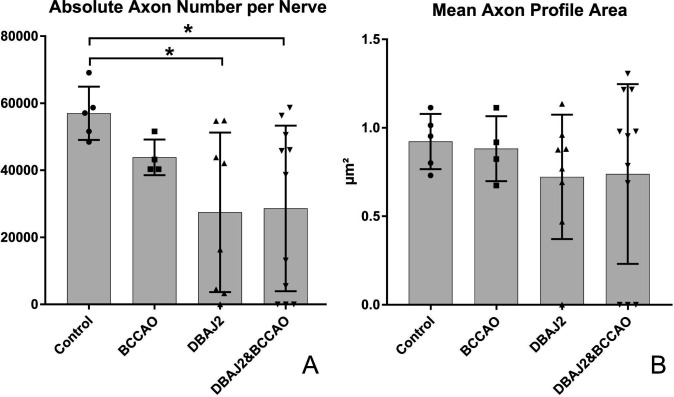
Results: All experimental groups showed a decreased total axon number per optic nerve compared with controls. In DBA/2J and combined DBA/2J & BCCAO mice the significant decrease was roughly 50%, while BCCAO leaded to a 23% reduction of axon number, however reaching significance only in the direct t-test. The difference in axon number between BCCAO and both DBA/2J mice was almost 30%, lacking statistical significance due to a remarkably high variation in both DBA/2J groups.
Conclusion: Elevated intraocular pressure in the DBA/2J mouse model of glaucoma leads to a much more pronounced optic nerve atrophy compared with transient forebrain hypoperfusion and reperfusion by BCCAO. A supposed worsening effect of an altered perfusion added to the pressure-related damage could not be detected.
Keywords: Anatomy; Experimental & animal models; Glaucoma; Optic Nerve.
© Author(s) (or their employer(s)) 2022. Re-use permitted under CC BY-NC. No commercial re-use. See rights and permissions. Published by BMJ.
Conflict of interest statement
Competing interests: None declared.
Figures
References
-
- GBD 2019 Blindness and Vision Impairment Collaborators, Vision Loss Expert Group of the Global Burden of Disease Study . Causes of blindness and vision impairment in 2020 and trends over 30 years, and prevalence of avoidable blindness in relation to vision 2020: the right to sight: an analysis for the global burden of disease study. Lancet Glob Health 2021;9:e144–60. 10.1016/S2214-109X(20)30489-7 - DOI - PMC - PubMed