


The association of mindfulness and psychological well-being among individuals who have recovered from COVID-19 in Jianghan District, Wuhan, China: A cross-sectional study
- PMID: 36162667
- PMCID: PMC9502442
- DOI: 10.1016/j.jad.2022.09.062
The association of mindfulness and psychological well-being among individuals who have recovered from COVID-19 in Jianghan District, Wuhan, China: A cross-sectional study
Abstract
Background: In the global pandemic of the coronavirus disease 2019 (COVID-19), depression and post-traumatic stress disorder (PTSD) have commonly occurred among COVID-19 patients, whose experiences of infection and subsequent treatment might develop negative consequences on their mental well-being even after recovery. Despite the general recognition of efficacy of mindfulness-based interventions in reducing psychological distress among various populations, there were insufficient studies on the relationship between mindfulness and mental health among individuals who have recovered from COVID-19.
Objective: The current study aims to identify the prevalence of common mental health challenges among recovered COVID-19 patients in Jianghan District, Wuhan, China and to explore the potential mechanism through which mindfulness alleviate depression and PTSD.
Methods: A cross-sectional survey on mental health was conducted among a convenience sample of adults recovered from COVID-19 in Jianghan District, Wuhan, China. The study participants completed questionnaires under the assistance of trained investigators. The questionnaire included Chinese version of Five Facets of Mindfulness Questionnaire-Short Form (FFMQ-SF), Generalized Anxiety Disorder Questionnaire (GAD-7), Resilience Style Questionnaire (RSQ), Impact of Events Scale-Revised (IES-R), and Patient Health Questionnaire (PHQ-9) to measure mindfulness, anxiety, resilience, PTSD, and depression respectively. Structural equation modeling was used to explore the relationship between mindfulness and mental health outcomes of this population.
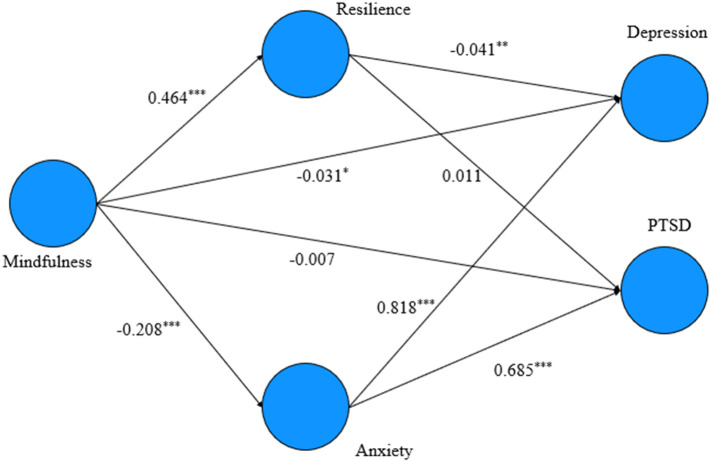
Results: 1541 respondents (654 [42.4 %] men and 887 [57.6 %] women) completed the questionnaire between June 10 and July 25, 2021, of whom 36.2 % and 27.1 % had mild and severe levels of depressive and anxiety symptoms respectively, and 15.2 % was indicated with PTSD. The average score of mindfulness of the study participants was (3.100 ± 0.387), and that of resilience was (3.560 ± 0.877). The structural equation model fit the data well, demonstrating that mindfulness was negatively associated with depressive symptoms directly (β = -0.031, P = 0.021) or indirectly through the mediation effect of resilience (β = -0.019, P = 0.009) and anxiety symptoms (β = -0.208, P < 0.001), and was negatively associated with PTSD through the mediation effect of anxiety symptoms (β = -0.142, P < 0.001).
Conclusion: Individuals who have recovered from COVID-19 commonly experienced psychological distress. Mindfulness is associated with alleviation of depressive and PTSD symptoms directly or indirectly. Interventions based on mindfulness are suggested to improve the mental well-being of this population.
Keywords: COVID-19; Mental health; Mindfulness; Recovered patients; Structural equation modeling.
Copyright © 2022 The Authors. Published by Elsevier B.V. All rights reserved.
Conflict of interest statement
Conflict of Interest None.
Figures
References
-
- Aliche C.J., Ifeagwazi C.M., Yankouskaya A., Comoretto A., Wezyk A., Ventouris A., Panourgia C. Post-traumatic stress disorder and depressive symptoms following a herdsmen attack: the role of life meaning in mediating trait mindfulness. Stress. Health. 2021;37:528–537.
-
- Amadeo S., Rereao M., Vanquin David G., Nguyen N., Seguin M., Beauchamp G., Favro P., Trouche H., Malogne A., Goodfellow B., Gokalsing E., Spodenkiewicz M., Sy A., Bocage-Barthelemy Y., Sebti J., Tuheiava A., Jehel L., De Leo D. Suicide in French Polynesia: a retrospective analysis based on medicolegal documents and interview with family. J. Int. Med. Res. 2021;49 3000605211003452. - PMC - PubMed
-
- Anyan F., Bizumic B., Hjemdal O. Specificity in mediated pathways by anxiety symptoms linking adolescent stress profiles to depressive symptoms: results of a moderated mediation approach. J. Affect. Disord. 2018;228:109–117. - PubMed
Publication types
MeSH terms
LinkOut - more resources
Full Text Sources
Medical
