. 2022 Sep 27;20(1):334.
doi: 10.1186/s12916-022-02519-6.

Circulating serum metabolites as predictors of dementia: a machine learning approach in a 21-year follow-up of the Whitehall II cohort study

Affiliations

Circulating serum metabolites as predictors of dementia: a machine learning approach in a 21-year follow-up of the Whitehall II cohort study

Marcos D Machado-Fragua et al. BMC Med. .

Abstract

Background: Age is the strongest risk factor for dementia and there is considerable interest in identifying scalable, blood-based biomarkers in predicting dementia. We examined the role of midlife serum metabolites using a machine learning approach and determined whether the selected metabolites improved prediction accuracy beyond the effect of age.

Methods: Five thousand three hundred seventy-four participants from the Whitehall II study, mean age 55.8 (standard deviation (SD) 6.0) years in 1997-1999 when 233 metabolites were quantified using nuclear magnetic resonance metabolomics. Participants were followed for a median 21.0 (IQR 20.4, 21.7) years for clinically-diagnosed dementia (N=329). Elastic net penalized Cox regression with 100 repetitions of nested cross-validation was used to select models that improved prediction accuracy for incident dementia compared to an age-only model. Risk scores reflecting the frequency with which predictors appeared in the selected models were constructed, and their predictive accuracy was examined using Royston's R2, Akaike's information criterion, sensitivity, specificity, C-statistic and calibration.

Results: Sixteen of the 100 models had a better c-statistic compared to an age-only model and 15 metabolites were selected at least once in all 16 models with glucose present in all models. Five risk scores, reflecting the frequency of selection of metabolites, and a 1-SD increment in all five risk scores was associated with higher dementia risk (HR between 3.13 and 3.26). Three of these, constituted of 4, 5 and 15 metabolites, had better prediction accuracy (c-statistic from 0.788 to 0.796) compared to an age-only model (c-statistic 0.780), all p<0.05.

Conclusions: Although there was robust evidence for the role of glucose in dementia, metabolites measured in midlife made only a modest contribution to dementia prediction once age was taken into account.

Keywords: Biomarkers; C-statistic; Dementia; Longitudinal study; Metabolites; Predictive accuracy; Risk score.


Conflict of interest statement

The authors declare that they have no competing interests.

Figures
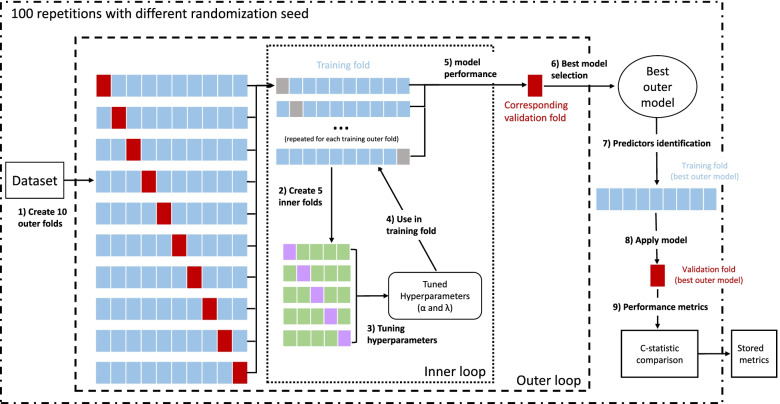
Fig. 1
Fig. 1
Scheme of the repeated nested cross-validation procedure. The following procedure was repeated 100 times to account for variation in results due to random partitioning of the cross-validation folds. The steps in the analyses are (1) Partition dataset into 10 outer folds with the same dementia rate in each fold. (2) Further partition each training outer fold (blue boxes) into 5 inner folds (same dementia rate) to build the inner loop. Grey boxes represent the validation folds (outer loop) which are not involved in the inner loop. 3) Use inner folds to tune the hyperparameters, select best combination of α and λ (model with the lowest partial likelihood deviance in the inner loop). (4) Apply selected hyperparameters to the corresponding training outer fold. (5) Evaluate model performance in the corresponding outer validation fold (red box). (6) Choose the best of 10 outer models (lowest partial likelihood deviance). (7) Identify predictors (variables with non-zero beta-coefficients) in the training fold of the best model in the outer fold. (8) Apply the best outer model hyperparameters to the corresponding validation outer fold. (9) Compare the c-statistic of the prediction model to the c-statistic of an age-specific model in the same validation outer fold
Fig. 2
Fig. 2
Observed and predicted rate of dementia per 1000 person-years (calibration-in-the-large) as a function of deciles of predictors (age, risk score 3, risk score 4 and risk score 5). VLDL, very low-density lipoproteins; HDL, high-density lipoprotein. The first and second decile were collapsed due to a small number of events in these deciles. Risk score 3 includes age, glucose, phospholipids to total lipids ratio in medium HDL (%) and creatinine (mmol/l). Risk score 4 includes age, glucose, phospholipids to total lipids ratio in medium HDL (%), creatinine (mmol/l), and triglycerides to total lipids ratio in very large VLDL (%). Risk score 5 includes age, glucose, phospholipids to total lipids ratio in medium HDL (%), creatinine (mmol/l), triglycerides to total lipids ratio in very large VLDL (%), phospholipids to total lipids ratio in medium VLDL (%), alanine (mmol/l), 3-hydroxybutyrate (mmol/l), free cholesterol to total lipids ratio in small HDL (%), citrate (mmol/l), free cholesterol to total lipids ratio in very large VLDL (%), free cholesterol to total lipids ratio in large HDL (%), triglycerides to total lipids ratio in medium HDL (%), phospholipids to total lipids ratio in small HDL (%), sphingomyelins (mmol/l) and albumin (signal area)

References

    1. Global Health Estimates 2020: Deaths by Cause, Age, Sex, by Country and by Region, 2000-2019. Geneva: World Health Organization; 2020.
    1. O'Brien RJ, Wong PC. Amyloid precursor protein processing and Alzheimer's disease. Annu Rev Neurosci. 2011;34:185–204. doi: 10.1146/annurev-neuro-061010-113613. - DOI - PMC - PubMed
    1. de la Monte SM, Tong M. Brain metabolic dysfunction at the core of Alzheimer's disease. Biochem Pharmacol. 2014;88(4):548–559. doi: 10.1016/j.bcp.2013.12.012. - DOI - PMC - PubMed
    1. Procaccini C, Santopaolo M, Faicchia D, Colamatteo A, Formisano L, de Candia P, et al. Role of metabolism in neurodegenerative disorders. Metabolism. 2016;65(9):1376–1390. doi: 10.1016/j.metabol.2016.05.018. - DOI - PubMed
    1. Silverberg N, Elliott C, Ryan L, Masliah E, Hodes R. NIA commentary on the NIA-AA Research Framework: Towards a biological definition of Alzheimer's disease. Alzheimers Dement. 2018;14(4):576–578. doi: 10.1016/j.jalz.2018.03.004. - DOI - PubMed

Publication types
