


Predictors of Long-Term Opioid Use After Hospitalization for Traumatic Injury in a Racially and Ethnically Diverse Population: A 12-Month Prospective Observational Study
- PMID: 36165692
- PMCID: PMC10167926
- DOI: 10.1093/pm/pnac147
Predictors of Long-Term Opioid Use After Hospitalization for Traumatic Injury in a Racially and Ethnically Diverse Population: A 12-Month Prospective Observational Study
Abstract
Background: Long-term prescription opioid use is a significant risk factor for opioid morbidity and mortality, and severe traumatic injury is an important initiation point for prescription opioid use. This study examines predictors of long-term prescription opioid use among a racially and ethnically diverse population of patients hospitalized for traumatic injury.
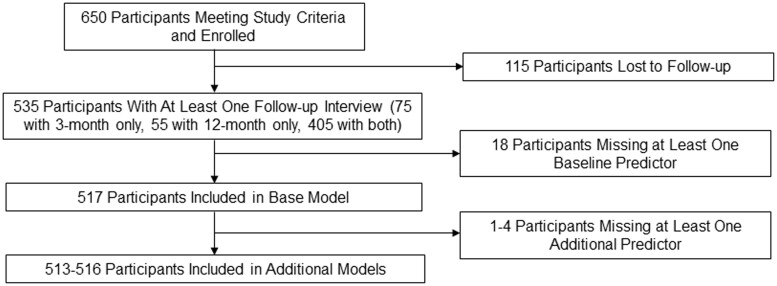
Methods: Study participants (N= 650) from two urban Level I trauma centers were enrolled. Baseline information on demographics, injury characteristics, self-reported pre-injury substance use and mental health, and personality characteristics and attitudes was collected through interviews during the initial hospitalization. Patients were interviewed again at 3 months and 12 months and asked about prescription opioid use in the prior 7 days. Multivariable logistic regressions assessed participants' baseline characteristics associated with opioid use at one or more follow-up interviews.
Results: Pre-injury use of prescription painkillers had the strongest association with prescription opioid use at follow-up (adjusted odds ratio: 3.10; 95% confidence interval: 1.86-5.17). Older age, health insurance coverage at baseline, length of hospitalization, higher current pain level, pre-injury post-traumatic stress disorder symptoms, and discharge to a location other than home were also associated with significantly higher odds of prescription opioid use at follow-up.
Conclusions: Providers could consider screening for past use of prescription pain relievers and post-traumatic stress disorder before hospital discharge to identify patients who might benefit from additional resources and support. However, providers should ensure that these patients' pain management needs are still being met and avoid abrupt discontinuation of prescription opioid use among those with a history of long-term use.
Keywords: Injury; Opioids; Trauma.
© The Author(s) 2022. Published by Oxford University Press on behalf of the American Academy of Pain Medicine. All rights reserved. For permissions, please e-mail: journals.permissions@oup.com.
References
-
- National Institute on Drug Abuse. Overdose Death Rates. Available at: https://nida.nih.gov/research-topics/trends-statistics/overdose-death-ra... (accessed July 18, 2022).
-
- Chou R, Turner JA, Devine EB, et al.The effectiveness and risks of long-term opioid therapy for chronic pain: A systematic review for a National Institutes of Health Pathways to Prevention Workshop. Ann Intern Med 2015;162(4):276–86. - PubMed
-
- Dasgupta N, Creppage K, Austin A, et al.Observed transition from opioid analgesic deaths toward heroin. Drug Alcohol Depend 2014;145:238–41. - PubMed
Publication types
MeSH terms
Substances
Grants and funding
LinkOut - more resources
Full Text Sources
Medical
Miscellaneous
