Real-Time Patient Portal Use Among Emergency Department Patients: An Open Results Study
- PMID: 36167337
- PMCID: PMC9713300
- DOI: 10.1055/a-1951-3268
Real-Time Patient Portal Use Among Emergency Department Patients: An Open Results Study
Abstract
Objectives: We characterized real-time patient portal test result viewing among emergency department (ED) patients and described patient characteristics overall and among those not enrolled in the portal at ED arrival.
Methods: Our observational study at an academic ED used portal log data to trend the proportion of adult patients who viewed results during their visit from May 04, 2021 to April 04, 2022. Correlation was assessed visually and with Kendall's τ. Covariate analysis using binary logistic regression assessed result(s) viewed as a function of time accounting for age, sex, ethnicity, race, language, insurance status, disposition, and social vulnerability index (SVI). A second model only included patients not enrolled in the portal at arrival. We used random forest imputation to account for missingness and Huber-White heteroskedasticity-robust standard errors for patients with multiple encounters (α = 0.05).
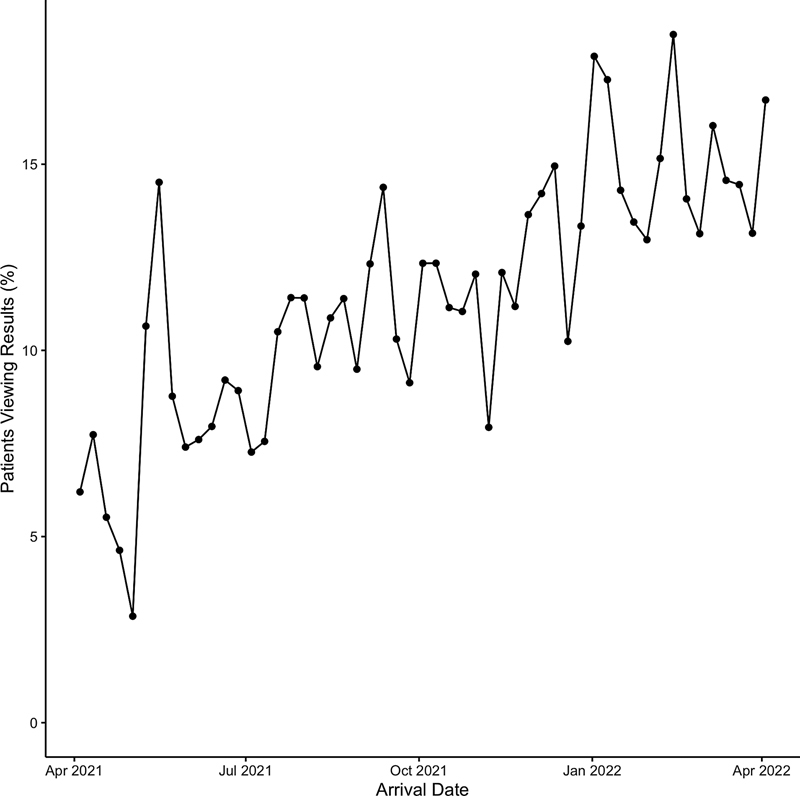
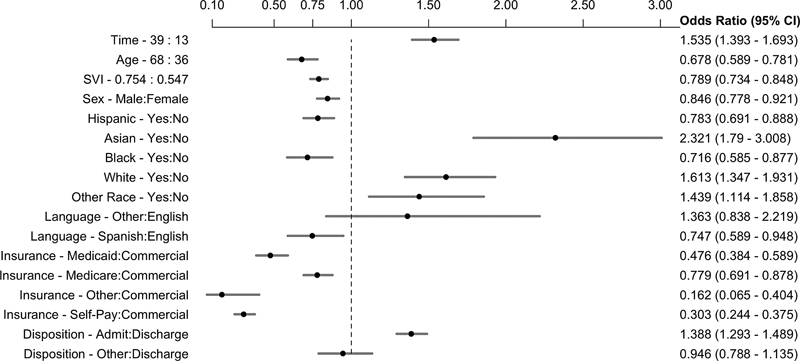
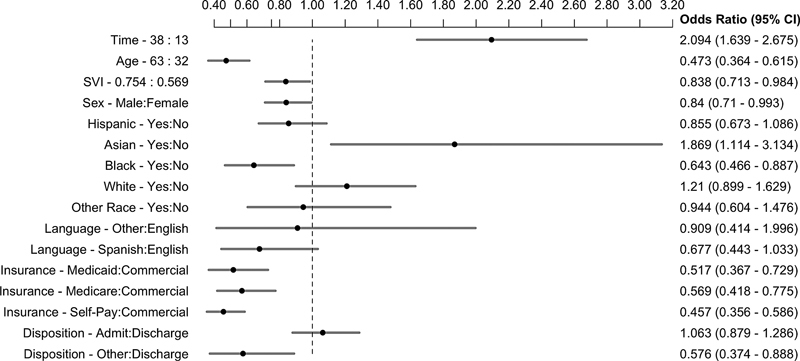
Results: There were 60,314 ED encounters (31,164 unique patients). In 7,377 (12.2%) encounters, patients viewed results while still in the ED. Patients were not enrolled for portal use at arrival in 21,158 (35.2%) encounters, and 927 (4.4% of not enrolled, 1.5% overall) subsequently enrolled and viewed results in the ED. Visual inspection suggests an increasing proportion of patients who viewed results from roughly 5 to 15% over the study (Kendall's τ = 0.61 [p <0.0001]). Overall and not-enrolled models yielded concordance indices (C) of 0.68 and 0.72, respectively, with significant overall likelihood ratio χ 2 (p <0.0001). Time was independently associated with viewing results in both models after adjustment. Models revealed disparate use between age, race, ethnicity, SVI, sex, insurance status, and disposition groups.
Conclusion: We observed increased portal-based test result viewing among ED patients over the year since the 21st Century Cures act went into effect, even among those not enrolled at arrival. We observed disparities in those who viewed results.
Thieme. All rights reserved.
Conflict of interest statement
C.U.L. reports royalties or licenses from Springer-Verlag (<$20) and stock ownership of Celanese and Markel.
Figures
References
-
- 114th Congress of the United StatesH.R.34 - Public Law No: 114 - 255 - 21st Century Cures Act. Washington, DC;2016
-
- Office of the National Coordinator for Health Information Technology USDoHaHS Federal Register: 21st Century Cures Act: Interoperability, Information Blocking, and the ONC Health IT Certification Program;2020
-
- Office of the National Coordinator for Health Information Technology USDoHaHS United States Core Data for Interoperability (USCDI)Accessed June 9, 2022 at:https://www.healthit.gov/uscdi
Publication types
MeSH terms
Grants and funding
LinkOut - more resources
Full Text Sources
Miscellaneous