


Using Normalisation Process Theory (NPT) to develop an intervention to improve referral and uptake rates for self-management education for patients with type 2 diabetes in UK primary care
- PMID: 36167564
- PMCID: PMC9513934
- DOI: 10.1186/s12913-022-08553-7
Using Normalisation Process Theory (NPT) to develop an intervention to improve referral and uptake rates for self-management education for patients with type 2 diabetes in UK primary care
Abstract
Background: Referral and uptake rates of structured self-management education (SSME) for Type 2 diabetes (T2DM) in the UK are variable and relatively low. Research has documented contributing factors at patient, practitioner and organisational levels. We report a project to develop an intervention to improve referral to and uptake of SSME, involving an integrative synthesis of existing datasets and stakeholder consultation and using Normalisation Process Theory (NPT) as a flexible framework to inform the development process.
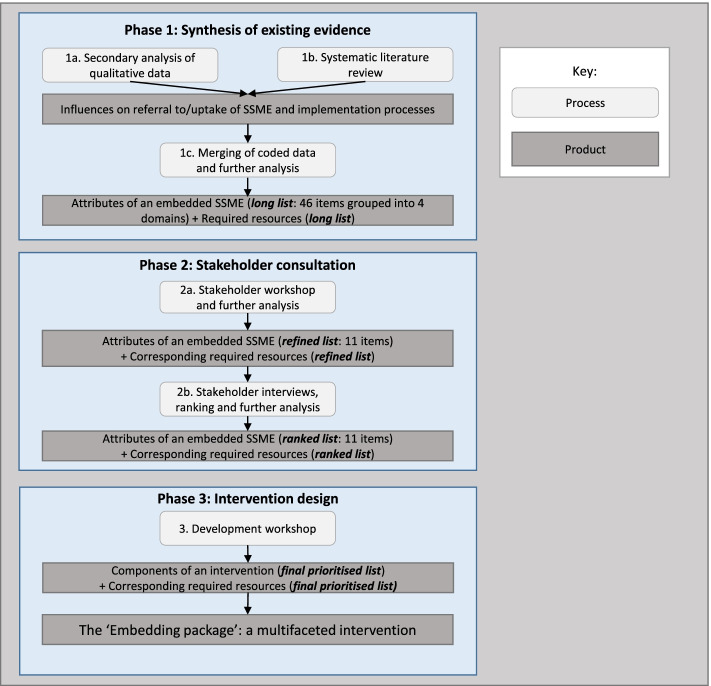
Methods: A three-phase mixed-methods development process involved: (1) synthesis of existing evidence; (2) stakeholder consultation; and (3) intervention design. The first phase included a secondary analysis of data from existing studies of T2DM SSME programmes and a systematic review of the literature on application of NPT in primary care. Influences on referral and uptake of diabetes SSME were identified, along with insights into implementation processes, using NPT constructs to inform analysis. This gave rise to desirable attributes for an intervention to improve uptake of SSME. The second phase involved engaging with stakeholders to prioritise and then rank these attributes, and develop a list of associated resources needed for delivery. The third phase addressed intervention design. It involved translating the ranked attributes into essential components of a complex intervention, and then further refinement of components and associated resources.
Results: In phase 1, synthesised analysis of 64 transcripts and 23 articles generated a longlist of 46 attributes of an embedded SSME, mapped into four overarching domains: valued, integrated, permeable and effectively delivered. Stakeholder engagement in phase 2 progressed this to a priority ranked list of 11. In phase 3, four essential components attending to the prioritised attributes and forming the basis of the intervention were identified: 1) a clear marketing strategy for SSME; 2) a user friendly and effective referral pathway; 3) new/amended professional roles; and 4) a toolkit of resources.
Conclusions: NPT provides a flexible framework for synthesising evidence for the purpose of developing a complex intervention designed to increase and reduce variation in uptake to SSME programmes in primary care settings.
Keywords: Intervention development; Normalisation Process Theory; Qualitative; Self-management; Structured education; Type 2 diabetes.
© 2022. The Author(s).
Conflict of interest statement
LH, NH, GM, LS, JT, CW declare that they have no competing interests.
MD, HE, AN, SS, have no conflicts of interest; however, for transparency, the following are provided: MD is the Principal Investigator (PI) on the DESMOND programme (Diabetes education and self-management for people with newly diagnosed Type 2 diabetes). SS and AN are employed by the University Hospitals of Leicester NHS Trust, which receives not-for-profit income for DESMOND. MD, HE, AN and SS have previously received grants for DESMOND from NIHR, MRC and Diabetes UK to develop and test Diabetes Self-Management Education and Support programmes like DESMOND. The University Hospitals of Leicester (UHL) NHS Trust (for which SS and AN have a contract) receives licensing fees to support implementation of the DESMOND programme in CCGs in the UK, Ireland and Australia.
Figures
References
-
- International Diabetes Foundation: Diabetes Atlas 9th Edition. https://diabetesatlas.org/en/ (2019). Accessed 01 Sept 2021.
-
- National Institute for Health and Care Excellence: Diabetes in adulthood Quality Standard [QS6]. https://www.nice.org.uk/guidance/qs6 (2011. Updated 2016). Accessed 01 Sept 2021.
-
- National Institute for Health and Care Excellence. Guidance on the use of patient-education models for diabetes. Technology appraisal guidance [TA60] https://www.nice.org.uk/guidance/ta60 (2003. Updated August 2015). Accessed 01 Sept 2021.
Publication types
MeSH terms
Grants and funding
LinkOut - more resources
Full Text Sources
Other Literature Sources
Medical
