


Reduction in grey matter atrophy in patients with relapsing multiple sclerosis following treatment with cladribine tablets
- PMID: 36168741
- PMCID: PMC10091690
- DOI: 10.1111/ene.15579
Reduction in grey matter atrophy in patients with relapsing multiple sclerosis following treatment with cladribine tablets
Abstract
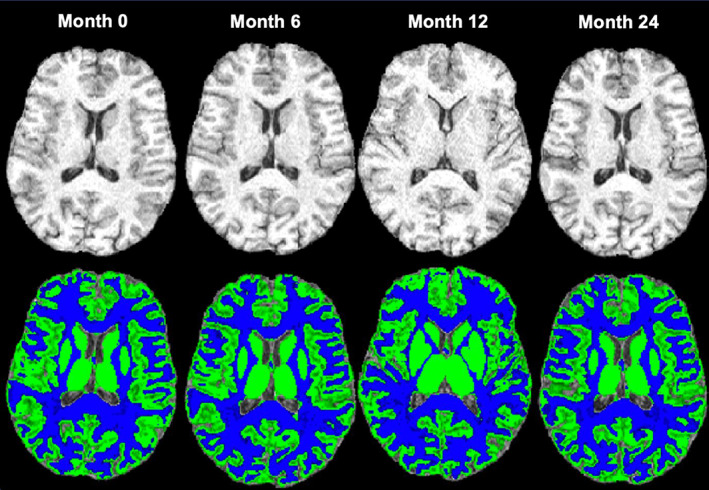
Background and purpose: Measures of atrophy in the whole brain can be used to reliably assess treatment effect in clinical trials of patients with multiple sclerosis (MS). Trials assessing the effect of treatment on grey matter (GM) and white matter (WM) atrophy are very informative, but hindered by technical limitations. This study aimed to measure GM and WM volume changes, using a robust longitudinal method, in patients with relapsing MS randomized to cladribine tablets 3.5 mg/kg or placebo in the CLARITY study.
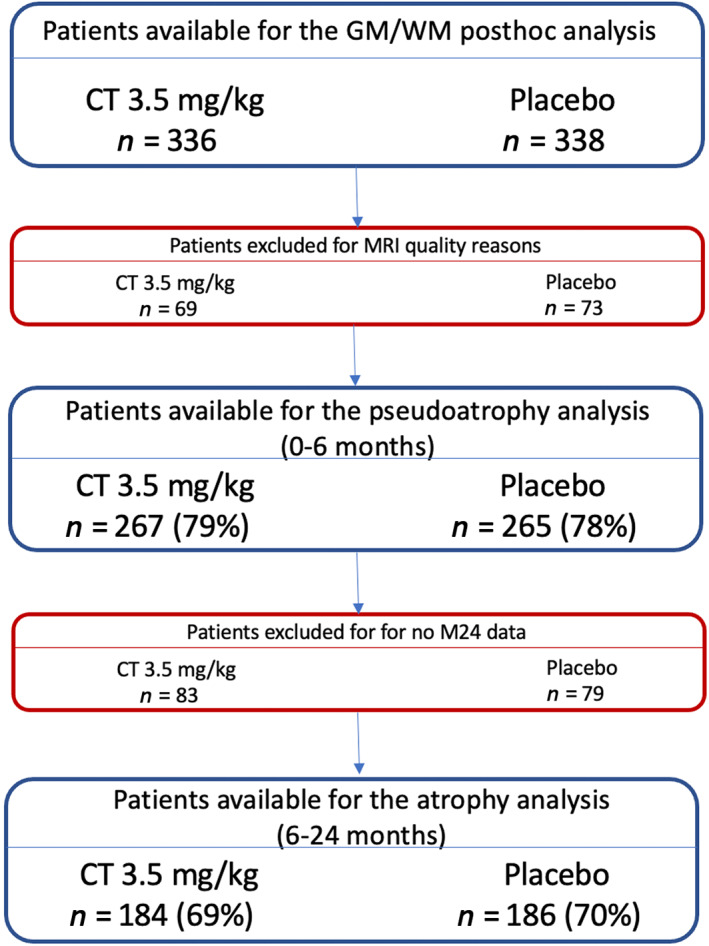
Methods: We analysed T1-weighted magnetic resonance sequences using SIENA-XL, from 0 to 6 months (cladribine, n = 267; placebo, n = 265) and 6 to 24 months (cladribine, n = 184; placebo, n = 186). Mean percentage GM and WM volume changes (PGMVC and PWMVC) were compared using a mixed-effect model.
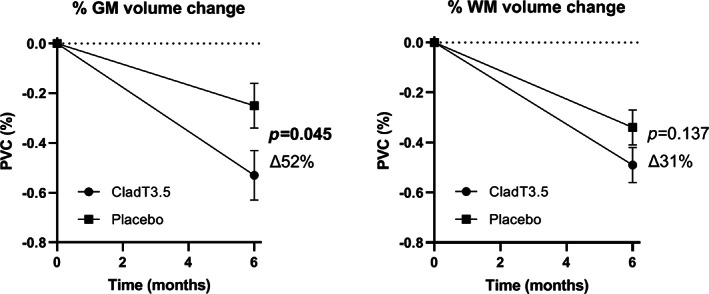
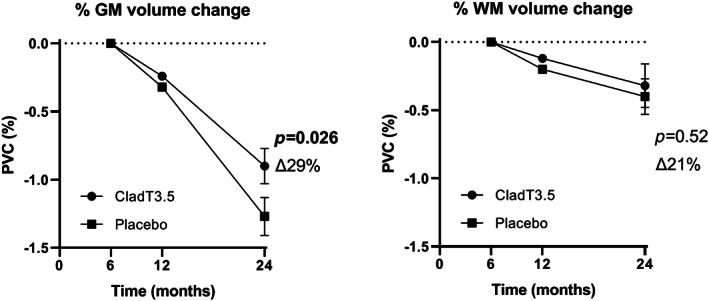
Results: More GM and WM volume loss was found in patients taking cladribine versus those taking placebo in the first 6 months of treatment (PGMVC: cladribine: -0.53 vs. placebo: -0.25 [p = 0.045]; PWMVC: cladribine: -0.49 vs. placebo: -0.34 [p = 0.137]), probably due to pseudoatrophy. However, over the period 6 to 24 months, GM volume loss was significantly lower in patients on cladribine than in those on placebo (PGMVC: cladribine: -0.90 vs. placebo: -1.27 [p = 0.026]). In this period, volume changes in WM were similar in the two treatment arms (p = 0.52).
Conclusions: After a short period of pseudoatrophy, treatment with cladribine 3.5 mg/kg significantly reduced GM atrophy in comparison with placebo. This supports the relevance of GM damage in MS and may have important implications for physical and cognitive disability progression.
Keywords: brain atrophy; cladribine tablets; grey matter; multiple sclerosis; white matter.
© 2022 The Authors. European Journal of Neurology published by John Wiley & Sons Ltd on behalf of European Academy of Neurology.
Conflict of interest statement
Rosa Cortese was awarded a MAGNIMS‐ECTRIMS fellowship in 2019. Marco Battaglini has nothing to disclose. Maria Pia Sormani has received consulting fees from Biogen, Genzyme, GeNeuro, MedDay, Merck, Novartis, Roche and Teva. Ludovico Luchetti, Giordano Gentile, and Maira Inderyas have nothing to disclose. NA is an employee of Merck Healthcare KGaA, Darmstadt, Germany. Nicola De Stefano is a consultant for Biogen, Merck, Novartis, Sanofi‐Genzyme, Roche and Teva, has grants or grants pending from FISM and Novartis, is on the speakers' bureaus of Biogen, Merck, Novartis, Roche, Sanofi‐Genzyme and Teva, and has received travel funds from Merck, Novartis, Roche, Sanofi‐Genzyme and Teva.
Figures
References
Publication types
MeSH terms
Substances
LinkOut - more resources
Full Text Sources
Medical
