


Evaluating the impact of naloxone dispensation at public health vending machines in Clark County, Nevada
- PMID: 36168975
- PMCID: PMC9542801
- DOI: 10.1080/07853890.2022.2121418
Evaluating the impact of naloxone dispensation at public health vending machines in Clark County, Nevada
Abstract
Introduction: Implementing public health vending machines (PHVMs) is an evidence-based strategy for mitigating substance use-associated morbidity and mortality via the dispensation of essential supplies to people who use drugs, including overdose prevention resources. PHVMs have been implemented throughout the world; however, their implementation in the United States (US) is a recent phenomenon. In 2017, Trac-B Exchange (a syringe services program in Clark County, Nevada) installed three PHVMs. In 2019, naloxone dispensation was launched at PHVMs in Clark County. The purpose of this research is to examine the extent to which naloxone dispensation at PHVMs was associated with changes in opioid-involved overdose fatalities.
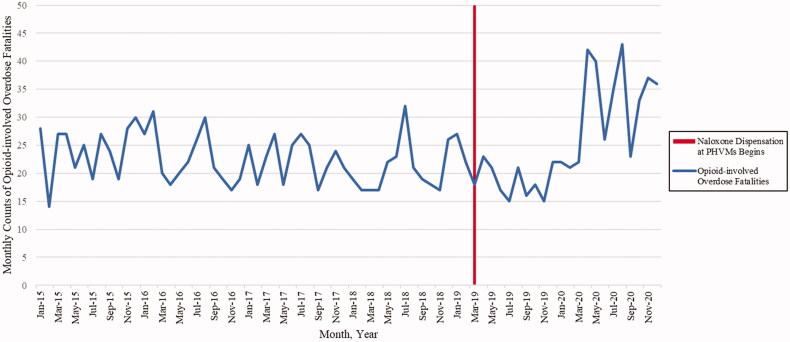
Methods: Monthly counts of opioid-involved overdose fatalities among Clark County residents that occurred from January 2015 to December 2020 were used to build an autoregressive integrated moving averages (ARIMA) model to measure the impact of naloxone dispensation at PHVMs. We forecasted the number of expected opioid-involved overdose fatalities had naloxone dispensation at PHVMs not occurred and compared to observed monthly counts. Interrupted time series analyses (ITSA) were used to evaluate the step (i.e. the immediate impact of naloxone dispensation at PHVMs on opioid-involved overdose fatalities) and slope change (i.e. changes in trend and directionality of monthly counts of opioid-involved overdose fatalities following naloxone dispensation at PHVMs).
Results: During the 12-months immediately following naloxone dispensation at PHVMs, our model forecasted 270 opioid-involved overdose fatalities, but death certificate data indicated only 229 occurred, suggesting an aversion of 41 deaths. ITSA identified a significant negative step change in opioid-involved overdose fatalities at the time naloxone dispensation at PHVMs was launched (B = -8.52, p = .0022) and a significant increasing slope change (B = 1.01, p<.0001). Forecasts that extended into the COVID-19 pandemic suggested worsening trends in overdose fatalities.
Conclusion: Naloxone dispensation at PHVMs was associated with immediate reductions in opioid-involved overdose fatalities. Key MessagesNaloxone dispensation at PHVMs was associated with immediate reductions in opioid-involved overdose fatalities.Communities should consider implementing public health vending machines in efforts to prevent opioid-involved overdose fatalities.The COVID-19 pandemic worsened the overdose crisis.
Keywords: Public health vending machines; harm reduction vending machines; naloxone; overdose fatalities.
Conflict of interest statement
No potential conflict of interest was reported by the author(s).
Figures
References
-
- CDC . Drug Overdose Deaths in the U.S. Top 100,000 Annually. 2021.
-
- Degenhardt L, Bucello C, Mathers B, et al. Mortality among regular or dependent users of heroin and other opioids: a systematic review and Meta-analysis of cohort studies. Addiction. 2011;106(1):32–51. - PubMed
-
- Paulozzi LJ, Xi Y.. Recent changes in drug poisoning mortality in the United States by urban-rural status and by drug type. Pharmacoepidemiol Drug Saf. 2008;17(10):997–1005. - PubMed
Publication types
MeSH terms
Substances
Grants and funding
LinkOut - more resources
Full Text Sources
Medical
