. 2023 Jan 6;51(D1):D1257-D1262.
doi: 10.1093/nar/gkac833.

Comparative Toxicogenomics Database (CTD): update 2023

Affiliations

Comparative Toxicogenomics Database (CTD): update 2023

Allan Peter Davis et al. Nucleic Acids Res. .

Abstract

The Comparative Toxicogenomics Database (CTD; http://ctdbase.org/) harmonizes cross-species heterogeneous data for chemical exposures and their biological repercussions by manually curating and interrelating chemical, gene, phenotype, anatomy, disease, taxa, and exposure content from the published literature. This curated information is integrated to generate inferences, providing potential molecular mediators to develop testable hypotheses and fill in knowledge gaps for environmental health. This dual nature, acting as both a knowledgebase and a discoverybase, makes CTD a unique resource for the scientific community. Here, we report a 20% increase in overall CTD content for 17 100 chemicals, 54 300 genes, 6100 phenotypes, 7270 diseases and 202 000 exposure statements. We also present CTD Tetramers, a novel tool that computationally generates four-unit information blocks connecting a chemical, gene, phenotype, and disease to construct potential molecular mechanistic pathways. Finally, we integrate terms for human biological media used in the CTD Exposure module to corresponding CTD Anatomy pages, allowing users to survey the chemical profiles for any tissue-of-interest and see how these environmental biomarkers are related to phenotypes for any anatomical site. These, and other webpage visual enhancements, continue to promote CTD as a practical, user-friendly, and innovative resource for finding information and generating testable hypotheses about environmental health.


Figures

Figure 1.
Figure 1.
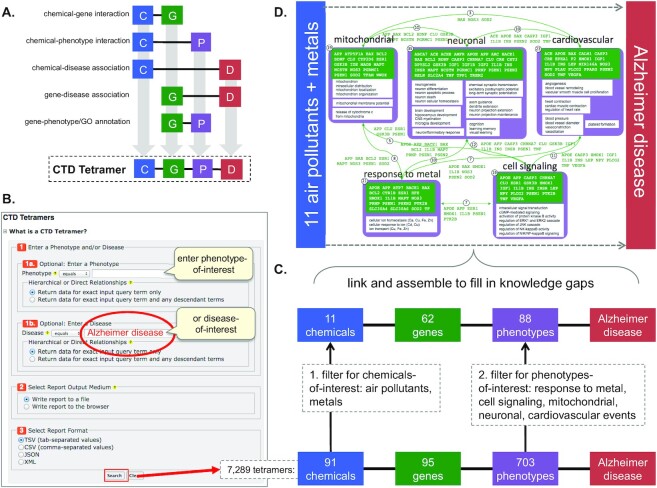
New CTD Tetramer tool generates CGPD-tetramers that can help fill in knowledge gaps and construct potential molecular mechanistic pathways. (A) A CGPD-tetramer is a computationally generated information block composed of four units: an initiating chemical (C), an interacting gene (G), a modulated phenotype (P), and a disease (D) outcome. To generate a tetramer, five direct dyad evidence statements are integrated from CTD: C–G interaction, C–P interaction, C–D association, G–D association, and an imported G–P annotation, since GO biological process terms are the equivalent vocabulary for phenotypes in CTD (19). A tetramer will be generated only if all five direct dyad evidence statements currently exist in CTD. This computational process generates a selective, but supported, set of tetramers and, importantly, does not require a priori knowledge by the user. (B) The CTD Tetramer tool (http://ctdbase.org/tools/tetramerQuery.go) can be queried for any phenotype and/or environmental disease-of-interest to automatically generate all possible tetramers. (C) For Alzheimer disease, the tool generates 7289 tetramers, composed of 91 chemicals, 95 genes, and 703 phenotypes. This output can be manually sorted, surveyed and filtered to focus on any subset of chemicals-of-interest (here, air pollutants and metals) as well as phenotype clusters (e.g. response to metal, cell signaling, mitochondrial-related, neuron-related, and cardiovascular-related), resulting in a sub-set of 601 tetramers, composed of 11 chemicals, 62 genes and 88 unique phenotypes. (D) Users can manually assemble the tetramers by hand by linking them together using the shared genes (green boxes/text/arrows) that connect different phenotype clusters (purple boxes) to build a complex, interrelated map. This manual process, outlined in (21), fills knowledge gaps with potential molecular mechanistic steps (e.g. intermediate genes and phenotypes) that link air pollution/metal exposure to Alzheimer disease, producing a testable framework for experimental verification.
Figure 2.
Figure 2.
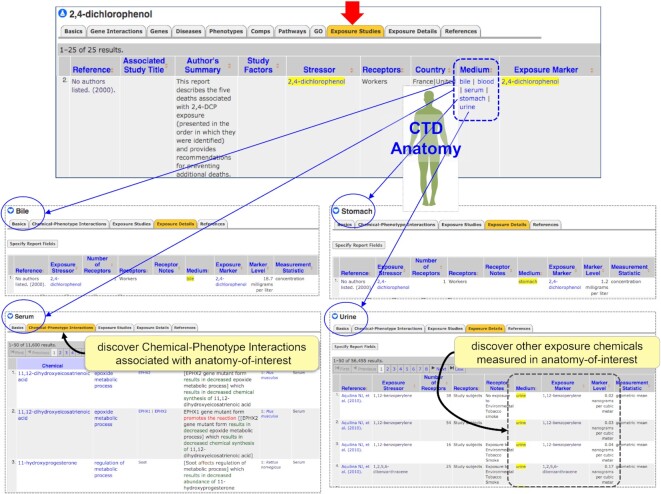
Human biological media assayed for chemical biomarkers in CTD Exposure are now integrated with CTD Anatomy. An exposure study reports that the environmental chemical 2,4-dichlorophenol is measured in a variety of human media (here, bile, blood, serum, stomach, and urine). These terms are now linked to their corresponding pages in CTD Anatomy, allowing users to seamlessly traverse and find additional chemicals detected in the same media reported by other exposure studies, as well as peruse the chemical-induced phenotypes associated with them. This integration helps tie mechanistic toxicology to the exposome concept.

References

    1. Davis A.P., Murphy C.G., Saraceni-Richards C.A., Rosenstein M.C., Wiegers T.C., Mattingly C.J.. Comparative toxicogenomics database: a knowledgebase and discovery tool for chemical-gene-disease networks. Nucleic Acids Res. 2009; 37:D786–D792. - PMC - PubMed
    1. Davis A.P., Wiegers T.C., Rosenstein M.C., Murphy C.G., Mattingly C.J.. The curation paradigm and application tool used for manual curation of the scientific literature at the comparative toxicogenomics database. Database. 2011; 2011:bar034. - PMC - PubMed
    1. Davis A.P., Wiegers T.C., Johnson R.J., Lay J.M., Lennon-Hopkins K., Saraceni-Richards C., Sciaky D., Murphy C.G., Mattingly C.J.. Text mining effectively scores and ranks the literature for improving chemical-gene-disease curation at the comparative toxicogenomics database. PLoS One. 2013; 8:e58201. - PMC - PubMed
    1. Davis A.P., Johnson R.J., Lennon-Hopkins K., Sciaky D., Rosenstein M.C., Wiegers T.C., Mattingly C.J.. Targeted journal curation as a method to improve data currency at the comparative toxicogenomics database. Database. 2012; 2012:bas051. - PMC - PubMed
    1. Wilkinson M.D., Dumontier M., Aalbersberg I.J., Appleton G., Axton M., Baak A., Blomberg N., Boiten J.W., da Silva Santos L.B., Bourne P.E.et al. .. The FAIR guiding principles for scientific data management and stewardship. Sci. Data. 2016; 3:160018. - PMC - PubMed

Publication types