Review
. 2022 Sep 28;256(5):90.
doi: 10.1007/s00425-022-04005-y.

Options for the generation of seedless cherry, the ultimate snacking product

Affiliations
Review

Options for the generation of seedless cherry, the ultimate snacking product

Edoardo Vignati et al. Planta. .

Abstract

This manuscript identifies cherry orthologues of genes implicated in the development of pericarpic fruit and pinpoints potential options and restrictions in the use of these targets for commercial exploitation of parthenocarpic cherry fruit. Cherry fruit contain a large stone and seed, making processing of the fruit laborious and consumption by the consumer challenging, inconvenient to eat 'on the move' and potentially dangerous for children. Availability of fruit lacking the stone and seed would be potentially transformative for the cherry industry, since such fruit would be easier to process and would increase consumer demand because of the potential reduction in costs. This review will explore the background of seedless fruit, in the context of the ambition to produce the first seedless cherry, carry out an in-depth analysis of the current literature around parthenocarpy in fruit, and discuss the available technology and potential for producing seedless cherry fruit as an 'ultimate snacking product' for the twenty-first century.

Keywords: Cherry; Fruit; June drop; Parthenocarpy; Seed.


Conflict of interest statement

The authors report no conflicts of interest in this work and have nothing to disclose.

Figures
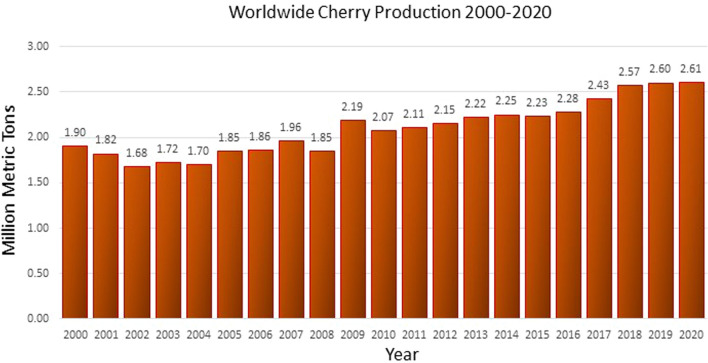
Fig. 1
Fig. 1
Graphical representation of worldwide cherry production between 2000 and 2020 (Statista.org). Cherry production has increased by 37% between 2000 and 2020 with the lowest production in 2002
Fig. 2
Fig. 2
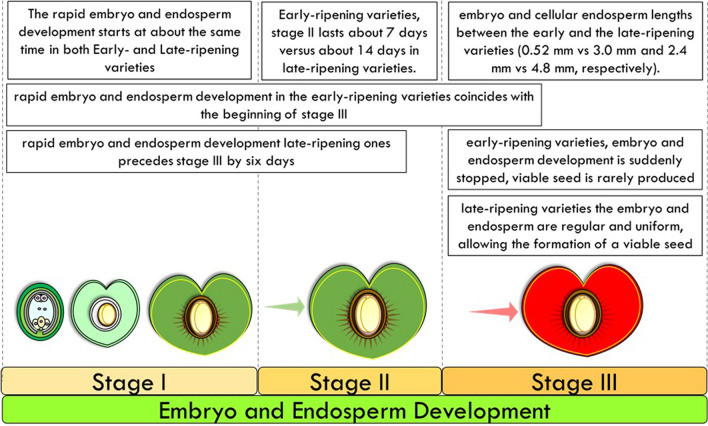
Graphical representation of embryo and endosperm development in the cultivated cherry during the three stages of fruit development
Fig. 3
Fig. 3
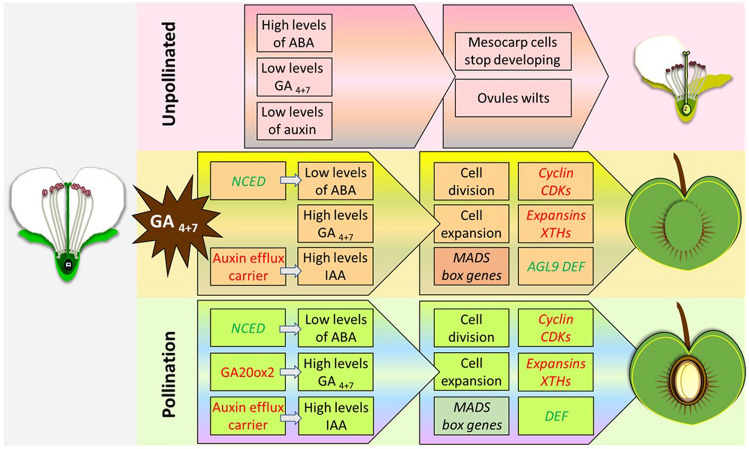
Proposed model of the crosstalk between auxin and GA signalling pathways during fruit development. In this model, three different scenarios are represented: unpollinated, GA4+7-treated, and following pollination. Red font represents genes up-regulated and green font genes down-regulated
Fig. 4
Fig. 4
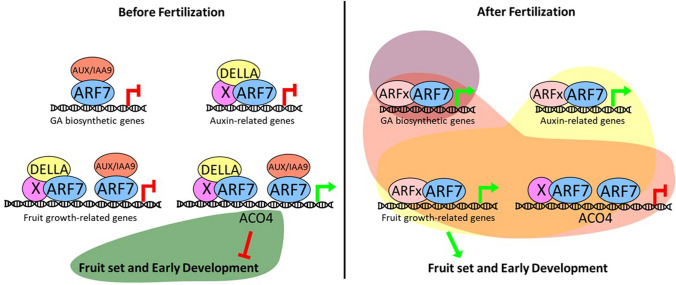
Proposed model of the crosstalk between auxin and GA signalling pathways during tomato fruit development. Before fertilization, SlARF7 (Auxin Response Factor 7) interacts with SlDELLA and SlAUX/IAA9, repressing the transcription of GA biosynthetic genes and the auxin-related genes. They also activate the transcription of ACO4, enhancing ethylene (green area) levels in the ovary which stays frozen. After fertilization, auxin signal (purple circle) comes from the fertilized ovule, promoting the degradation of SlAUX/IAA9. Gibberellins (yellow area) are synthetised and promote the degradation of SlDELLA and a further accumulation of auxin (pink area). SlARF7 can interact with other SlARF proteins and promote fruit set
Fig. 5
Fig. 5
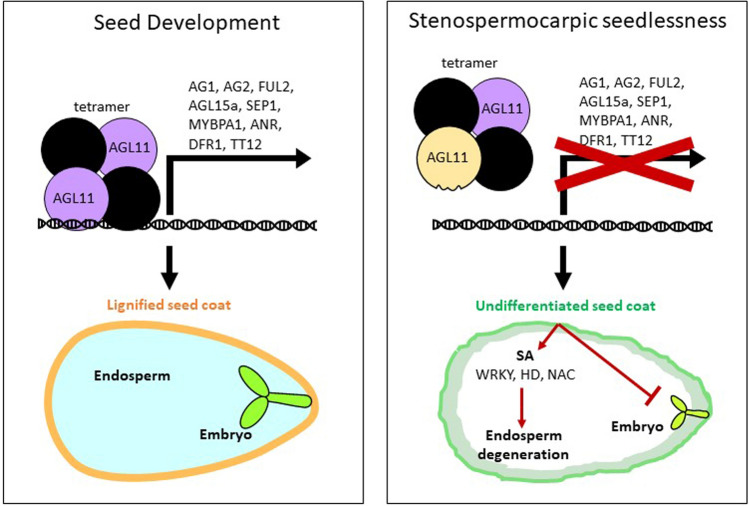
Model of seedlessness proposed by Royo et al. (Royo et al. 2018) to explain the seedless phenotype in grape. The panel on the left shows the initiation of seed morphogenesis that occurs under normal development. The wild-type VviAGL11 (AGAMOUS-LIKE11) protein complex (shown in purple) either directly or indirectly initiates the expression of genes involved in seed coat sclerification, permitting embryo development. The panel on the right shows a heterozygous individual with a dominant phenotype due to a single missense mutation in the VviAGL11 protein (Arg197 to Leu197; shown in yellow). This mutation prevents the assembly of the multiprotein complex halting seed coat differentiation, leading to degeneration of the embryo and endosperm

References

    1. Aglawe SB, Barbadikar KM, Mangrauthia SK, Madhav MS. New breeding technique "genome editing" for crop improvement: applications, potentials and challenges. 3 Biotech. 2018;8(8):336. doi: 10.1007/s13205-018-1355-3. - DOI - PMC - PubMed
    1. Aida M, Ishida T, Fukaki H, Fujisawa H, Tasaka M. Genes involved in organ separation in Arabidopsis: an analysis of the cup-shaped cotyledon mutant. Plant Cell. 1997;9(6):841–857. doi: 10.1105/tpc.9.6.841. - DOI - PMC - PubMed
    1. Aida M, Ishida T, Tasaka M. Shoot apical meristem and cotyledon formation during Arabidopsis embryogenesis: interaction among the CUP-SHAPED COTYLEDON and SHOOT MERISTEMLESS genes. Development. 1999;126(8):1563–1570. doi: 10.1242/dev.126.8.1563. - DOI - PubMed
    1. Aida M, Vernoux T, Furutani M, Traas J, Tasaka M. Roles of PIN-FORMED1 and MONOPTEROS in pattern formation of the apical region of the Arabidopsis embryo. Development. 2002;129(17):3965–3974. doi: 10.1242/dev.129.17.3965. - DOI - PubMed
    1. Alba CM-A, Daya M, Franck C. Tart Cherries and health: current knowledge and need for a better understanding of the fate of phytochemicals in the human gastrointestinal tract. Crit Rev Food Sci Nutr. 2019;59(4):626–638. doi: 10.1080/10408398.2017.1384918. - DOI - PubMed

LinkOut - more resources