


Tumor microenvironment antigens
- PMID: 36175673
- PMCID: PMC10335965
- DOI: 10.1007/s00281-022-00966-0
Tumor microenvironment antigens
Abstract
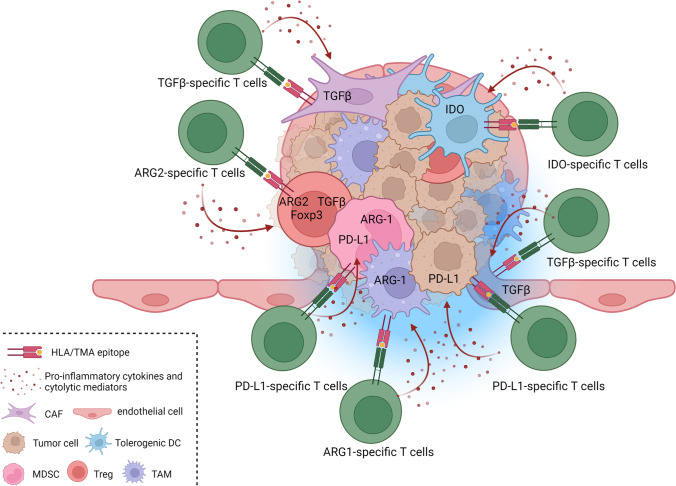
The identification and characterization of tumor antigens are central objectives in developing anti-cancer immunotherapy. Traditionally, tumor-associated antigens (TAAs) are considered relatively restricted to tumor cells (i.e., overexpressed proteins in tumor cells), whereas tumor-specific antigens (TSAs) are considered unique to tumor cells. Recent studies have focused on identifying patient-specific neoantigens, which might be highly immunogenic because they are not expressed in normal tissues. The opposite strategy has emerged with the discovery of anti-regulatory T cells (anti-Tregs) that recognize and attack many cell types in the tumor microenvironment, such as regulatory immune cells, in addition to tumor cells. The term proposed in this review is "tumor microenvironment antigens" (TMAs) to describe the antigens that draw this attack. As therapeutic targets, TMAs offer several advantages that differentiate them from more traditional tumor antigens. Targeting TMAs leads not only to a direct attack on tumor cells but also to modulation of the tumor microenvironment, rendering it immunocompetent and tumor-hostile. Of note, in contrast to TAAs and TSAs, TMAs also are expressed in non-transformed cells with consistent human leukocyte antigen (HLA) expression. Inflammation often induces HLA expression in malignant cells, so that targeting TMAs could additionally affect tumors with no or very low levels of surface HLA expression. This review defines the characteristics, differences, and advantages of TMAs compared with traditional tumor antigens and discusses the use of these antigens in immune modulatory vaccines as an attractive approach to immunotherapy. Different TMAs are expressed by different cells and could be combined in anti-cancer immunotherapies to attack tumor cells directly and modulate local immune cells to create a tumor-hostile microenvironment and inhibit tumor angiogenesis. Immune modulatory vaccines offer an approach for combinatorial therapy with additional immunotherapy including checkpoint blockade, cellular therapy, or traditional cancer vaccines. These combinations would increase the number of patients who can benefit from such therapeutic measures, which all have optimal efficiency in inflamed tumors.
Keywords: Anti-Tregs; Anti-regulatory T cells; Arginase; IDO; Immune modulatory vaccine; PD-L1; TGF-beta; TMA; Tumor microenvironment antigens.
© 2022. The Author(s).
Conflict of interest statement
MHA is a shareholder and scientific advisor of IO Biotech ApS.
Figures
References
-
- Welters MJ, Kenter GG, Piersma SJ, Vloon AP, Löwik MJ, B-vdM DM, et al. Induction of tumor-specific CD4+ and CD8+ T-cell immunity in cervical cancer patients by a human papillomavirus type 16 E6 and E7 long peptides vaccine. Clin Cancer Res. 2008;14(1):178–187. doi: 10.1158/1078-0432.CCR-07-1880. - DOI - PubMed
-
- Gjertsen MK, Bjorheim J, Saeterdal I, Myklebust J, Gaudernack G. Cytotoxic CD4+ and CD8+ T lymphocytes, generated by mutant p21-ras (12Val) peptide vaccination of a patient, recognize 12Val-dependent nested epitopes present within the vaccine peptide and kill autologous tumour cells carrying this mutation. Int J Cancer. 1997;72(5):784–790. doi: 10.1002/(SICI)1097-0215(19970904)72:5<784::AID-IJC14>3.0.CO;2-9. - DOI - PubMed
Publication types
MeSH terms
Substances
LinkOut - more resources
Full Text Sources
Medical
Research Materials
