. 2022 Sep 13:9:979667.
doi: 10.3389/fnut.2022.979667. eCollection 2022.

Persistent or new symptoms 1 year after a single high dose of vitamin D3 in patients with moderate to severe COVID-19

Affiliations

Persistent or new symptoms 1 year after a single high dose of vitamin D3 in patients with moderate to severe COVID-19

Alan L Fernandes et al. Front Nutr. .

Abstract

Purpose: The aim of this study was to investigate the reported persistent or new symptoms 1 year after a single dose of 200,000 IU of vitamin D3 and hospitalization in patients with moderate to severe COVID-19.

Methods: This is a post-hoc, exploratory analysis from a multicenter, double-blind, placebo-controlled, randomized clinical trial from two hospitals in São Paulo, Brazil, registered in ClinicalTrials.gov, NCT04449718. Discharged patients were followed for up to 1 year and evaluated by telephone interviews at 6 and 12 months. The primary and secondary outcomes were previously published. These post-hoc exploratory secondary outcomes are the persistent or new symptoms and quality of life (QoL) at the post-viral stage of COVID-19. Generalized estimating equations (GEE) for repeated measures with Bonferroni's adjustment were used for testing outcomes.

Results: Between 2 June and 27 August 2020, we randomized 240 patients of which 144 were included in this study [the vitamin D3 (n = 71) or placebo (n = 73) group]. The mean (SD) age was 54.3 (13.1) years, and body mass index (BMI) was 32.4 (6.5) kg/m2. Fever demonstrated a significant main effect of time (P < 0.001) with a reduction from baseline to 6 (52-0) and 12 months (52-0). No significant differences between groups were observed for fever, cough, fatigue, fever, myalgia, joint pain, runny nose, nasal congestion, sore throat, hypertension, diabetes, cardiovascular disease, rheumatic disease, asthma, chronic obstructive pulmonary, chronic kidney disease, QoL, and new or persistent symptoms up to 1-year of follow-up.

Conclusion: The findings do not support the use of 200,000 IU of vitamin D3 compared to placebo for the management of persistence or new symptoms, and QoL reported by moderate to severe patients after hospitalization for COVID-19.

Keywords: SARS-CoV-2; persistent symptoms; post-COVID-19; post-viral stage; quality of life; vitamin D.


Conflict of interest statement

The authors declare that the research was conducted in the absence of any commercial or financial relationships that could be construed as a potential conflict of interest.

Figures
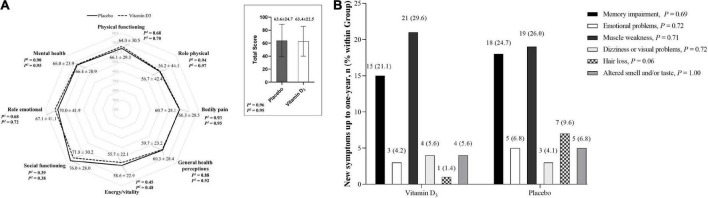
FIGURE 1
FIGURE 1
Quality of life and new symptoms related to COVID-19. (A) Quality of life was assessed using the 36-Item Short Form Health Survey (SF-36) at 6 months. Values are mean ± SD. Data were analyzed using an independent T-test and generalized estimating equations (GEE) with normal distribution and identity link function with the first-order autoregressive correlation matrix. 1P-value represents a 2-tailed independent t-test comparison. 2P-value represents the main effect of the group adjusted by the length of hospital stay. (B) Frequency of new symptoms from hospital discharge to 1 year of follow-up. Values are n (% within the group). Proportions were compared between groups using chi-square tests (χ2). New symptoms were missing for 11.8% of patients (n = 9 in the placebo group and n = 8 in the vitamin D3 group) due to a lack of contact during follow-up.
FIGURE 2
FIGURE 2
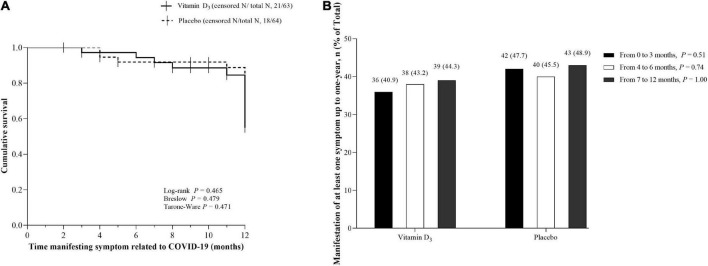
Kaplan-Meier curves for time manifesting symptoms and frequency of participants manifesting at least one symptom up to 1 year. (A) Cumulative survival for time (months) manifesting symptoms related to COVID-19 after hospital discharge in the vitamin D3 (42/63) and placebo groups (46/64). Vertical bars present single censored events (stop manifesting the symptom) in the vitamin D3 (n = 21) and placebo (n = 18) groups. (B) Frequency of participants manifesting at least one symptom from hospital discharge to 1-year follow-up. Values are n (% within the group). Proportions were compared between groups using chi-square tests (χ2). In panels A and B, data were missing for 11.8% of patients (n = 9 in the placebo group and n = 8 in the vitamin D3 group) due to lack of contact during follow-up, representing 127 patients in total.

References

    1. Gupta A, Madhavan MV, Sehgal K, Nair N, Mahajan S, Sehrawat TS, et al. Extrapulmonary manifestations of COVID-19. Nat Med. (2020) 26:1017–32. 10.1038/s41591-020-0968-3 - DOI - PMC - PubMed
    1. Huang C, Huang L, Wang Y, Li X, Ren L, Gu X, et al. 6-month consequences of COVID-19 in patients discharged from hospital: a cohort study. Lancet. (2021) 397:220–32. 10.1016/S0140-6736(20)32656-8 - DOI - PMC - PubMed
    1. Writing Committee for the COMEBAC Study Group, Morin L, Savale L, Pham T, Colle R, Figueiredo S, et al. Four-month clinical status of a cohort of patients after hospitalization for COVID-19. JAMA. (2021) 325:1525–34. 10.1001/jama.2021.3331 - DOI - PMC - PubMed
    1. Shah W, Hillman T, Playford ED, Hishmeh L. Managing the long term effects of covid-19: summary of NICE, SIGN, and RCGP rapid guideline. BMJ. (2021) 372:n136. 10.1136/bmj.n136 - DOI - PubMed
    1. Venkatesan P. NICE guideline on long COVID. Lancet Respir Med. (2021) 9:129. 10.1016/S2213-2600(21)00031-X - DOI - PMC - PubMed

Associated data