


The Impact of Complementary and Alternative Medicine on Insomnia: A Systematic Review
- PMID: 36176875
- PMCID: PMC9509538
- DOI: 10.7759/cureus.28425
The Impact of Complementary and Alternative Medicine on Insomnia: A Systematic Review
Abstract
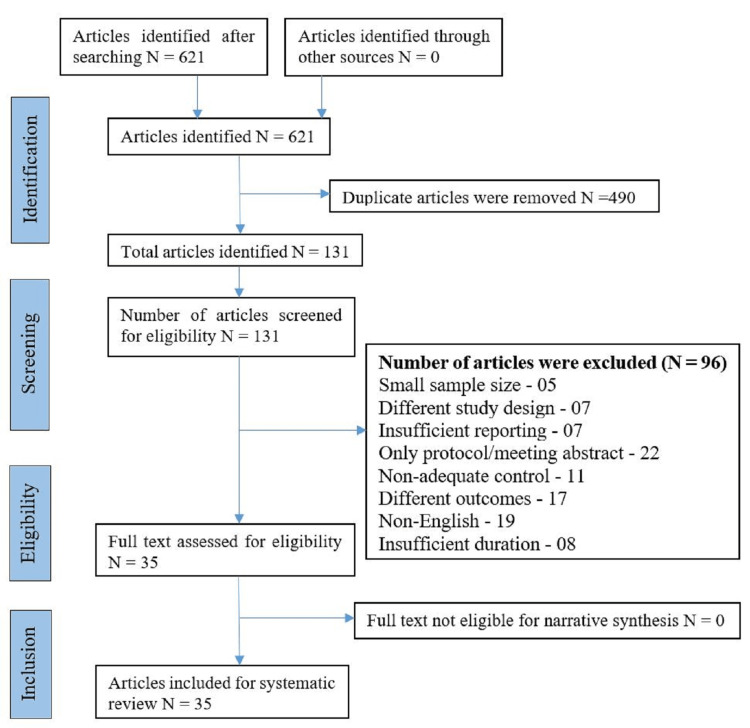
Insomnia is characterized by difficulty in maintaining sleep and early morning awakenings. Although pharmacotherapies and psychological interventions remain essential for conventional treatment, motivational factors and interest in using complementary and alternative therapies for insomnia have developed over the last two decades. This review aims to comprehensively explore the effects of complementary and alternative medicine (CAM) on improving sleep quality to guide evidence-based clinical decision-making and inform future research. Several electronic databases such as MEDLINE, PubMed, Scopus, EMBASE, Clinical key, Cochrane, and Research gate were explored to search the relevant articles. For the systematic review, CAM studies were classified under "manual practices," "natural practices," and "mind-body practices." A total of 35 clinical trials were selected for inclusion in the systematic review, comprising adult samples. The systematic review revealed 11 RCTs with manual practice, 12 with mind-body practice, and 12 with natural medicine practice. The methodological quality of the RCTs was measured using the modified Jadad scale, a scientific quality index of ≥ 5/10 (on the augmented Jadad scale). Effect sizes (Cohen's d) were calculated and reported in all placebo-controlled studies with the available data. Regardless of systematic reviews, and randomized controlled trials on CAM, acupuncture, acupressure, herbal medicine, yoga, and tai chi, for insomnia, most of the RCTs did not agree with the findings. Further RCT for insomnia should be developed by considering the current advanced studies in the field of CAM.
Keywords: acupressure; acupuncture; insomnia; kava; tai-chi; valerian; yoga.
Copyright © 2022, Verma et al.
Conflict of interest statement
The authors have declared that no competing interests exist.
References
-
- A systematic review of insomnia and complementary medicine. Sarris J, Byrne GJ. Sleep Med Rev. 2011;15:99–106. - PubMed
-
- Sleep patterns and insomnia among adolescents: a population-based study. Hysing M, Pallesen S, Stormark KM, Lundervold AJ, Sivertsen B. J Sleep Res. 2013;22:549–556. - PubMed
-
- Nighttime insomnia symptoms and perceived health in the America Insomnia Survey (AIS) Walsh JK, Coulouvrat C, Hajak G, et al. https://doi.org/10.5665/SLEEP.1150. Sleep. 2011;34:997–1011. - PMC - PubMed
-
- Epidemiology of insomnia: prevalence, course, risk factors, and public health burden. Morin CM, Jarrin DC. Sleep Med Clin. 2022;17:173–191. - PubMed
Publication types
LinkOut - more resources
Full Text Sources