


Huntington's Disease: A Clinical Review
- PMID: 36176885
- PMCID: PMC9512951
- DOI: 10.7759/cureus.28484
Huntington's Disease: A Clinical Review
Abstract
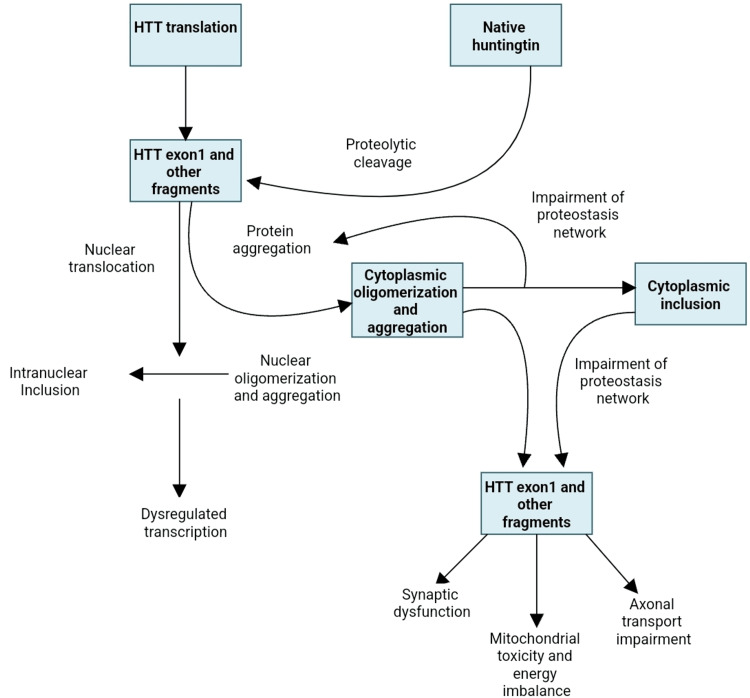
The Huntington's gene on chromosome 4 has a dominantly inherited CAG trinucleotide repeat expansion, ultimately resulting in Huntington's disease (HD), a completely penetrant neurological condition. The frequency is 10-100 times higher in the population descended from Europe than in East Asia. Through various processes, including impairment of proteostasis, transcription, and cell function, as well as direct toxicity of the mutant protein, mutated huntingtin triggers neuronal malfunction and loss at the cellular level. As the disease worsens, the brain becomes affected together with the striatum's initial macroscopic alterations. Since there are presently few medications that can change the course of the disease, palliative therapy, and symptom control are the cornerstone of treatment. Studying the cellular pathology and gross structural changes to the brain which occur as the illness advances have made enormous progress in recent years. There's been a substantial increase in medical studies and possible treatment options over the past ten years. The new treatments that aim to reduce amounts of mutant huntingtin are the most optimistic. However, one strategy is antisense oligonucleotide treatment, for which clinical trials are currently being conducted. These control trials might help us get another inch ahead of managing and perhaps even eliminating this nasty disease.
Keywords: autosomal dominant disease; cag repeat; chorea; genetic disorder; huntington's disease.
Copyright © 2022, Andhale et al.
Conflict of interest statement
The authors have declared that no competing interests exist.
Figures
References
-
- Vinken and Bruyn's handbook of clinical neurology. Koehler PJ, Jennekens FG. J Hist Neurosci. 2008;17:46–55. - PubMed
-
- A novel gene containing a trinucleotide repeat that is expanded and unstable on Huntington’s disease chromosomes. Macdonald M. Cell. 1993;72:971–983. - PubMed
-
- Somatic and gonadal mosaicism of the Huntington’s disease gene CAG repeats in the brain and sperm. [ Jul; 2022 ];Telenius H, Kremer B, Goldberg YP, et al. Nature Gen. 1994 6:409–414. - PubMed
-
- Huntington disease. Bates GP, Dorsey R, Gusella JF, et al. Nat Rev Dis Primers. 2015;1:15005. - PubMed
Publication types
LinkOut - more resources
Full Text Sources
Research Materials
Miscellaneous