


A longitudinal analysis of nosocomial bloodstream infections among preterm neonates
- PMID: 36178568
- PMCID: PMC9556429
- DOI: 10.1007/s10096-022-04502-8
A longitudinal analysis of nosocomial bloodstream infections among preterm neonates
Abstract
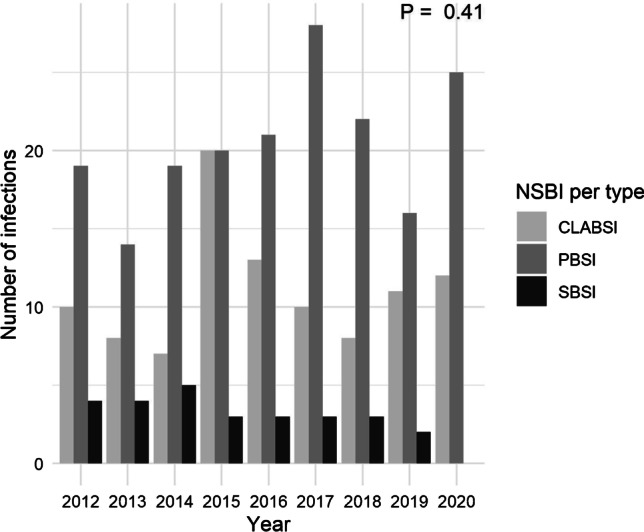
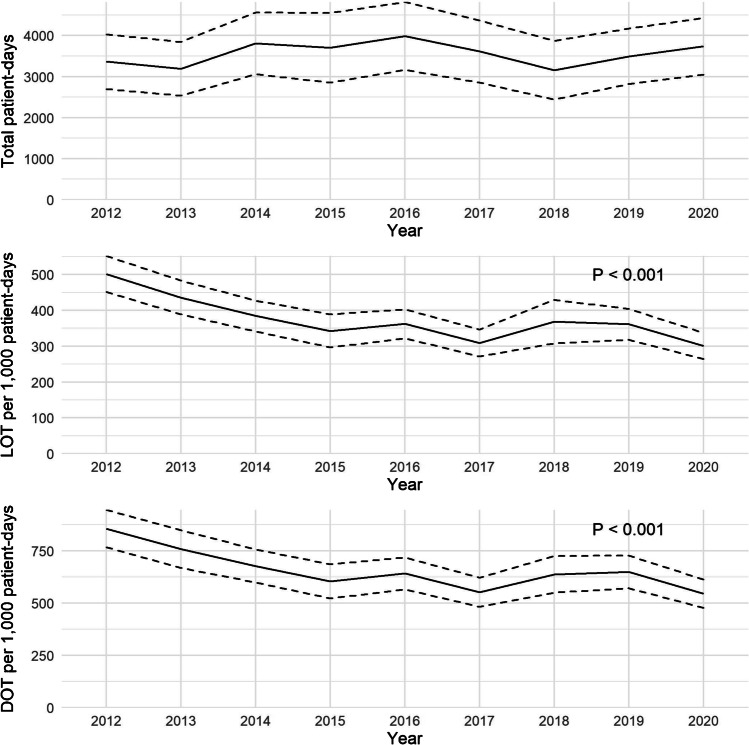
Nosocomial bloodstream infections (NBSIs), commonly due to central-line associated bloodstream infections (CLABSI), contribute substantially to neonatal morbidity and mortality. We aimed to identify longitudinal changes in incidence of NBSI, microbiological-spectrum, and antibiotic exposure in a large cohort of preterm neonates admitted to the neonatal intensive care unit. We retrospectively assessed differences in annual rates of NBSI (per 1000 patient-days), CLABSI (per 1000 central-line days), and antibiotic consumption (per 1000 patient-days) among preterm neonates (< 32 weeks' gestation) hospitalized between January 2012 and December 2020. Multi-state Markov models were created to model states of progression of NBSI and infection risk given a central-line on days 0, 3, 7, and 10 of admission. Of 1547 preterm infants, 292 (19%) neonates acquired 310 NBSI episodes, 99 (32%) of which were attributed to a central-line. Over the years, a significant reduction in central-line use was observed (p < 0.001), although median dwell-time increased (p = 0.002). CLABSI incidence varied from 8.83 to 25.3 per 1000 central-line days, with no significant difference between years (p = 0.27). Coagulase-negative staphylococci accounted for 66% of infections. A significant decrease was found in antibiotic consumption (p < 0.001). Probability of NBSI decreased from 16% on day 3 to 6% on day 10. NBSI remains a common problem in preterm neonates. Overall antibiotic consumption decreased over time despite the absence of a significant reduction in infection rates. Further research aimed at reducing NBSI, in particular CLABSI, is warranted, particularly with regard to limiting central-line dwell-time and fine-tuning insertion and maintenance practices.
Keywords: Central-lines; Epidemiology; Hospital-acquired infections; Neonates.
© 2022. The Author(s).
Conflict of interest statement
The authors declare no competing interests.
Figures


References
-
- Shim GH, Kim SD, Kim HS, Kim ES, Lee HJ, Lee JA, Choi CW, Kim EK, Choi EH, Kim BI, Lee HJ, Choi JH. Trends in epidemiology of neonatal sepsis in a tertiary center in Korea: a 26-year longitudinal analysis, 1980–2005. J Korean Med Sci. 2011;26:284–289. doi: 10.3346/jkms.2011.26.2.284. - DOI - PMC - PubMed
-
- Stoll BJ, Hansen N, Fanaroff AA, Wright LL, Carlo WA, Ehrenkranz RA, Lemons JA, Donovan EF, Stark AR, Tyson JE, Oh W, Bauer CR, Korones SB, Shankaran S, Laptook AR, Stevenson DK, Papile L, Poole WK. Late-onset sepsis in very low birth weight neonates; the experience of the NICHD Neonatal Research Network. Pediatrics. 2002;110:285–291. doi: 10.1542/peds.110.2.285. - DOI - PubMed
-
- Benjamin DK, Stoll BJ, Fanaroff AA, McDonald SA, Oh W, Higgins RD, Duara S, Poole K, Laptook A, Golderb R, National Institute of Child Health and Human Development Neonatal Research Network Neonatal candidiasis among extremely low birth weight infants: risk factors, mortality rates, and neurodevelopmental outcomes at 18–22 months. Pediatrics. 2006;117:84–92. doi: 10.1542/peds.2004-2292. - DOI - PubMed
MeSH terms
Substances
LinkOut - more resources
Full Text Sources
Medical
