


Elevated C-Reactive Protein and Subsequent Patient-Reported Cognitive Problems in Older Breast Cancer Survivors: The Thinking and Living With Cancer Study
- PMID: 36179271
- PMCID: PMC9839283
- DOI: 10.1200/JCO.22.00406
Elevated C-Reactive Protein and Subsequent Patient-Reported Cognitive Problems in Older Breast Cancer Survivors: The Thinking and Living With Cancer Study
Abstract
Purpose: To examine longitudinal relationships between levels of C-reactive protein (CRP) and cognition in older breast cancer survivors and noncancer controls.
Methods: English-speaking women age ≥ 60 years, newly diagnosed with primary breast cancer (stage 0-III), and frequency-matched controls were enrolled from September 2010 to March 2020; women with dementia, neurologic disorders, and other cancers were excluded. Assessments occurred presystemic therapy/enrollment and at annual visits up to 60 months. Cognition was measured using the Functional Assessment of Cancer Therapy-Cognitive Function and neuropsychological testing. Mixed linear effect models tested for survivor-control differences in natural log (ln)-transformed CRP at each visit. Random effect-lagged fluctuation models tested directional effects of ln-CRP on subsequent cognition. All models controlled for age, race, study site, cognitive reserve, obesity, and comorbidities; secondary analyses evaluated if depression or anxiety affected results.
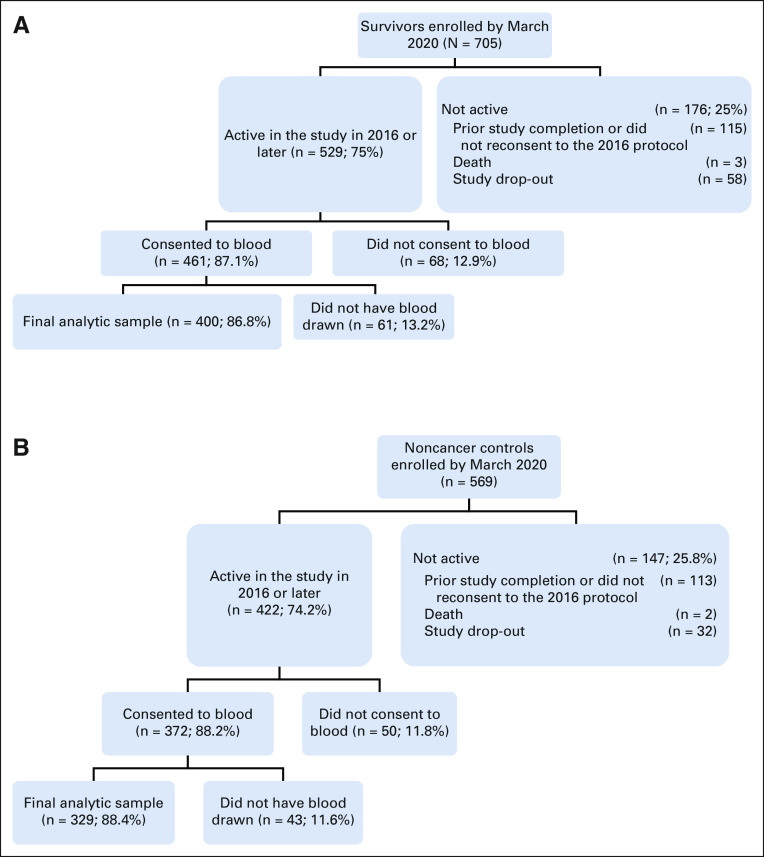
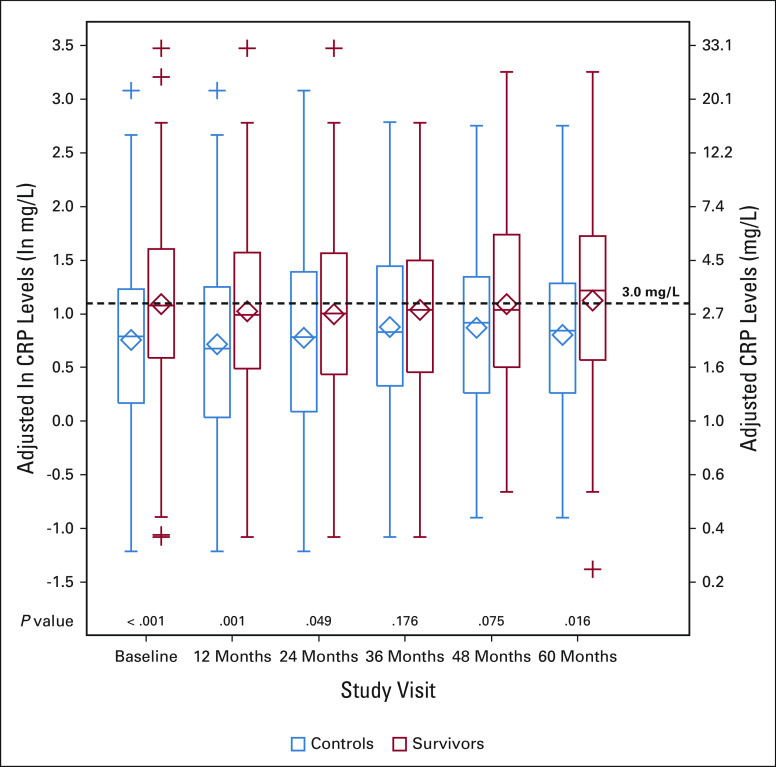
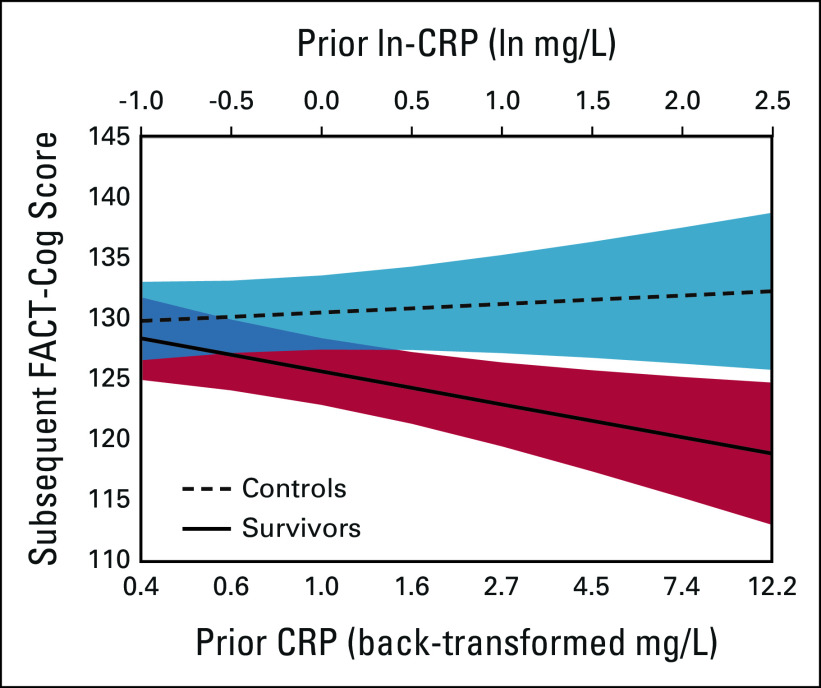
Results: There were 400 survivors and 329 controls with CRP specimens and follow-up data (average age of 67.7 years; range, 60-90 years). The majority of survivors had stage I (60.9%), estrogen receptor-positive (87.6%) tumors. Survivors had significantly higher adjusted mean ln-CRP than controls at baseline and 12-, 24-, and 60-month visits (all P < .05). Higher adjusted ln-CRP predicted lower participant-reported cognition on subsequent visits among survivors, but not controls (P interaction = .008); effects were unchanged by depression or anxiety. Overall, survivors had adjusted Functional Assessment of Cancer Therapy-Cognitive Function scores that were 9.5 and 14.2 points lower than controls at CRP levels of 3.0 and 10.0 mg/L. Survivors had poorer neuropsychological test performance (v controls), with significant interactions with CRP only for the Trails B test.
Conclusion: Longitudinal relationships between CRP and cognition in older breast cancer survivors suggest that chronic inflammation may play a role in development of cognitive problems. CRP testing could be clinically useful in survivorship care.
Conflict of interest statement
No other potential conflicts of interest were reported.
Figures
Comment in
-
Cognitive Problems in Older Breast Cancer Survivors.J Clin Oncol. 2023 Apr 20;41(12):2297-2298. doi: 10.1200/JCO.22.02282. Epub 2023 Feb 13. J Clin Oncol. 2023. PMID: 36780587 No abstract available.
References
-
- Surveillance Epidemiology and End Results (SEER) Program: SEER*Stat Database: Incidence—SEER 21 Regs Research Data, Nov 2018 Sub (2000-2016) <Katrina/Rita Population Adjustment>—Linked to County Attributes—Total U.S., 1969-2017 Counties, Bethesda, MD, National Cancer Institute; 2019
Publication types
MeSH terms
Substances
Grants and funding
- U54 CA137788/CA/NCI NIH HHS/United States
- K01 CA212056/CA/NCI NIH HHS/United States
- R01 CA237535/CA/NCI NIH HHS/United States
- R01 CA244673/CA/NCI NIH HHS/United States
- R56 AG068086/AG/NIA NIH HHS/United States
- K08 CA241337/CA/NCI NIH HHS/United States
- P30 CA008748/CA/NCI NIH HHS/United States
- K99 CA270294/CA/NCI NIH HHS/United States
- R01 CA129769/CA/NCI NIH HHS/United States
- K01 AG065485/AG/NIA NIH HHS/United States
- P30 AG072976/AG/NIA NIH HHS/United States
- T32 CA090314/CA/NCI NIH HHS/United States
- P30 AG010133/AG/NIA NIH HHS/United States
- R01 CA172119/CA/NCI NIH HHS/United States
- U54 CA132378/CA/NCI NIH HHS/United States
- P30 CA051008/CA/NCI NIH HHS/United States
- R01 AG068193/AG/NIA NIH HHS/United States
- P30 AG028716/AG/NIA NIH HHS/United States
- R35 CA197289/CA/NCI NIH HHS/United States
- K12 HD001441/HD/NICHD NIH HHS/United States
LinkOut - more resources
Full Text Sources
Medical
Research Materials
Miscellaneous
