


Association Between Aluminum Exposure From Vaccines Before Age 24 Months and Persistent Asthma at Age 24 to 59 Months
- PMID: 36180331
- PMCID: PMC10109516
- DOI: 10.1016/j.acap.2022.08.006
Association Between Aluminum Exposure From Vaccines Before Age 24 Months and Persistent Asthma at Age 24 to 59 Months
Abstract
Objective: To assess the association between cumulative aluminum exposure from vaccines before age 24 months and persistent asthma at age 24 to 59 months.
Methods: A retrospective cohort study was conducted in the Vaccine Safety Datalink (VSD). Vaccination histories were used to calculate cumulative vaccine-associated aluminum in milligrams (mg). The persistent asthma definition required one inpatient or 2 outpatient asthma encounters, and ≥2 long-term asthma control medication dispenses. Cox proportional hazard models were used to evaluate the association between aluminum exposure and asthma incidence, stratified by eczema presence/absence. Adjusted hazard ratios (aHR) and 95% confidence intervals (CI) per 1 mg increase in aluminum exposure were calculated, adjusted for birth month/year, sex, race/ethnicity, VSD site, prematurity, medical complexity, food allergy, severe bronchiolitis, and health care utilization.
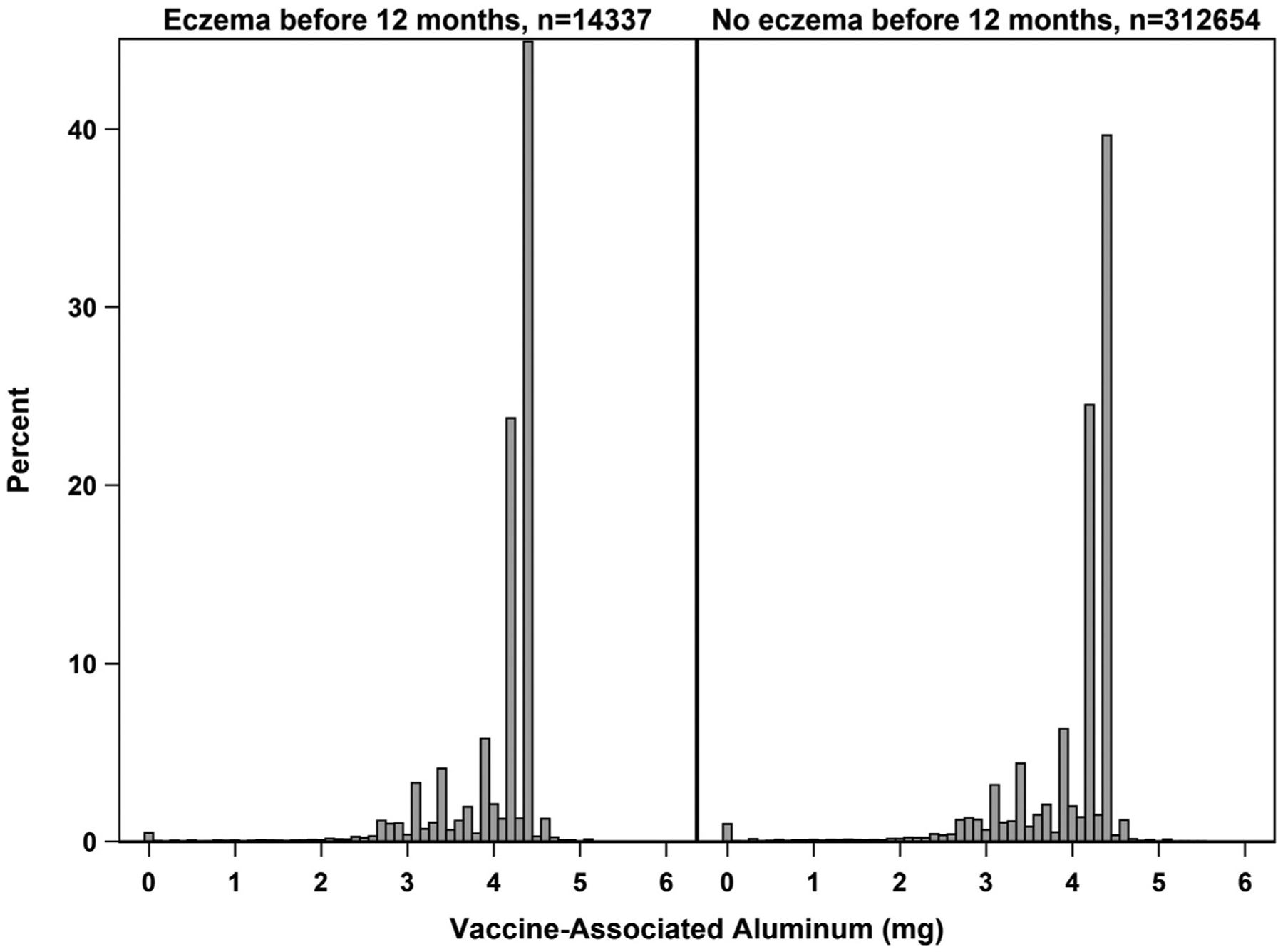
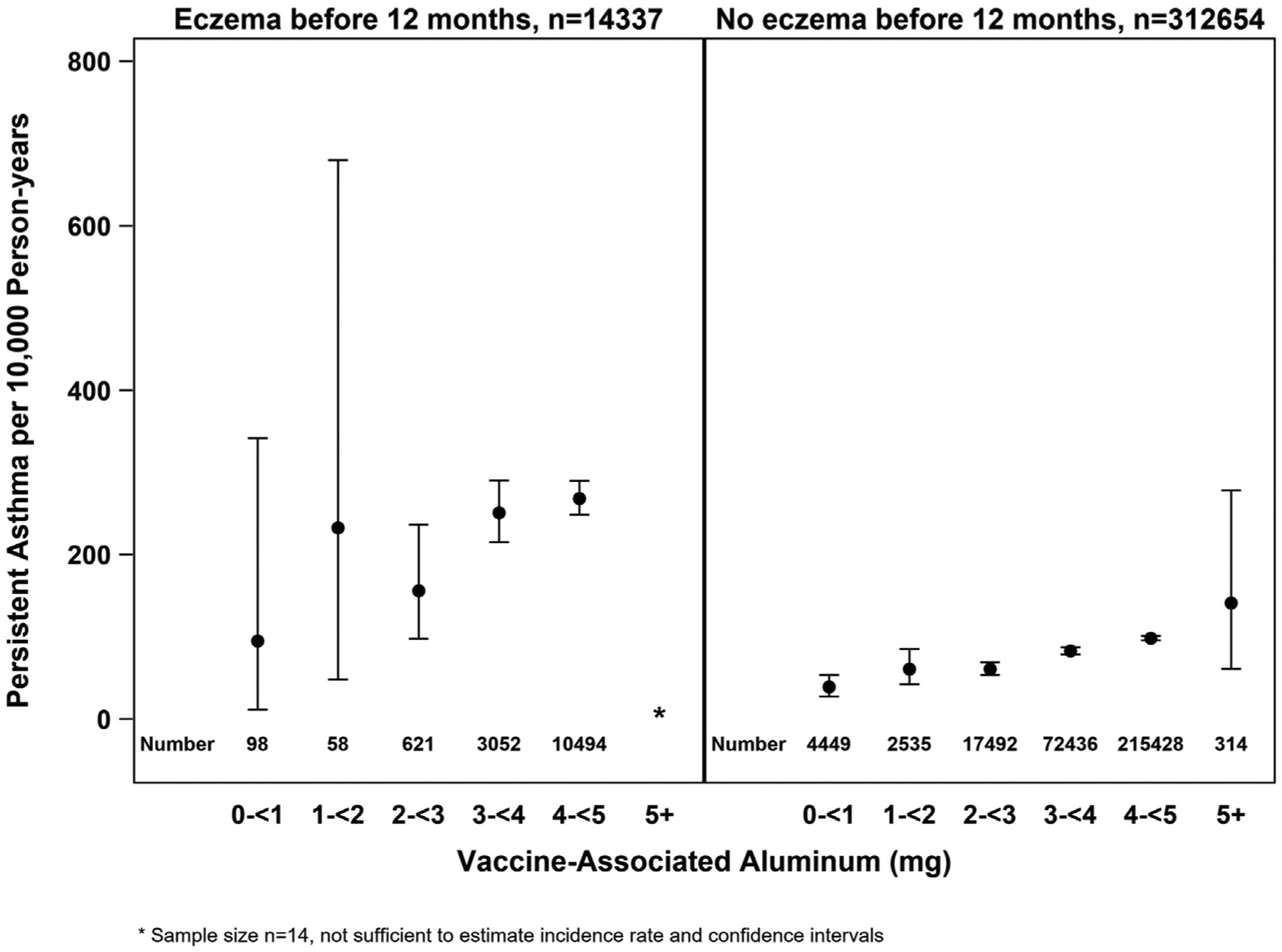
Results: The cohort comprised 326,991 children, among whom 14,337 (4.4%) had eczema. For children with and without eczema, the mean (standard deviation [SD]) vaccine-associated aluminum exposure was 4.07 mg (SD 0.60) and 3.98 mg (SD 0.72), respectively. Among children with and without eczema, 6.0% and 2.1%, respectively, developed persistent asthma. Among children with eczema, vaccine-associated aluminum was positively associated with persistent asthma (aHR 1.26 per 1 mg increase in aluminum, 95% CI 1.07, 1.49); a positive association was also detected among children without eczema (aHR 1.19, 95% CI 1.14, 1.25).
Conclusion: In a large observational study, a positive association was found between vaccine-related aluminum exposure and persistent asthma. While recognizing the small effect sizes identified and the potential for residual confounding, additional investigation of this hypothesis appears warranted.
Keywords: aluminum; asthma; immunization; vaccine safety; vaccine schedule.
Copyright © 2022 Academic Pediatric Association. All rights reserved.
Conflict of interest statement
The authors have no conflicts of interest relevant to this article to disclose.
Figures
References
-
- Institute of Medicine. Adverse Effects of Vaccines: Evidence and Causality. Washington, DC: National Academies Press; 2011. - PubMed
