


Estimating the effect of the wMel release programme on the incidence of dengue and chikungunya in Rio de Janeiro, Brazil: a spatiotemporal modelling study
- PMID: 36182679
- PMCID: PMC9630156
- DOI: 10.1016/S1473-3099(22)00436-4
Estimating the effect of the wMel release programme on the incidence of dengue and chikungunya in Rio de Janeiro, Brazil: a spatiotemporal modelling study
Abstract
Background: Introgression of genetic material from species of the insect bacteria Wolbachia into populations of Aedes aegypti mosquitoes has been shown in randomised and non-randomised trials to reduce the incidence of dengue; however, evidence for the real-world effectiveness of large-scale deployments of Wolbachia-infected mosquitoes for arboviral disease control in endemic settings is still scarce. A large Wolbachia (wMel strain) release programme was implemented in 2017 in Rio de Janeiro, Brazil. We aimed to assess the effect of this programme on the incidence of dengue and chikungunya in the city.
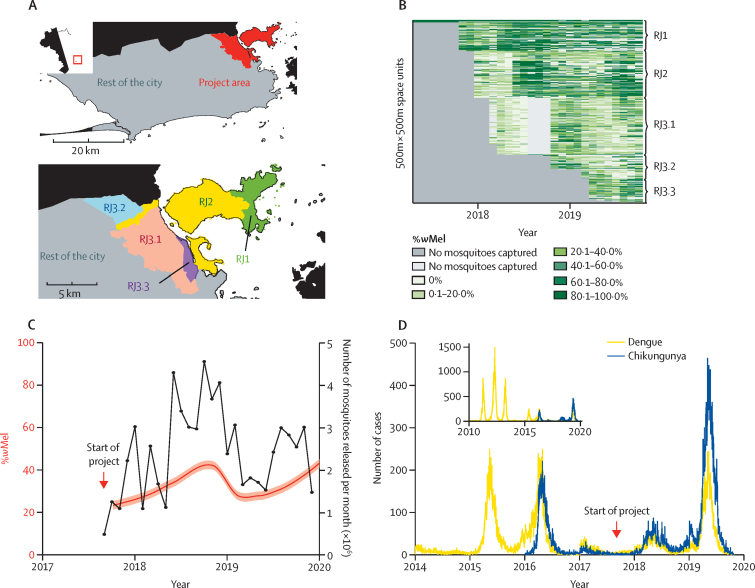
Methods: 67 million wMel-infected mosquitoes were released across 28 489 locations over an area of 86·8 km2 in Rio de Janeiro between Aug 29, 2017 and Dec 27, 2019. Following releases, mosquitoes were trapped and the presence of wMel was recorded. In this spatiotemporal modelling study, we assessed the effect of the release programme on the incidence of dengue and chikungunya. We used spatiotemporally explicit mathematical models applied to geocoded dengue cases (N=283 270) from 2010 to 2019 and chikungunya cases (N=57 705) from 2016 to 2019.
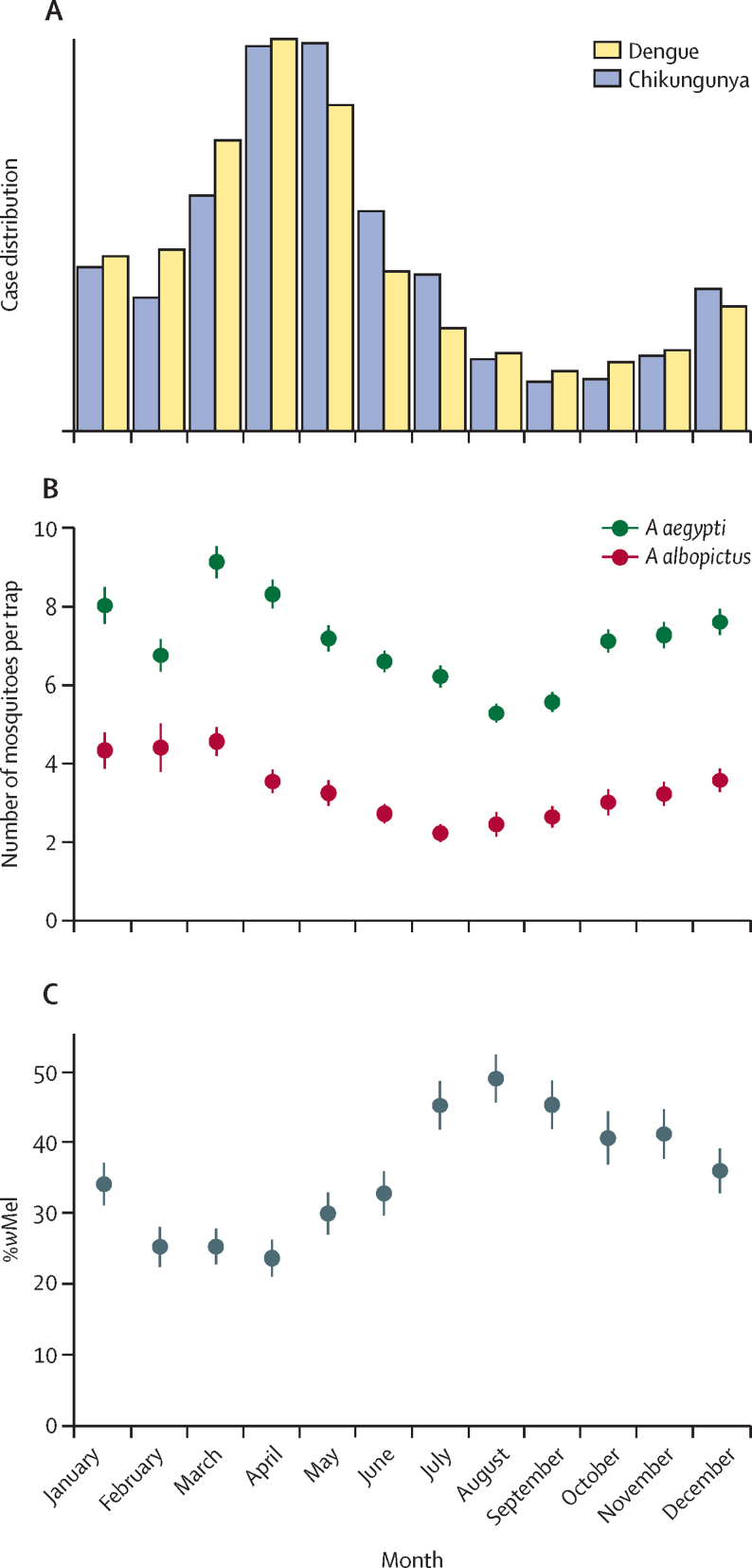
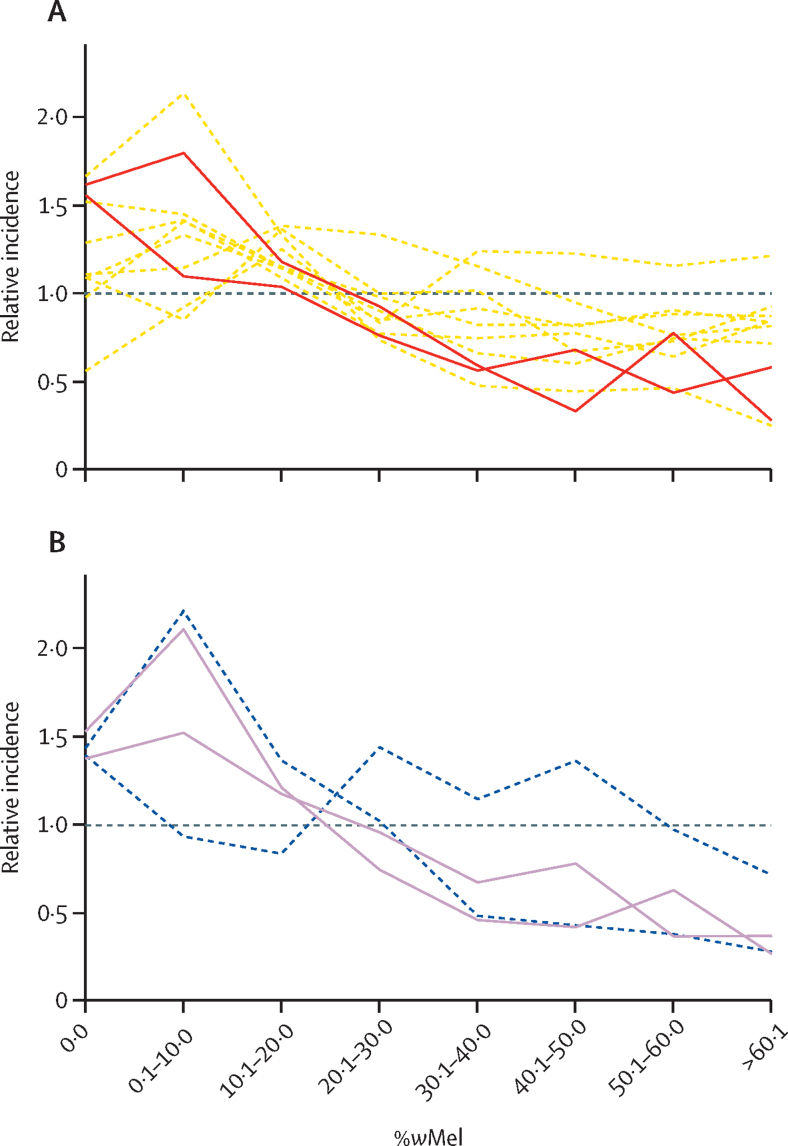
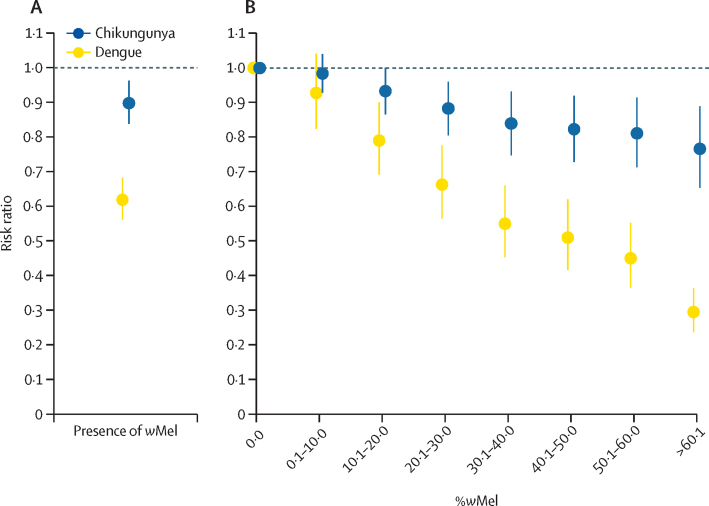
Findings: On average, 32% of mosquitoes collected from the release zones between 1 month and 29 months after the initial release tested positive for wMel. Reduced wMel introgression occurred in locations and seasonal periods in which cases of dengue and chikungunya were historically high, with a decrease to 25% of mosquitoes testing positive for wMel during months in which disease incidence was at its highest. Despite incomplete introgression, we found that the releases were associated with a 38% (95% CI 32-44) reduction in the incidence of dengue and a 10% (4-16) reduction in the incidence of chikungunya.
Interpretation: Stable establishment of wMel in the geographically diverse, urban setting of Rio de Janeiro seems to be more complicated than has been observed elsewhere. However, even intermediate levels of wMel seem to reduce the incidence of disease caused by two arboviruses. These findings will help to guide future release programmes.
Funding: Bill & Melinda Gates Foundation and the European Research Council.
Copyright © 2022 The Author(s). Published by Elsevier Ltd. This is an Open Access article under the CC BY-NC-ND 4.0 license. Published by Elsevier Ltd.. All rights reserved.
Conflict of interest statement
Declaration of interests We declare no competing interests.
Figures
Comment in
-
Externalities modulate the effectiveness of the Wolbachia release programme.Lancet Infect Dis. 2022 Nov;22(11):1518-1519. doi: 10.1016/S1473-3099(22)00497-2. Epub 2022 Sep 28. Lancet Infect Dis. 2022. PMID: 36182681 No abstract available.
References
-
- Pan American Health Organization Chikungunya weekly report. Jan 17, 2019. https://www3.paho.org/data/index.php/en/mnu-topics/chikv-en/550-chikv-we...
-
- Hoffmann AA, Montgomery BL, Popovici J, et al. Successful establishment of Wolbachia in Aedes populations to suppress dengue transmission. Nature. 2011;476:454–457. - PubMed
-
- Walker T, Johnson PH, Moreira LA, et al. The wMel Wolbachia strain blocks dengue and invades caged Aedes aegypti populations. Nature. 2011;476:450–453. - PubMed
Publication types
MeSH terms
LinkOut - more resources
Full Text Sources
Medical
Research Materials
