. 2022 Nov 7;32(21):4743-4751.e6.
doi: 10.1016/j.cub.2022.09.023. Epub 2022 Oct 1.

The population genomic legacy of the second plague pandemic

Shyam Gopalakrishnan  1 S Sunna Ebenesersdóttir  2 Inge K C Lundstrøm  3 Gordon Turner-Walker  4 Kristjan H S Moore  5 Pierre Luisi  6 Ashot Margaryan  3 Michael D Martin  7 Martin Rene Ellegaard  8 Ólafur Þ Magnússon  5 Ásgeir Sigurðsson  5 Steinunn Snorradóttir  5 Droplaug N Magnúsdóttir  5 Jason E Laffoon  9 Lucy van Dorp  10 Xiaodong Liu  11 Ida Moltke  11 María C Ávila-Arcos  12 Joshua G Schraiber  13 Simon Rasmussen  14 David Juan  15 Pere Gelabert  16 Toni de-Dios  15 Anna K Fotakis  3 Miren Iraeta-Orbegozo  3 Åshild J Vågene  17 Sean Dexter Denham  18 Axel Christophersen  7 Hans K Stenøien  7 Filipe G Vieira  3 Shanlin Liu  19 Torsten Günther  20 Toomas Kivisild  21 Ole Georg Moseng  22 Birgitte Skar  7 Christina Cheung  23 Marcela Sandoval-Velasco  3 Nathan Wales  24 Hannes Schroeder  3 Paula F Campos  25 Valdís B Guðmundsdóttir  2 Thomas Sicheritz-Ponten  26 Bent Petersen  26 Jostein Halgunset  27 Edmund Gilbert  28 Gianpiero L Cavalleri  28 Eivind Hovig  29 Ingrid Kockum  30 Tomas Olsson  30 Lars Alfredsson  31 Thomas F Hansen  32 Thomas Werge  33 Eske Willerslev  34 Francois Balloux  10 Tomas Marques-Bonet  35 Carles Lalueza-Fox  36 Rasmus Nielsen  37 Kári Stefánsson  38 Agnar Helgason  2 M Thomas P Gilbert  8
Affiliations

The population genomic legacy of the second plague pandemic

Shyam Gopalakrishnan et al. Curr Biol. .

Abstract

Human populations have been shaped by catastrophes that may have left long-lasting signatures in their genomes. One notable example is the second plague pandemic that entered Europe in ca. 1,347 CE and repeatedly returned for over 300 years, with typical village and town mortality estimated at 10%-40%.1 It is assumed that this high mortality affected the gene pools of these populations. First, local population crashes reduced genetic diversity. Second, a change in frequency is expected for sequence variants that may have affected survival or susceptibility to the etiologic agent (Yersinia pestis).2 Third, mass mortality might alter the local gene pools through its impact on subsequent migration patterns. We explored these factors using the Norwegian city of Trondheim as a model, by sequencing 54 genomes spanning three time periods: (1) prior to the plague striking Trondheim in 1,349 CE, (2) the 17th-19th century, and (3) the present. We find that the pandemic period shaped the gene pool by reducing long distance immigration, in particular from the British Isles, and inducing a bottleneck that reduced genetic diversity. Although we also observe an excess of large FST values at multiple loci in the genome, these are shaped by reference biases introduced by mapping our relatively low genome coverage degraded DNA to the reference genome. This implies that attempts to detect selection using ancient DNA (aDNA) datasets that vary by read length and depth of sequencing coverage may be particularly challenging until methods have been developed to account for the impact of differential reference bias on test statistics.

Keywords: Trondheim; Yersinia pestis; pandemic genomics; plague; population genomics; population replacement; second plague pandemic; selection.


Conflict of interest statement

Declaration of interests The authors declare no competing interests.

Figures
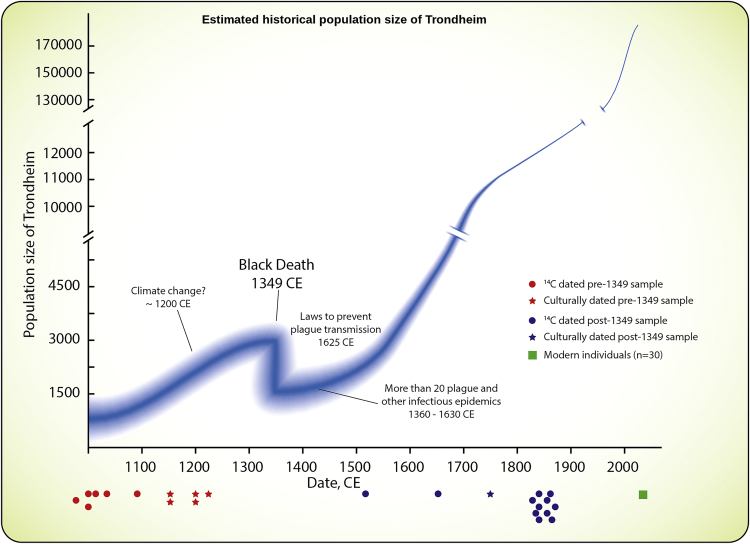
Figure 1
Figure 1
Estimated population size in Trondheim Illustrative reconstruction of Trondheim’s population size from 1,000 CE (based on Sandnes and Salvesen, Christophersen, and Sandnes and Supphellen9). Three major demographic phases were experienced: (1) an initial growth period up until around the 14th century, (2) a plague pandemic induced bottleneck followed by a low, fluctuating population size for ca. 300 years up to the mid-17th century, and (3) relatively rapid growth from ca. 1,650 CE. The midpoint of the estimate of the ages of samples from which genomic data were generated is shown on the x axis—for full age distributions see Table S1. See also Figure S1 and Data S1A.
Figure 2
Figure 2
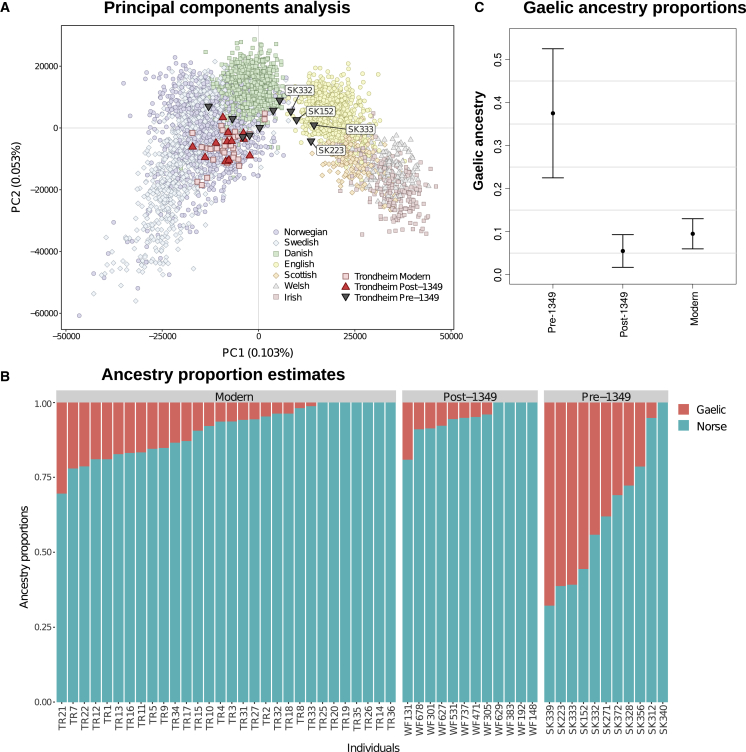
Ancestry estimates of ancient and modern Trondheim individuals (A) Principal-component analysis projection of the ancient and modern Trondheim individuals on the principal components estimated in reference populations from Scandinavia and the British Isles. (B) Ancestry proportions estimated for ancient and modern Trondheim samples, visualized using a supervised ADMIXTURE analysis with modern Norse and Gaelic populations used as the two reference populations. The high proportion of Gaelic ancestry in SK339 can likely be attributed to its low sequencing coverage. (C) The mean Gaelic ancestry of the three temporal groups from Trondheim, based on the ADMIXTURE results with 95% CI shown as error bars. See also Figures S2 and S3.
Figure 3
Figure 3
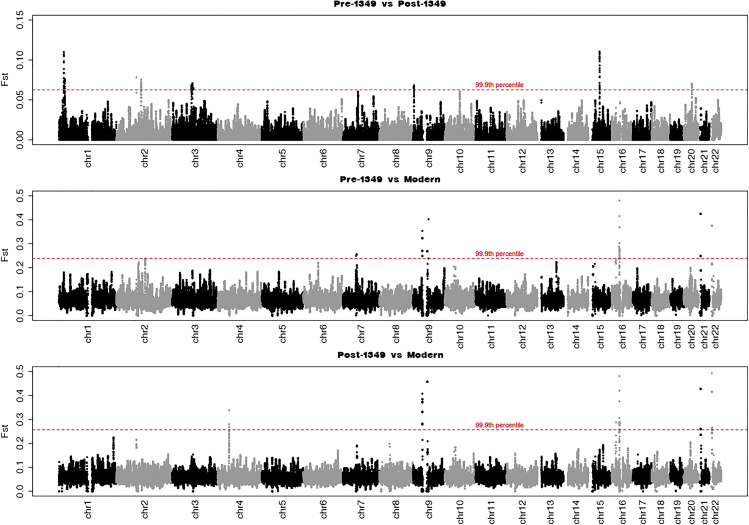
Population-pairwise FST estimates The Bhatia-Hudson estimate of FST (uncorrected for reference genome bias) for each of the two-way population comparisons, computed across the entire genome in 500-kb overlapping windows, using a step size of 20 kb. See also Figure S4.
Figure 4
Figure 4
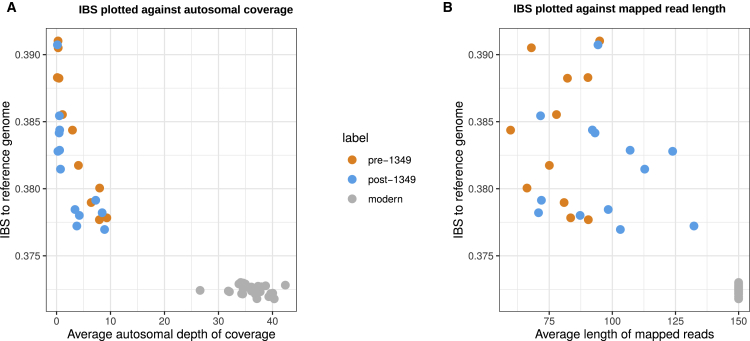
Reference bias among the historical samples The proportion of sites that are shared identical-by-state (IBS) to reference genome plotted as a function of sample characteristics. (A) The IBS values are plotted against the average autosomal sequencing depth of the samples. (B) The IBS values are plotted as a function of the length of mapped reads, for ancient and modern Trondheim individuals.

References

    1. Slack P. Routledge & K. Paul; 1985. The Impact of Plague in Tudor and Stuart England.
    1. Laayouni H., Oosting M., Luisi P., Ioana M., Alonso S., Ricaño-Ponce I., Trynka G., Zhernakova A., Plantinga T.S., Cheng S.-C., et al. Convergent evolution in European and Rroma populations reveals pressure exerted by plague on toll-like receptors. Proc. Natl. Acad. Sci. USA. 2014;111:2668–2673. - PMC - PubMed
    1. Gilbert M.T.P., Hansen A.J., Willerslev E., Turner-Walker G., Collins M.J. Insights into the processes behind the contamination of degraded human teeth and bone samples with exogenous sources of DNA. Int. J. Osteoarchaeol. 2006;16:156–164.
    1. Gissel S. Almqvist & Wiksell International; 1981. Desertion and Land Colonization in the Nordic Countries C. 1300–1600: Comparative Report from the Scandinavian Research Project on Deserted Farms and Villages.
    1. Sandnes J., Salvesen H. University Press; 1978. Ødegårdstid i Norge: Det Nordiske ødegårdsprosjekts norske undersøkelser (Nordiske Ødegårdsprosjekt; nr. 4)

Publication types