


Working with alcohol prevention in occupational health services: "knowing how" is more important than "knowing that" - the WIRUS OHS study
- PMID: 36183127
- PMCID: PMC9526525
- DOI: 10.1186/s13722-022-00335-0
Working with alcohol prevention in occupational health services: "knowing how" is more important than "knowing that" - the WIRUS OHS study
Abstract
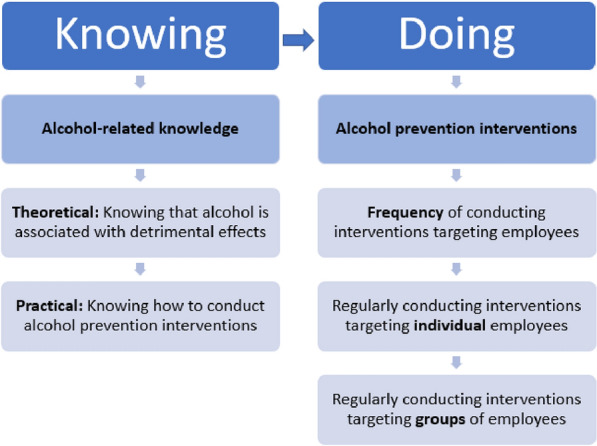
Background: Alcohol consumption is a major public health challenge; the majority of employees consume alcohol regularly and a considerable proportion of employees can be characterized as risky drinkers in need of interventions. Occupational health services (OHS) are uniquely positioned for implementing alcohol prevention interventions targeting employees, but rarely do so. Studies have shown that lack of knowledge among OHS personnel is a barrier to alcohol prevention activity. This study aimed to explore OHS personnels' levels of theoretical and practical alcohol knowledge, and whether these two ways of knowing were differentially associated with alcohol prevention activity.
Methods: In this cross-sectional study, survey data were collected from 322 OHS personnel in Norway in 2018 (response rate = 53.6%). The survey included variables of two ways of knowing (theoretical and practical) and three types of doing (intervention frequency, conducting individual interventions, and conducting group interventions). Data were analyzed with descriptive statistics, paired sample t-tests, bivariate correlations, and adjusted linear and logistic regression analyses.
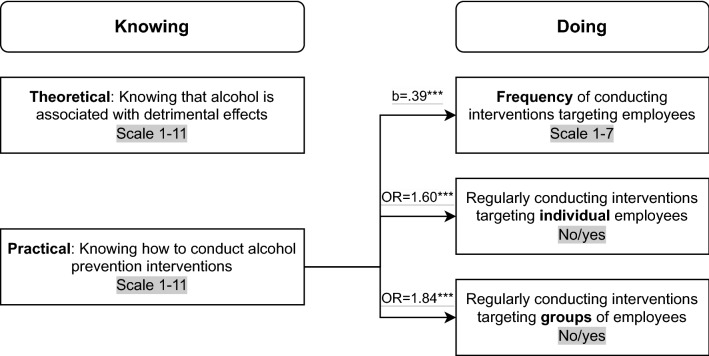
Results: OHS personnel rated their theoretical alcohol knowledge higher than their practical knowledge (η2 = 0.33, p < 0.001). Higher reported levels of practical knowledge were associated with higher intervention frequency (b = 0.39, β = 0.60, p < 0.001) and greater likelihood of conducting individual interventions (OR = 1.60, p < .001) as well as group interventions (OR = 1.84, p < 0.001). Theoretical knowledge was not associated with conducting interventions, and there was no evidence of an interaction between the two ways of knowing in their association with doing. Sensitivity analyses did not indicate clustering effects of OHS personnel being employed within different units.
Conclusions: Different ways of knowing about alcohol among OHS personnel were dissimilarly associated with conducting alcohol prevention interventions in occupational health settings. For doing, knowing how seems to be more important than knowing that. Training programs for OHS personnel should emphasize knowledge about how to deal with alcohol-related issues and how to conduct prevention interventions, rather than focus on detrimental effects of alcohol.
Keywords: Alcohol consumption; Knowledge translation; Occupational health services; Prevention; Workforce; Workplace interventions.
© 2022. The Author(s).
Conflict of interest statement
The authors declare that they have no competing interests.
Figures
Similar articles
-
Current practices and perceived implementation barriers for working with alcohol prevention in occupational health services: the WIRUS OHS study.Subst Abuse Treat Prev Policy. 2019 Jun 26;14(1):30. doi: 10.1186/s13011-019-0217-2. Subst Abuse Treat Prev Policy. 2019. PMID: 31242911 Free PMC article.
-
Do health professionals' attitudes towards alcohol use matter for alcohol prevention efforts? Results from the WIRUS-OHS study.BMC Health Serv Res. 2022 Aug 6;22(1):1004. doi: 10.1186/s12913-022-08400-9. BMC Health Serv Res. 2022. PMID: 35933345 Free PMC article.
-
Willingness to Participate in Alcohol Prevention Interventions Targeting Risky Drinking Employees. The WIRUS Project.Front Public Health. 2021 Jun 25;9:692605. doi: 10.3389/fpubh.2021.692605. eCollection 2021. Front Public Health. 2021. PMID: 34249850 Free PMC article. Clinical Trial.
-
Interventions for common mental disorders in the occupational health service: a systematic review with a narrative synthesis.Int Arch Occup Environ Health. 2020 Oct;93(7):823-838. doi: 10.1007/s00420-020-01535-4. Epub 2020 Apr 3. Int Arch Occup Environ Health. 2020. PMID: 32246230 Free PMC article.
-
Accessing Occupational Health Services in the Southern African Development Community Region.Int J Environ Res Public Health. 2020 Sep 17;17(18):6767. doi: 10.3390/ijerph17186767. Int J Environ Res Public Health. 2020. PMID: 32957436 Free PMC article. Review.
Cited by
-
Adjusting the 15-method to Danish general practice: identification of barriers, facilitators, and user needs.BMC Prim Care. 2024 Jul 6;25(1):248. doi: 10.1186/s12875-024-02508-z. BMC Prim Care. 2024. PMID: 38971738 Free PMC article.
References
-
- Wood AM, Kaptoge S, Butterworth AS, Willeit P, Warnakula S, Bolton T, et al. Risk thresholds for alcohol consumption: combined analysis of individual-participant data for 599 912 current drinkers in 83 prospective studies. Lancet. 2018;391:1513–1523. doi: 10.1016/S0140-6736(18)30134-X. - DOI - PMC - PubMed
Publication types
MeSH terms
LinkOut - more resources
Full Text Sources
Medical
