


Mammographic breast density and the risk of breast cancer: A systematic review and meta-analysis
- PMID: 36183671
- PMCID: PMC9530665
- DOI: 10.1016/j.breast.2022.09.007
Mammographic breast density and the risk of breast cancer: A systematic review and meta-analysis
Abstract
Objectives: Mammographic density is a well-defined risk factor for breast cancer and having extremely dense breast tissue is associated with a one-to six-fold increased risk of breast cancer. However, it is questioned whether this increased risk estimate is applicable to current breast density classification methods. Therefore, the aim of this study was to further investigate and clarify the association between mammographic density and breast cancer risk based on current literature.
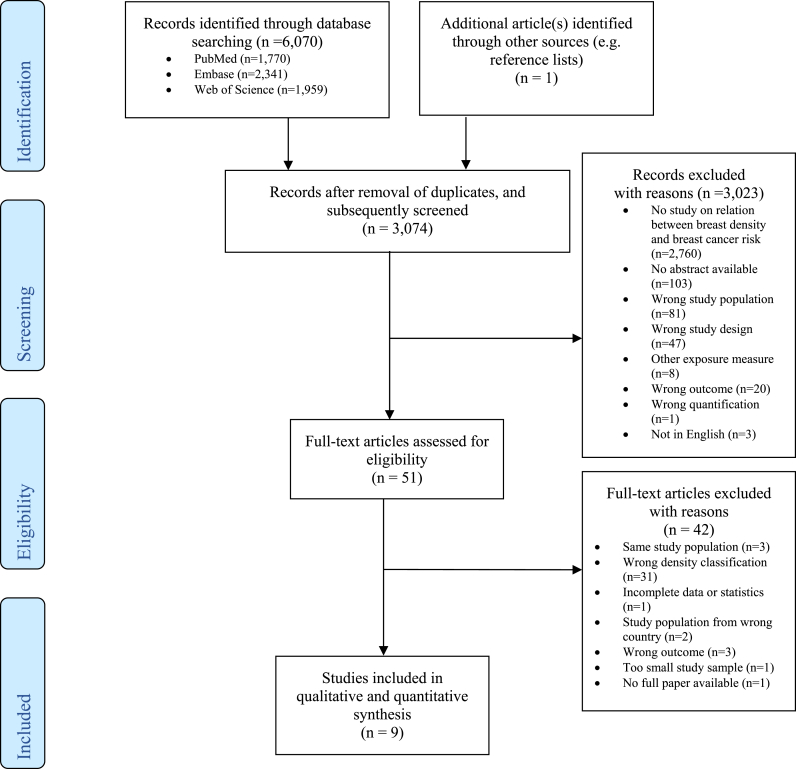
Methods: Medline, Embase and Web of Science were systematically searched for articles published since 2013, that used BI-RADS lexicon 5th edition and incorporated data on digital mammography. Crude and maximally confounder-adjusted data were pooled in odds ratios (ORs) using random-effects models. Heterogeneity regarding breast cancer risks were investigated using I2 statistic, stratified and sensitivity analyses.
Results: Nine observational studies were included. Having extremely dense breast tissue (BI-RADS density D) resulted in a 2.11-fold (95% CI 1.84-2.42) increased breast cancer risk compared to having scattered dense breast tissue (BI-RADS density B). Sensitivity analysis showed that when only using data that had adjusted for age and BMI, the breast cancer risk was 1.83-fold (95% CI 1.52-2.21) increased. Both results were statistically significant and homogenous.
Conclusions: Mammographic breast density BI-RADS D is associated with an approximately two-fold increased risk of breast cancer compared to having BI-RADS density B in general population women. This is a novel and lower risk estimate compared to previously reported and might be explained due to the use of digital mammography and BI-RADS lexicon 5th edition.
Keywords: BI-RADS; Breast cancer; Breast cancer risk; Breast density; Mammographic density.
Copyright © 2022 The Authors. Published by Elsevier Ltd.. All rights reserved.
Conflict of interest statement
Declaration of competing interest The authors declare that they have no known competing financial interests or personal relationships that could have appeared to influence the work reported in this paper.
Figures


References
-
- Torre L.A., Siegel R.L., Ward E.M., Jemal A. Global cancer incidence and mortality rates and trends - an update. Cancer Epidemiol Biomarkers Prev. 2016 Jan 1;25(1):16–27. - PubMed
-
- Lauby-Secretan B., Scoccianti C., Loomis D., Benbrahim-Tallaa L., Bouvard V., Bianchini F., et al. Breast-cancer screening — viewpoint of the IARC working group. N Engl J Med. 2015 Jun 11;372(24):2353–2358. - PubMed
-
- Njor S., Nystrom L., Moss S., Paci E., Broeders M., Segnan N., et al. Breast cancer mortality in mammographic screening in Europe: a review of incidence-based mortality studies. J Med Screen. 2012 Sep;19(SUPPL. 1):33–41. - PubMed
-
- Fracheboud J., van Luijt P.A., Sankatsing V.D.V., Ripping T.M., Broeders M.J.M., Otten J.D.M., et al. Erasmus MC; Rotterdam: 2014. National evaluation of breast cancer screening in The Netherlands 1990 – 2011/2012 [Internet]https://www.lrcb.nl/resources/uploads/2017/02/LETB-XIII-English.pdf [cited 2020 Jun 15]. Available from:
Publication types
MeSH terms
LinkOut - more resources
Full Text Sources
Medical
