. 2022 Sep 22;11(1):2124678.
doi: 10.1080/2162402X.2022.2124678. eCollection 2022.

Urinary T cells are detected in patients with immune checkpoint inhibitor-associated immune nephritis that are clonotypically identical to kidney T cell infiltrates

Affiliations

Urinary T cells are detected in patients with immune checkpoint inhibitor-associated immune nephritis that are clonotypically identical to kidney T cell infiltrates

Shailbala Singh et al. Oncoimmunology. .

Abstract

Acute kidney injury (AKI) occurs in ~20% of patients receiving immune checkpoint inhibitor (ICI) therapy; however, only 2-5% will develop ICI-mediated immune nephritis. Conventional tests are nonspecific in diagnosing disease pathology and invasive procedures (i.e. kidney biopsy) may not be feasible. In other autoimmune renal diseases, urinary immune cells correlated with the pathology or were predictive of disease activity. Corresponding evidence and analysis are absent for ICI-mediated immune nephritis. We report the first investigation analyzing immune cell profiles of matched kidney biopsies and urine of patients with ICI-AKI. We demonstrated the presence of urinary T cells in patients with immune nephritis by flow cytometry analysis. Clonotype analysis of T cell receptor (TCR) sequences confirmed enrichment of kidney TCRs in urine. As ICI therapies become standard of care for more cancers, noninvasively assessing urinary immune cells of ICI therapy recipients can facilitate clinical management and an opportunity to tailor ICI-nephritis treatment.

Keywords: Immune checkpoint inhibitor; T cell receptor clonotype; acute interstitial nephritis; acute kidney injury; immune nephritis; immune-related adverse event; urinary immune cells.


Conflict of interest statement

The authors declare that they have no competing interests.

Figures
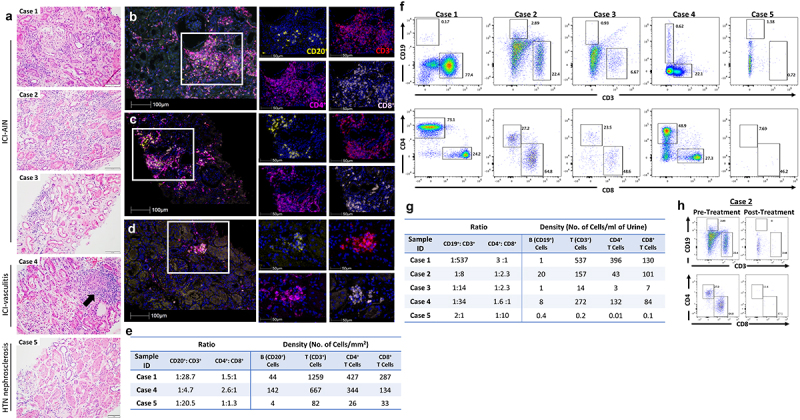
Figure 1.
Figure 1.
Pathologic representative images. (a) Photomicrographs of hematoxylin and eosin (H&E)-stained renal tissue sections, 20x magnification. Case 1–3: active tubulointerstitial nephritis with lymphocytic tubulitis. Case 4: necrotizing vasculitis with granuloma formation (black arrow). Case 5: renal cortex without significant inflammation. (B, C, D) Multiplex immunofluorescence (mIF) staining with immune-oncology panel composed of anti-CD20 (yellow), anti-CD3 (red), anti-CD4 (magenta) and anti-CD8 (pink) antibodies for Case 1 (b), Case 4 (c) and Case 5 (d). mIF composite images (left) 20x magnification and details (right) 40x magnification. (e) Ratio of B to T cells and CD4+T to CD8+T cells and density of cells per mm2. Flow cytometric analysis was performed on mononuclear cells isolated from urine and frequencies and density of B (CD19+) and T (CD3+) cells in viable mononuclear cell fraction and CD4+ T and CD8+ T cells in T cell fraction were assessed. (f) Phenotypic profile of lymphocytes isolated from urine of Cases 1–5. (g) Ratio of B to T cells and CD4+ T to CD8+ T cells and density of cells in urine samples. (h) Phenotypic profile of lymphocytes isolated from urine of Case 2 pre- and post-corticosteroid therapy.
Figure 2.
Figure 2.
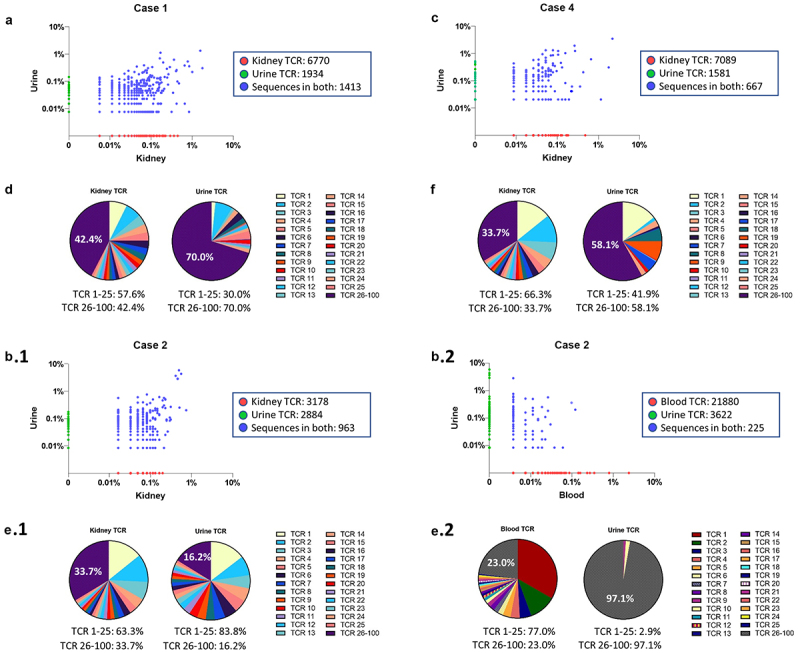
Composition of TCR repertoires in Case 1, 2 and 4. (A, B, C) Scatterplot of TCRβ sequences in paired specimens. TCRβ sequences shared in paired specimens (blue dots). Non-shared TCRβ sequences are located on x-axis (red dots) or y-axis (green dots). (a) In Case 1, a total of 3,347 urine TCRβ sequences were detected (3,347 TCRβ = 1,413 shared TCRβ sequences + 1,934 TCRβ sequences unique to urine) where 42.2% urine TCRβ sequences were also found in the kidney TCRβ sequences. (B.1 and B.2) In Case 2, 25% urine TCRβ sequences (963 shared TCRβ sequences out of a total of 3,847 urine TCRβ sequences) were also found in kidney TCRβ sequences, but only 5.8% of TCRβ sequences in urine (225 shared TCRβ sequences out of a total of 3,847 urine TCRβ sequences) were found in blood TCRβ sequences. (c) In Case 4, approximately 29.7% of urine TCRβ sequences (667 shared TCRβ sequences out of 2,248 total urine TCRβ sequences) were shared with kidney TCRβ sequences. (D, E.1, F) Pie charts display the frequency of the top 25 productive kidney TCRβ sequences as a percent of the top 100 kidney TCRβ sequences. The top 25 kidney TCRβ sequences are identified in the urine and displayed as a percent of the top 100 urine TCRβ sequences. (E.2) The frequency of the top 25 blood TCRβ sequences are displayed as a percent of the top 100 TCRβ blood sequences. The top 25 blood TCRβ sequences are identified in the urine and displayed as a percent of the top 100 urine TCRβ sequences.

References

    1. Meraz-Munoz A, Amir E, Ng P, Avila-Casado C, Ragobar C, Chan C, Kim J, Wald R, Kitchlu A.. Acute kidney injury associated with immune checkpoint inhibitor therapy: incidence, risk factors and outcomes. J Immunother Cancer. 2020;8(1):e000467. doi:10.1136/jitc-2019-000467. - DOI - PMC - PubMed
    1. Cortazar FB, Marrone KA, Troxell ML, Ralto KM, Hoenig MP, Brahmer JR, Le DT, Lipson EJ, Glezerman IG, Wolchok J, et al. Clinicopathological features of acute kidney injury associated with immune checkpoint inhibitors. Kidney Int. 2016;90(3):638–8. doi:10.1016/j.kint.2016.04.008. - DOI - PMC - PubMed
    1. Mamlouk O, Selamet U, Machado S, Abdelrahim M, Glass WF, Tchakarov A, Gaber L, Lahoti A, Workeneh B, Chen S, et al. Nephrotoxicity of immune checkpoint inhibitors beyond tubulointerstitial nephritis: single-center experience. J Immunother Cancer. 2019;7(1):2. doi:10.1186/s40425-018-0478-8. - DOI - PMC - PubMed
    1. Gupta S, Cortazar FB, Riella LV, Leaf DE. Immune Checkpoint Inhibitor Nephrotoxicity: update 2020. Kidney360. 2020;1(2):130–140. doi:10.34067/KID.0000852019. - DOI - PMC - PubMed
    1. Halimi J-M, Gatault P, Longuet H, Barbet C, Bisson A, Sautenet B, Herbert J, Buchler M, Grammatico-Guillon L, Fauchier L, et al. Major bleeding and risk of death after percutaneous native kidney biopsies: a French nationwide cohort study. Clin J Am Soc Nephrol. 2020;15(11):1587–1594. doi:10.2215/CJN.14721219. - DOI - PMC - PubMed

Publication types

MeSH terms

Substances