


Plant growth-promoting rhizobacterial biofertilizers for crop production: The past, present, and future
- PMID: 36186083
- PMCID: PMC9523260
- DOI: 10.3389/fpls.2022.1002448
Plant growth-promoting rhizobacterial biofertilizers for crop production: The past, present, and future
Abstract
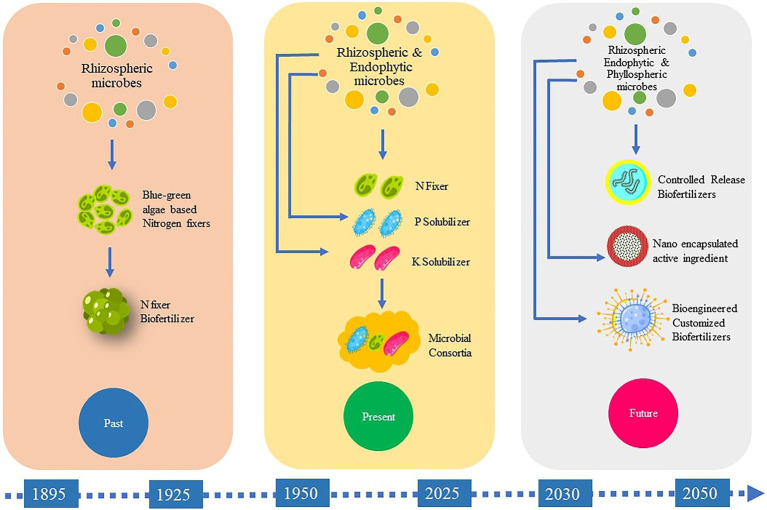
Recent decades have witnessed increased agricultural production to match the global demand for food fueled by population increase. Conventional agricultural practices are heavily reliant on artificial fertilizers that have numerous human and environmental health effects. Cognizant of this, sustainability researchers and environmentalists have increased their focus on other crop fertilization mechanisms. Biofertilizers are microbial formulations constituted of indigenous plant growth-promoting rhizobacteria (PGPR) that directly or indirectly promote plant growth through the solubilization of soil nutrients, and the production of plant growth-stimulating hormones and iron-sequestering metabolites called siderophores. Biofertilizers have continually been studied, recommended, and even successfully adopted for the production of many crops in the world. These microbial products hold massive potential as sustainable crop production tools, especially in the wake of climate change that is partly fueled by artificial fertilizers. Despite the growing interest in the technology, its full potential has not yet been achieved and utilization still seems to be in infancy. There is a need to shed light on the past, current, and future prospects of biofertilizers to increase their understanding and utility. This review evaluates the history of PGPR biofertilizers, assesses their present utilization, and critically advocates their future in sustainable crop production. It, therefore, updates our understanding of the evolution of PGPR biofertilizers in crop production. Such information can facilitate the evaluation of their potential and ultimately pave the way for increased exploitation.
Keywords: biofertilizers; microbial formulations; microbial stimulants; plant growth-promoting rhizobacteria; sustainable agriculture.
Copyright © 2022 Aloo, Tripathi, Makumba and Mbega.
Conflict of interest statement
The authors declare that the research was conducted in the absence of any commercial or financial relationships that could be construed as a potential conflict of interest.
Figures
References
-
- Abdelmoteleb A., Gonzalez-Mendoza D. (2020). Isolation and identification of phosphate solubilizing bacillus spp. from Tamarix ramosissima rhizosphere and their effect on growth of Phaseolus vulgaris under salinity stress. Geomicrobiol J. 37, 901–908. doi: 10.1080/01490451.2020.1795321 - DOI
-
- Abhilash P., Tripathi V., Edrisi S. A., Dubey R. K., Bakshi M., Dubey P. K., et al. (2016b). Sustainability of crop production from polluted lands. Energy Ecol. Environ. 1, 54–65. doi: 10.1007/s40974-016-0007-x - DOI
-
- Adeleke R. A., Raimi A. R., Roopnarain A., Mokubedi S. M. (2019). “Status and prospects of bacterial inoculants for sustainable Management of Agroecosystems” in Biofertilizers for Sustainable Agriculture and Environment. eds. Giri B., Prasad R., Wu Q. S., Varma A. (Cham: Springer International Publishing; ), 137–172.
-
- Agisha V. N., Kumar A., Eapen S. J., Sheoran N., Suseelabhai R. (2019). Broad-spectrum antimicrobial activity of volatile organic compounds from endophytic pseudomonas putida BP25 against diverse plant pathogens. Biocontrol Sci. Technol. 29, 1069–1089. doi: 10.1080/09583157.2019.1657067 - DOI
Publication types
LinkOut - more resources
Full Text Sources
Miscellaneous
